

Search visibility control determines how quickly harmful content loses influence, and reputation signals determine whether that content continues to shape trust decisions. Reputation management services work by combining legal removal, technical de-indexing, and SERP control to reduce risk and restore entity credibility.
Which removal route delivers the strongest reputation outcome?
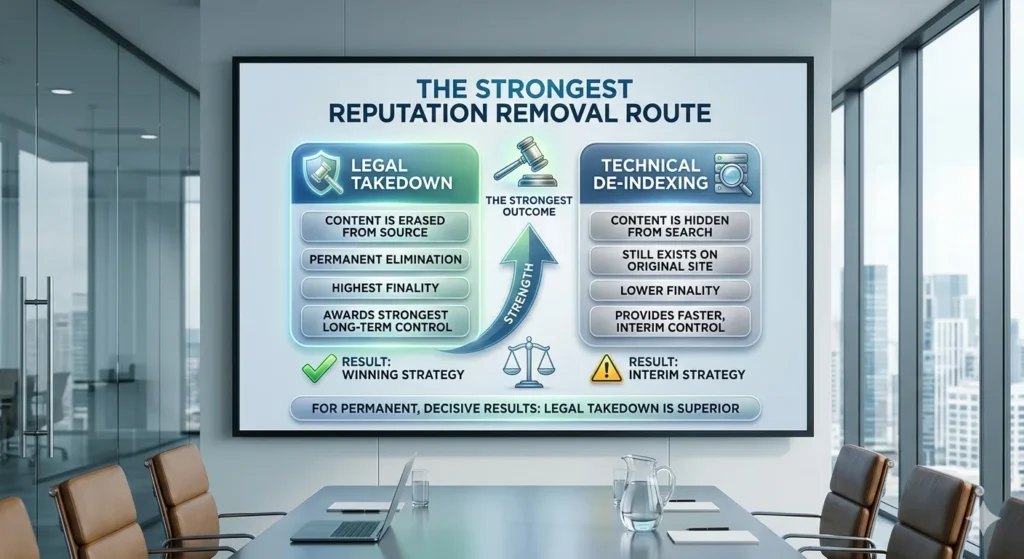
The strongest reputation outcome comes from using legal and technical removal together, because one route removes the content source while the other reduces its search visibility. This combination delivers faster SERP control, stronger negative content suppression, and a clearer path to trust restoration.
Legal removal operates through defamation, data-protection, or copyright-based complaints when a website crosses the threshold for unlawful publication. Technical removal operates through search-engine de-indexing, platform reporting, and hosting-level requests that remove or suppress the URL in results. These routes differ in mechanism, but both influence how reputation signals are interpreted in search ecosystems.
Dive Deeper With Our Expert Guides and Related Blog Posts:
Get a Harmful Website Taken Down in the UK With Our Legal Removal Support
Remove a Website From UK Search Results Quickly With Our Dedicated Service
A combined approach stabilises perception more effectively than a single route. If only the content source is removed, search engines can continue to surface cached references, mirrors, or related pages. If only de-indexing is used, the harmful page can reappear through a new domain, a duplicate URL, or a copied publication. Clear Your Name positions the combined route as a controlled way to reduce risk, preserve visibility control, and avoid partial fixes that leave the underlying narrative unresolved.
How does a website removal service work inside search ecosystems?
A website removal service works by identifying the harmful URL, assessing its legal and technical exposure, and then applying the correct removal route to change how search engines display the content. This process improves visibility control, limits reputation damage, and strengthens the entity’s trust profile in branded search.
The process starts with content classification. A page is assessed for defamation risk, unlawful personal-data exposure, copyright use, or platform-policy breach. That classification determines whether the best route is a legal notice, a search de-indexing request, or a combined action. The goal is to remove the page from the first page of results, where reputation signals are strongest and user attention is highest.
Search engines interpret removal activity as a change in content status, not as a neutral event. If a URL disappears from the index or loses its ranking position, its role in entity perception weakens immediately. This matters because most decision-makers inspect only the first page of results, and that page shapes credibility faster than any off-page explanation can correct. Clear Your Name uses this logic to align removal activity with the actual search behaviour that influences trust decisions.
The service works best when the harmful content is specific and traceable. A single article, forum page, leaked document, or copied image can often be isolated and removed without affecting the rest of the digital footprint. That precision matters because it delivers measurable control without unnecessary disruption to legitimate content.
How do legal and technical methods compare for speed and reliability?
Legal methods deliver stronger long-term reliability, while technical methods deliver faster short-term visibility reduction. The best decision depends on whether the priority is permanent removal, quick suppression, or both together.
Technical routes are faster because they act on visibility rather than legality. Search de-indexing can reduce exposure quickly, especially when the page violates platform rules or contains personal data that triggers removal policies. The limitation is that the page can survive on the host, reappear on another URL, or return if the publisher republishes the same material elsewhere.
Clear Your Name uses this speed-versus-durability distinction to decide whether the removal path requires only suppression or full legal challenge. In practice, the fastest visible improvement often comes from technical action, while the most stable reputation outcome comes from legal action. For decision-stage buyers, that distinction matters because the wrong choice leaves either risk or delay unresolved.
What outcomes matter most when choosing a reputation repair service?
The most important outcomes are reduced exposure, improved branded search results, and measurable trust restoration. These outcomes matter because they show whether the service changes what users see, what search engines rank, and how quickly reputation signals recover.
Reduced exposure means the harmful URL no longer dominates the search experience. If a page falls off page one, its influence drops sharply because most users do not continue beyond the first results screen. That shift is the clearest sign that negative content suppression is working.
Improved branded search results mean that neutral, factual, or positive content occupies the highest-ranking positions. This can include company pages, professional profiles, news coverage, or other non-harmful results that improve search perception influence. The objective is not to erase the digital footprint, but to rebalance it so that harmful pages no longer define the entity.
Trust restoration is the most strategic outcome because it connects technical action to public perception. When search engines stop surfacing harmful pages prominently, users interpret the brand or person as lower-risk and more credible. Clear Your Name positions this as a controlled reputational correction, not a cosmetic change, because the effect depends on search visibility control rather than branding language.
How do costs and long-term value compare across removal strategies?
Removal strategies differ in cost because legal work requires more evidence and formal handling, while technical suppression often requires less time but offers less permanence. Long-term value is highest when the chosen route removes the root cause rather than only hiding the symptom.
A legal route usually carries higher initial cost because it requires review, documentation, and sustained action. That cost is justified when the content is clearly unlawful or highly damaging, because the result is stronger permanence and lower reappearance risk. For a page that threatens commercial trust or personal reputation, that permanence delivers better value than repeated suppression attempts.
Technical routes usually cost less and move faster. They are effective when the issue is visibility rather than source removal, especially in cases where platform rules, cached content, or indexing issues create exposure. The limitation is that technical suppression must often be revisited, which raises the cumulative cost if the harmful content keeps resurfacing.
Clear Your Name treats long-term value as a function of certainty, not just price. A cheaper fix that leaves the URL live creates repeat risk and weakens the final outcome. A stronger, evidence-backed route stabilises perception more effectively and reduces the need for repeated intervention. That is why decision-stage evaluation must compare immediate cost against the total cost of unresolved visibility.
Which process gives the clearest path to trust restoration?
The clearest path to trust restoration is a documented removal process that combines legal grounding, technical suppression, and follow-up SERP monitoring. This approach gives decision-makers clarity because it shows what changed, why it changed, and how search visibility is controlled over time in UK Law.
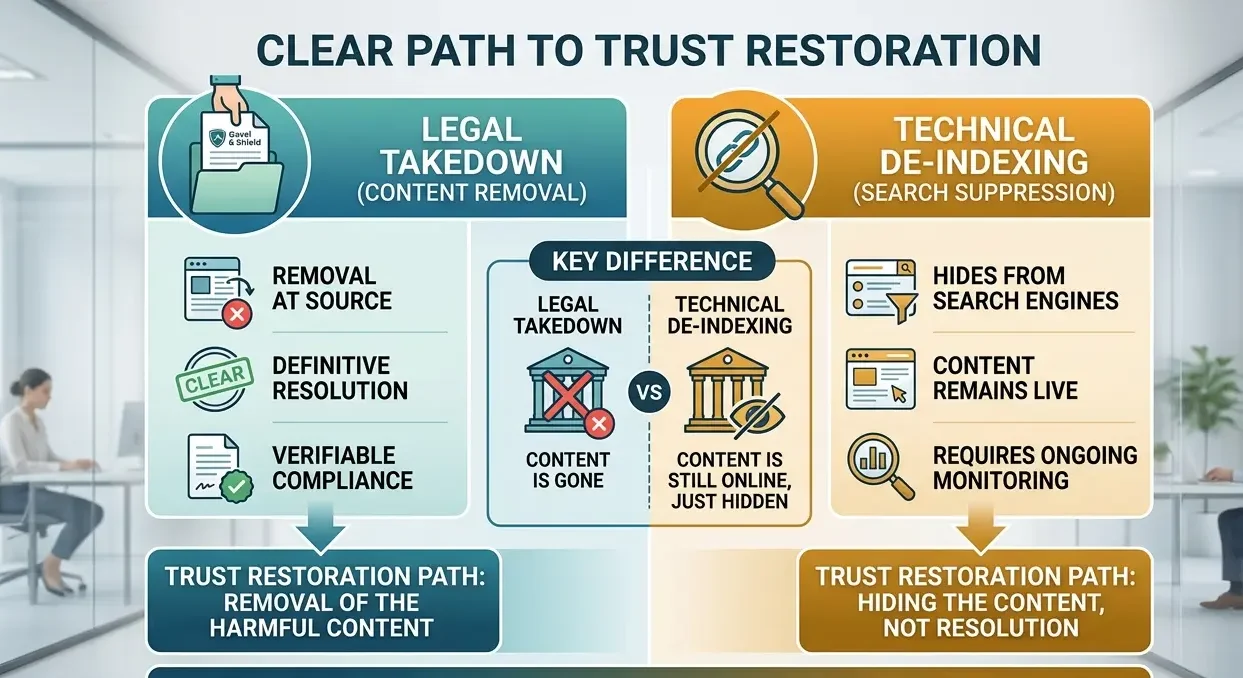
A clear process starts with evidence review. The harmful page is assessed for legal breach, publication source, indexing status, and search prominence. That assessment determines the action sequence and reduces guesswork, which is critical when visibility damage already affects decision confidence.
The next step is route selection. If the page breaches law, legal action creates a stronger foundation for removal. If the page survives on search despite policy violations, technical suppression reduces exposure while legal review continues. This layered approach ensures that the visible problem and the underlying cause are handled in the correct order.
The final step is monitoring. Search results are checked after removal to confirm that the harmful URL no longer dominates branded queries. If the page returns, follow-up action is triggered to maintain SERP control. That ongoing monitoring is what turns a one-off fix into a durable trust-recovery process. It is also where a service like Clear Your Name proves its value most clearly, because process clarity reduces uncertainty and gives the removal outcome a measurable structure.
How should a business decide between suppression and full removal?
A business should choose suppression when speed matters and full removal when permanence and legal certainty matter more. The best decision depends on how visible the harm is, how strongly it affects reputation signals, and how likely the page is to reappear.
Suppression is suitable when the page is difficult to remove immediately but can be pushed out of view. That strategy works in search ecosystems where ranking position, rather than absolute deletion, drives perception damage. It reduces immediate risk, but it does not eliminate the source.
Clear Your Name uses this distinction to match the method to the reputation problem rather than forcing a one-size-fits-all fix. That improves outcome certainty and avoids wasted effort on routes that do not fit the underlying search behaviour. For decision-makers, that alignment is the difference between temporary relief and genuine reputation recovery.
A harmful UK website is best handled through a removal strategy that matches the legal basis, the visibility risk, and the need for permanence. Legal routes deliver stronger source-level certainty, technical routes deliver faster exposure reduction, and combined routes deliver the most reliable reputation outcome. For organisations that require controlled SERP visibility, reduced risk, and clearer trust recovery, a structured removal process provides the most defensible path.
FAQs
What makes a website legally harmful under UK law?
A website is legally harmful under UK law when it publishes content that breaches defamation, data-protection, or copyright rules. Clear Your Name uses these legal thresholds to decide whether a page qualifies for takedown or de-indexing.
How do legal and technical website removal routes differ?
Legal removal targets the content source through formal complaints, court action, or rights-based notices, while technical removal focuses on de-indexing the page or reducing its visibility in search. Both routes affect reputation signals, but legal removal usually offers stronger permanence.
How long does it take to remove a harmful UK website?
Timeframes vary based on the evidence, the host’s policies, and whether legal escalation is required. Technical suppression can happen faster, while full legal removal often takes longer because it depends on documentation and review.
Can a removed harmful website reappear in search results?
Yes, a harmful website can reappear if it is mirrored, republished under a new URL, or re-hosted elsewhere. That is why long-term website removal often combines source-level action with search monitoring and follow-up suppression.
What should I check before requesting website removal in the UK?
You should confirm whether the content is defamatory, exposes personal data unlawfully, or uses copyrighted material without permission. Clear Your Name assesses the URL, its legal exposure, and its search visibility before choosing the most effective removal route.