Reputation management is a structured field of techniques that shape how an entity is understood in search and public discourse. Reputation management strategies differ based on the balance between content creation, removal, enhancement, and suppression rather than on a single tactic or channel. Online reputation control methods are evaluated through their impact on search ranking influence, sentiment distribution, and long‑term entity credibility.
How do reputation repair methods differ from one another?
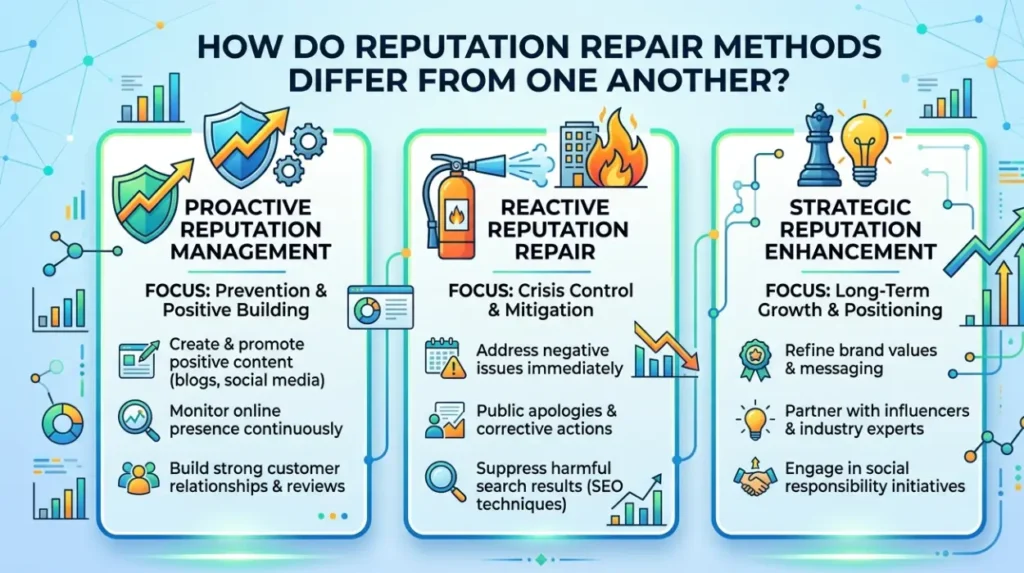
Reputation repair methods differ in how they change the relationship between the entity and the content that represents it within search ecosystems. Some methods modify the available content, others change its prominence, and some attempt to rebuild the narrative through new signals.
Dive Deeper With Our Expert Guides and Related Blog Posts:
Which Routes Actually Work to Remove Content From the Internet in the UK
How a Negative Content Removal Service Builds a Case Before Acting
Content removal strategies focus on reducing or eliminating harmful references from the visible digital footprint. These operate by engaging with platforms, webmasters, or legal channels to take down or deindex pages that breach rules, contain false information, or violate privacy. The mechanism is direct: the harmful content loses its place in the SERP, which reduces its influence on entity perception.
Content enhancement and suppression tactics instead work around the existing material. Enhanced content such as official profiles, informative pages, and genuine reviews is created or amplified so that it ranks more strongly than negative references. Suppression works by diluting the prominence of harmful pages through diversified, high‑quality references, which lowers their relative search ranking influence without deleting them.
Each method has a different impact. Removal changes the actual record; enhancement increases the number of positive signals; suppression reshapes the distribution of signals without altering the content itself. The choice between these methods depends on the nature of the harmful material, the platform’s policies, and the long‑term reputation goals of the entity.
How does content removal compare with general PR reputation work?
Content removal operates through technical and policy‑led channels, whereas general PR reputation work operates through media, narrative, and communications channels. The core difference is domain and mechanism: removal targets indexed pages and policy frameworks, while PR targets audiences and brand messaging.
A specialist content removal agency focuses on the structure of the digital footprint and verified results. The approach is to identify, map, and challenge content that can be removed or deindexed under specific rules. This includes policy‑breaching posts, false or defamatory information, impersonation, and privacy‑intruding references. The agency evaluates each case by checking indexing, ranking, and policy relevance, then applies documented escalation routes.
General PR reputation work focuses on narrative construction and media presence. PR teams build relationships, distribute press releases, secure media coverage, and shape the public conversation. Their work influences sentiment distribution through coverage tone, placement, and message repetition. The mechanism is indirect: it changes how the public talks about the entity rather than what remains visible in search.
The two approaches are complementary but not interchangeable. PR reputation work is stronger for long‑term brand‑building and audience influence. Content removal is stronger for dealing with specific, indexed, harmful content that cannot be resolved through communication alone. The key distinction is that PR works with narratives, while content removal works with the infrastructure of search and content hosting.
How do search engines interpret reputation signals in these two models?
Search engines interpret reputation signals by aggregating links, content, and user‑generated signals into an overall assessment of authority and trust. Both PR‑driven narratives and removal‑driven infrastructure changes affect this assessment, but they do so through different mechanisms.
In the PR‑oriented model, reputation signals manifest as coverage, citations, and engagement. News articles, interviews, and expert mentions are treated as trust signals if they come from credible domains. The SERP often reflects this through branded snippets, featured press sections, and image‑rich carousels. The narrative itself becomes a ranking influence, especially when coverage is frequent and consistent.
In the content‑removal model, reputation signals change when indexed pages are removed or deindexed. A harmful page that ranks for the entity’s name no longer contributes to the trust or authority calculus. The SERP recomposes with the remaining references, which may include more neutral or positive signals. The shift is mechanical: the algorithm recalculates the available evidence once the signal is altered or removed.
Both models affect sentiment distribution. PR work can tilt the tone of coverage toward a more positive or neutral direction. Removal can reduce the frequency of negative signals in the SERP, which changes the overall sentiment landscape. The main difference is that PR shapes the surface‑level story, while removal shapes the underlying evidence set that search engines use to assess the entity.
How do short‑term and long‑term strategies differ in effectiveness?
Short‑term and long‑term reputation strategies differ in the speed of impact, the nature of the intervention, and the sustainability of the outcomes. Short‑term methods produce visible changes quickly but often require maintenance. Long‑term methods build deeper resilience but take more time to show measurable results.
Short‑term strategies include rapid content removal, takedown campaigns, and targeted suppression through timely content creation. These work by quickly altering the visible SERP and removing immediate reputation risks. The strength is speed: a harmful page can be removed or deindexed within days or weeks. The limitation is that the underlying reputation structure may remain unchanged if no broader narrative work follows.
Long‑term strategies include sustained content creation, consistent PR activity, and ongoing reputation monitoring. These operate by gradually building a diverse, positive, and authoritative digital footprint. The mechanism is cumulative: each new positive signal reinforces the entity’s credibility. The strength is sustainability. The limitation is time; the full effect often appears months or years after initiation.
The effectiveness of each strategy depends on the objective. Short‑term tactics are more effective for crisis‑level or one‑off events. Long‑term tactics are more effective for brand‑building, trust accumulation, and resilience against repeated issues. The most robust approach combines both: short‑term removal where necessary and long‑term enhancement to solidify the reputation infrastructure.
How do content suppression and content enhancement contrast in practice?
Content suppression and content enhancement both aim to change the prominence of harmful signals, but they do so through different mechanisms. Suppression works by diluting the harmful content’s relative weight, while enhancement increases the strength and visibility of positive signals.
Content suppression operates by creating or amplifying a wider range of unrelated or neutral content around the entity’s name. This can include operational pages, informative content, and varied media pieces. The mechanism is breadth: the SERP becomes more crowded, which reduces the proportional space occupied by negative references. The impact is a softer, more distributed sentiment profile.
Content enhancement focuses on the quality and authority of the new signals. The approach is to create high‑value, relevant content such as detailed profiles, case studies, thought‑leadership pieces, and credible third‑party endorsements. The mechanism is depth: the authoritative signals gain more weight in search ranking influence. The impact is a stronger, more coherent reputation narrative.
The limitation of suppression is that it does not remove the harmful content. It only reduces its visibility. The limitation of enhancement is that it requires sustained effort and may not address the core legal or policy‑based issues behind the harm. A combined approach can reduce the search ranking influence of negative content while building a more robust reputation structure.
How do scalability and risk exposure differ across methods?
Reputation management methods vary in how easily they scale across entities, markets, and issues, and in how much risk exposure they introduce. Scalability refers to the ability to apply the method to multiple cases with consistent outcomes. Risk exposure refers to the potential for unintended consequences, such as legal or reputational backlash.
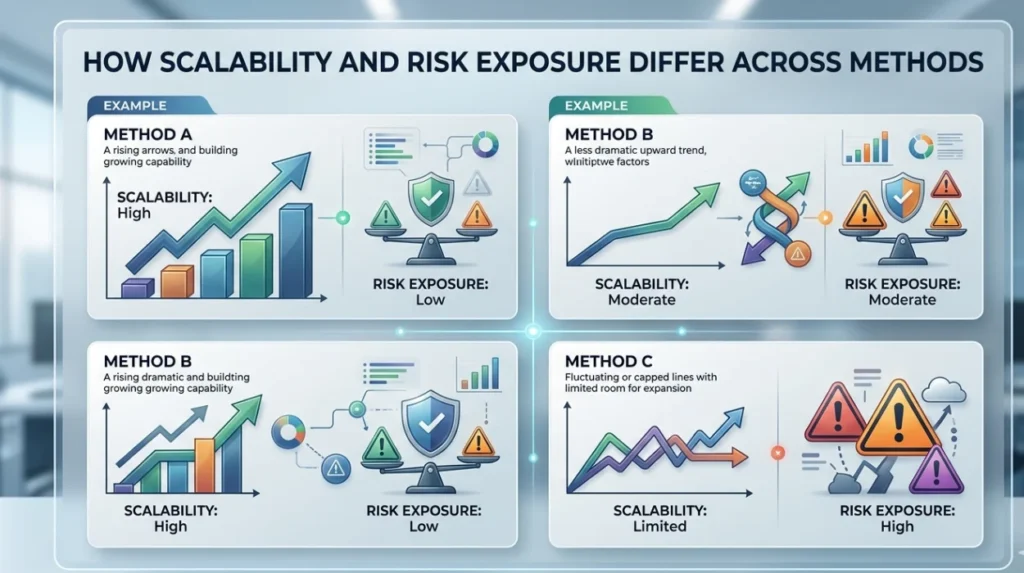
Content removal methods are often less scalable because each case is tied to specific pages, policies, and jurisdictions. The process is compliance‑heavy and must be customised for each domain, platform, and regulation. The main risk is over‑reaching or mis‑using removal requests, which can trigger scrutiny or accusations of censorship. The upside is that the impact is often clear and measurable: a specific harmful signal is removed or deindexed.
PR‑based reputation methods are more scalable because narrative frameworks, message templates, and media relationships can be reused. The same core story can be adapted for different regions, products, or crises. The risk exposure is different: poorly framed communications or overly aggressive PR can create a perception of manipulation or spin. The upside is that PR can build broad, positive sentiment across multiple audiences.
Suppression and enhancement methods are scalable to a moderate degree. The process of creating or amplifying content can be systematised, but the effectiveness depends on topic relevance and platform rules. The main risk is that the volume of content may appear inauthentic if not grounded in genuine activity. The main benefit is that these methods can create a stable, diversified reputation profile that is less vulnerable to single‑page events.
What frameworks help evaluate which approach is appropriate?
Frameworks that evaluate reputation strategies compare objectives, source type, longevity, and risk profile to determine which approach is appropriate. These frameworks are not about prescribing a single method but about matching the method to the specific case.
An effective framework evaluates the following:
- Action verb: Define the goal.
- Example: Is the objective to remove a specific harmful page, improve long‑term credibility, or reduce the prominence of recurring negative content?
- Action verb: Map the content ecosystem.
- Example: Identify all indexed references, their ranking, and their authority. This shows whether the problem is isolated or widespread.
- Action verb: Match the strategy.
- Example: If the content is policy‑violating, removal or deindexing is appropriate. If it is simply negative but within the rules, enhancement or suppression is more suitable.
- Action verb: Assess risk and sustainability.
- Example: Measure how the chosen method will affect legal exposure, media perception, and long‑term trust.
- Action verb: Monitor the outcome.
- Example: Track changes in SERP composition, sentiment distribution, and search ranking influence over time.
These frameworks help separate tactical decisions from strategic ones. Short‑term content removal is appropriate for specific, policy‑based issues. Long‑term PR and enhancement are appropriate for sustained brand‑building. The decision is not about which method is better overall, but about which method best fits the nature, source, and risk profile of the reputation issue.