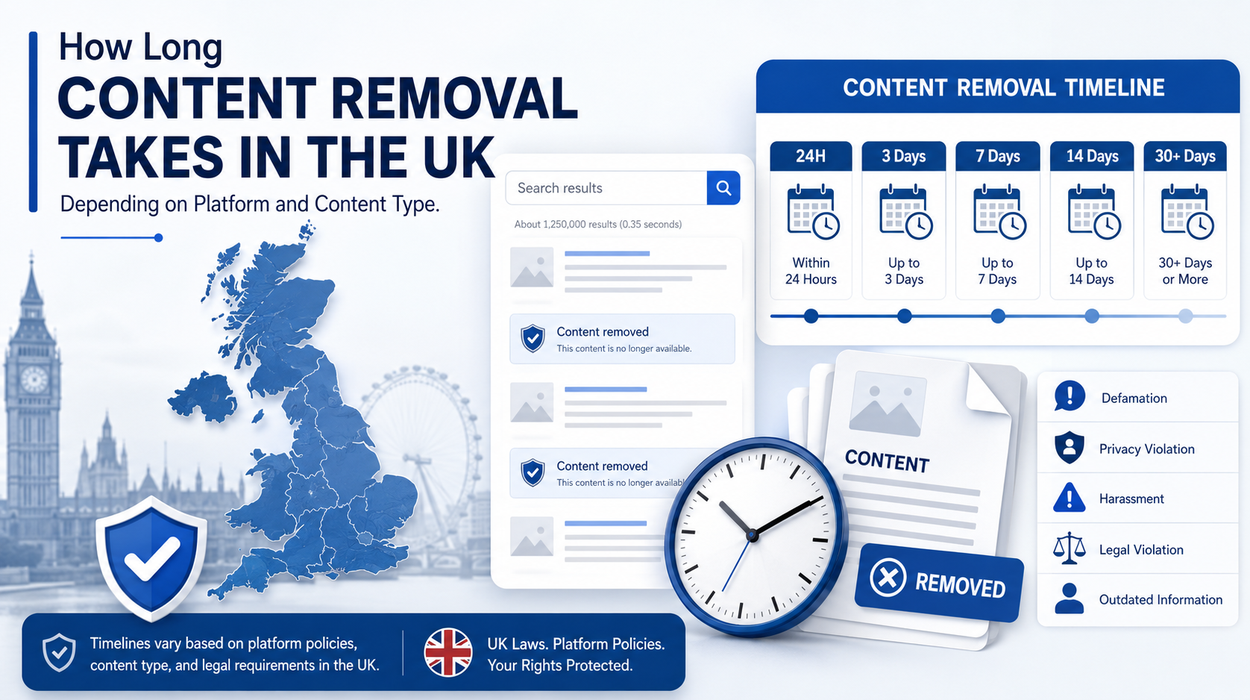
Content removal timelines in the UK vary significantly depending on the platform and type of content involved. Some requests may be resolved in days, while others can extend to several months due to regulatory, procedural, or technical factors.
Reputation management is the practice of monitoring, analysing, and influencing how individuals or organisations are perceived across digital platforms. Online reputation refers to the cumulative perception of an entity as expressed through indexed content, reviews, and mentions within search ecosystems. This includes the way search engines, social media platforms, and review sites store, rank, and display information, shaping public perception and digital trust signals.
What Determines the Speed of Content Removal in the UK?
The speed of content removal is primarily dictated by platform policies, legal frameworks, and technical processes.
Content removal refers to the procedure of deleting, de-indexing, or suppressing specific digital material from public access or search engine visibility. Platforms evaluate requests based on policy compliance, content type, and jurisdictional regulations. For instance, social networks have automated reporting mechanisms that flag harmful or illegal content, whereas search engines require structured takedown notices and verification before de-indexing links.
Technical mechanisms, such as URL blocking, content filtering, or manual review, directly influence timelines. Platforms that rely on manual assessment may take longer due to internal workloads and cross-departmental validation. Legal notices invoking the UK Data Protection Act or the GDPR can accelerate removal if the content violates privacy rights, whereas content lacking regulatory basis is often subjected to prolonged review periods.
Search visibility is affected throughout this process. Content that remains indexed maintains its influence on entity perception until removal is completed. Delays in processing, miscommunication, or complex verification can prolong exposure and reinforce negative reputation signals in SERPs. Understanding these dynamics supports evaluation of the content removal timeline UK.
How Does Platform Type Affect Content Removal Timelines?
Different platforms enforce content policies and processing workflows that directly impact removal duration.
Major social media platforms implement automated detection systems and user-reporting channels. Short-form content, images, and comments flagged for policy violations are often removed within 24–72 hours. In contrast, blogs, forums, and professional networks require manual verification, legal assessment, and potential cross-checks with hosting providers, which can extend timelines to several weeks or months.
Content type also defines workflow. Text-based posts and comments with clear policy breaches can be processed faster, while multimedia files such as videos or documents may require additional verification steps including file analysis, copyright evaluation, or authentication of claims.
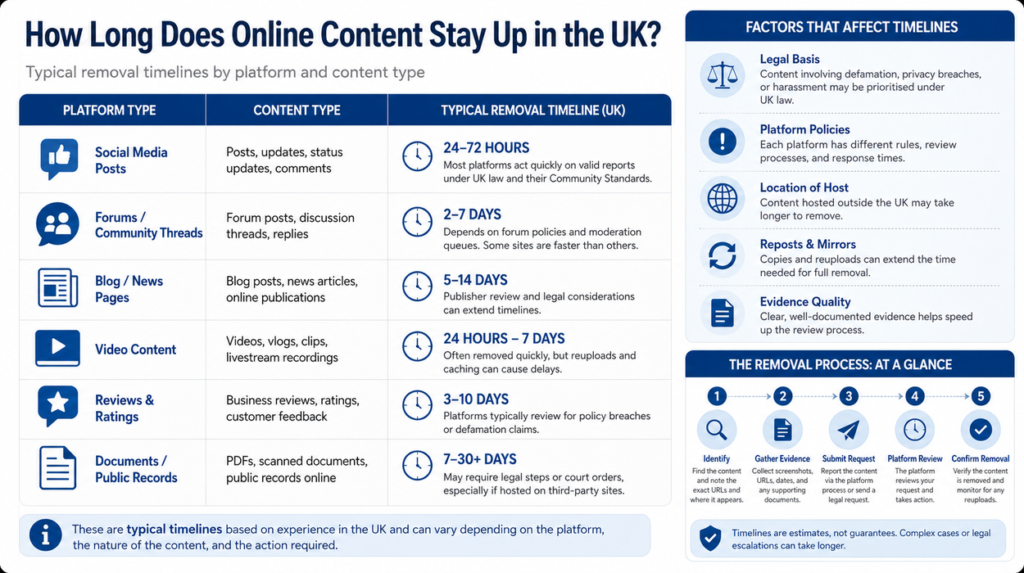
Impact on search visibility is critical: platforms that directly host content can remove it entirely, whereas content indexed by search engines but hosted elsewhere may persist in SERPs until formal takedown requests or de-indexing measures are implemented. Platforms with high domain authority also reinforce the visibility of content, making delays in removal more pronounced in the public perception of the entity.
Which Legal Considerations Influence Removal Speed?
Legal frameworks in the UK, including the GDPR, Data Protection Act 2018, and defamation laws, define mandatory conditions for content removal.
Requests backed by legal rights, such as personal data removal or unlawful content, are processed faster due to statutory obligations. For instance, under the GDPR, data controllers must respond to removal requests within one month, extendable to three months under complex circumstances. Defamatory content that meets the threshold for legal action can also trigger expedited removal through court orders or regulatory interventions.
Platforms must evaluate jurisdictional applicability. Content hosted overseas may not fall under UK legal enforcement, leading to slower processing or requiring international cooperation. Legal interventions increase procedural rigour, involving documentation, verification, and sometimes judicial review, which collectively elongates timelines.
Entity perception and trust signals in search ecosystems are sensitive to these delays. Even when a removal request is legally justified, prolonged visibility of negative or infringing content continues to affect search rankings, review sentiment, and public perception.

How Do Content Type and Complexity Impact Removal Timelines?
The intrinsic characteristics of the content determine how quickly it can be evaluated and removed.
Short textual posts or comments are typically easier to process due to automated scanning and straightforward policy interpretation. Multimedia content—videos, audio files, PDFs—requires additional steps including format verification, context assessment, and sometimes manual review to confirm violations. Embedded or shared content across multiple platforms compounds complexity, as synchronised takedown requests may be needed across hosting networks, which extends processing time.
Mechanisms for content removal vary: URL removal, content de-indexing, account suspension, or content modification. Each method involves different internal workflows and levels of human oversight. Complexity in content format and platform integration directly correlates with slower resolution and prolonged presence in search results.
Search visibility is disproportionately affected by complex content. Multimedia hosted on high-authority platforms remains highly ranked in SERPs, creating persistent entity perception signals that may continue to influence public opinion even after removal requests are submitted.
Explore Our Expert Guides:
Why Harmful Content Online Causes Lasting Damage Even After It Stops Circulating
How Removing Harmful Online Content Differs by Platform Type and Jurisdiction
What Role Do Search Engines Play in Content Removal Timelines?
Search engines function as aggregators and indexes, not content hosts.
Content removal in search engines requires de-indexing or blocking URLs, often initiated through formal legal requests or webmaster tools. Mechanisms include automated algorithms that remove flagged links or human assessment teams that evaluate takedown notices for validity. Timing depends on the search engine’s procedural load, verification steps, and potential disputes regarding content ownership or public interest exemptions.
Content that is merely de-indexed still exists on the host platform, maintaining an underlying digital footprint. SERP evaluation continues to register signals such as link authority, anchor text relevance, and page engagement, which collectively influence entity perception even after removal requests are acknowledged.
Trust and authority signals are interpreted by algorithms. Sites with robust reputation and high domain authority may retain prominence in results, prolonging negative content’s visibility if removal is delayed. Consequently, the technical and procedural efficiency of search engines is directly correlated with speed of content removal and the modulation of digital reputation.
How Do User Reporting and Platform Policies Affect Timelines?
Platform-specific policies dictate the responsiveness to user reports and takedown requests.
Automated reporting systems prioritize content flagged for legal violations, safety risks, or policy breaches. Platforms apply semantic analysis to evaluate flagged material, determining whether it meets thresholds for immediate removal. Manual review channels require content evaluation against internal standards and legal compliance checks, creating variable timelines depending on the volume and complexity of reports.
Policies define prioritisation. Platforms that enforce rapid action on harmful content expedite removals, whereas non-urgent cases or ambiguous content may remain visible for extended periods. Reviews, user interactions, and engagement metrics influence algorithmic prioritisation in SERPs, indirectly affecting perceived reputation until resolution is completed.
Search visibility is contingent upon these policies. Algorithms rank content based on authority, engagement, and relevance signals, which persist until removal or suppression is confirmed. Thus, the efficacy of reporting frameworks and policy enforcement directly shapes the trajectory of content visibility in public digital spaces.
What External Factors Can Accelerate or Delay Removal in the UK?
Several external variables influence how long content remains accessible online.
Regulatory actions, such as complaints to data protection authorities, expedite review and removal, as statutory deadlines compel platforms to respond. Technical factors, including content replication across multiple servers or cross-platform sharing, create additional procedural layers, extending timelines. Verification complexity, authenticity checks, and potential disputes further influence speed.
User behaviour also impacts processing. Repeated reporting, legal escalation, or engagement metrics like shares and comments can elevate content priority for evaluation, indirectly accelerating removal. Conversely, low-priority content on smaller or less regulated platforms may experience extended presence due to limited moderation resources.
Entity perception is highly sensitive to these external factors. Prolonged visibility of negative content reinforces undesirable signals, affecting trust, authority, and credibility scores within search ecosystems. Algorithms integrate these signals, resulting in sustained search visibility that may influence public perception until removal is enacted.
Get More Insights:
Remove Harmful Online Content Through Our UK Privacy and Removal Experts
How Do Reputation Signals Affect Perception During Removal Delays?
Reputation signals are derived from content visibility, engagement, and sentiment interpretation by algorithms.
Delayed removal allows persistent negative content to influence search ranking, user perception, and entity credibility. Search engines evaluate semantic associations, link authority, and user interaction patterns to assign trust scores, which remain active until the content is either removed or de-indexed.
Mechanisms such as review aggregation, citation frequency, and cross-linking amplify negative content impact if left unaddressed. Authority and trust signals derived from high-ranking sources maintain their effect on SERP evaluation, creating residual reputation influence even after a removal request is filed.
Understanding these dynamics highlights that timelines are not merely operational metrics but integral to managing online reputation. Algorithms continuously monitor content interactions, and delays in removal compound the weight of undesirable signals in digital perception.
How Can Understanding These Timelines Inform Reputation Management?
Awareness of platform procedures, content complexity, legal considerations, and search engine mechanisms informs strategic approaches to reputation monitoring.
Organisations and individuals can anticipate potential delays based on content type, hosting platform, and regulatory framework. Monitoring SERPs, indexing status, and engagement metrics provides insight into the persistence of content and its effect on entity perception.
Semantic evaluation of digital footprints enables prediction of visibility persistence. For example, high-authority domains hosting content require more robust legal or procedural measures to effect removal, while minor platforms may respond more rapidly. Understanding these patterns assists in evaluating the timeframe for content influence and the duration of exposure to negative reputation signals.
External factors such as regulatory enforcement, cross-platform replication, and engagement metrics must be integrated into removal timeline analysis. These variables collectively inform realistic expectations for online reputation modulation and visibility management.
Conclusion
Content removal timelines in the UK are influenced by platform type, content format, legal frameworks, reporting mechanisms, and external variables. Reputation management operates within these parameters, analysing how visibility, indexing, and engagement shape entity perception. Search engines, platforms, and regulatory bodies form an ecosystem where content persistence generates trust, authority, and reputation signals.
Understanding how these processes interact enables precise evaluation of the timeframe for content removal and its impact on digital perception. Digital footprints, content complexity, and platform authority collectively determine the persistence of reputation signals in search ecosystems. Informed awareness of these dynamics supports systematic assessment of entity visibility and guides expectations for content suppression within the UK context.
FAQs
1. How long does content removal take with Clear Your Name?
The timeframe for content removal varies depending on the platform, content type, and legal factors. Simple social media posts may be removed within 24–72 hours, whereas documents, reviews, or multimedia may take several days or weeks to process.
2. What types of content can be removed by Clear Your Name?
Content removal can include social media posts, forum threads, blog articles, online reviews, and publicly accessible documents. Platforms differ in removal policies, so each request is evaluated for legal compliance and technical feasibility.
3. Can Clear Your Name remove content from search engines?
Yes, search engine de-indexing is part of content removal. This process involves submitting formal requests to search engines to suppress or remove URLs, though the original hosted content may still exist on the platform until action is completed.
4. What legal considerations affect content removal in the UK?
UK content removal is influenced by GDPR, the Data Protection Act 2018, and defamation laws. Requests backed by legal rights, such as personal data violations or unlawful content, are prioritised and processed according to statutory deadlines.
5. How does content type affect the speed of removal?
Short text posts are typically removed faster than multimedia content such as videos or PDFs. Complexity, cross-platform replication, and platform-specific policies can extend the timeline for full removal or de-indexing.