
A website is legally harmful under UK law when it hosts content that violates established legal frameworks such as defamation, data‑protection rules, or copyright, and is therefore eligible for formal takedown or delisting requests. Reputation management is the structured oversight of how information about an entity is created, indexed, and interpreted across digital channels. Online reputation refers to how that entity is judged through the combination of search results, reviews, profiles, and media coverage.
How does UK law define when a website is legally harmful?
UK law defines a website as legally harmful when its content breaches statutes or common‑law principles that protect individuals, businesses, or the public from unlawful or harmful information. The determination is not based on mere offence or disagreement, but on whether specific rights or duties have been violated within the applicable legal framework.
Dive Deeper With Our Expert Guides and Related Blog Posts:
What Grounds Are Required to Get a Website Taken Down in the UK Legally
How Google Decides Whether to Remove a Website From Its Search Results
Within defamation law, a website is legally harmful if it publishes a statement that is false, refers to the claimant, and causes or is likely to cause serious harm to reputation. This typically covers articles, forum posts, or profiles that attribute misconduct, dishonesty, or unprofessional behaviour without justification. When such content is indexed and visible in search, it becomes a reputation signal that search engines can evaluate as part of SERP composition.
Under data‑protection and privacy rules, a website may be deemed legally harmful if it processes or discloses personal data unlawfully, excessively, or without lawful basis. This includes publishing identifying information, leaked documents, or detailed profiles that are inaccurate, outdated, or no longer necessary. Such content can be challenged under rights such as erasure or restriction, especially when it appears in search results under a person’s name.
Copyright and intellectual‑property frameworks also generate grounds for harm. A website that hosts or republishes copyrighted text, images, or other works without permission can be treated as a legal violation. In this context, “harm” is measured not against the subject’s reputation, but against the owner’s economic and moral rights. Even when reputation is not the primary concern, illegal content influences how search engines interpret trust and credibility for the domain.
How do search engines interpret legally harmful content in SERP evaluation?
Search engines interpret legally harmful content as a negative signal when it is validated through formal removal requests, platform‑specific policies, or demonstrable breaches of safety or legality. This interpretation does not automatically erase content from the web, but it can alter its ranking, visibility, and prominence in SERPs.
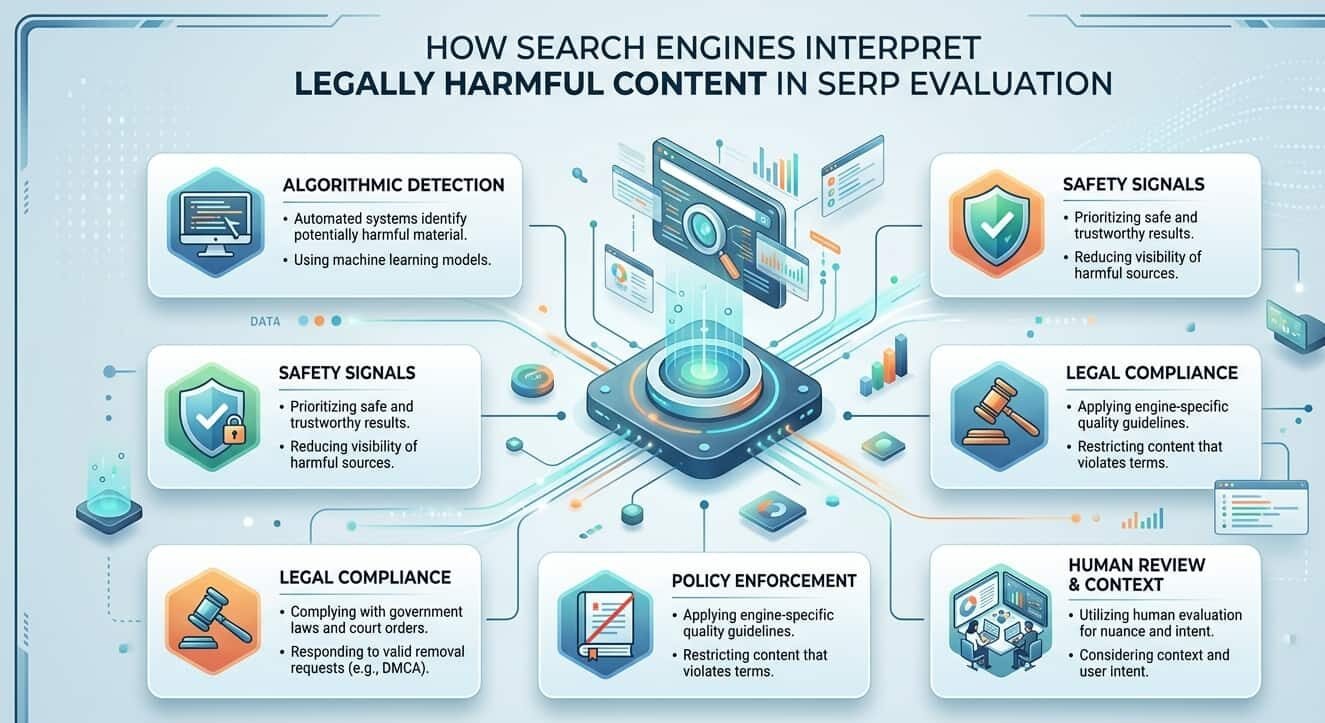
Within content indexing, search engines treat legally harmful content as higher‑risk when it is associated with takedown notices, court orders, or regulatory findings. When a page is repeatedly flagged under defamation, data‑protection, or copyright rules, automated or human reviewers may downgrade its trust signals or reduce its ranking depth. This adjustment influences how often the page appears in organic results and in which contexts.
Search also evaluates the broader context in which harmful content sits. A single page that violates UK law may be partially or fully delisted, while the surrounding domain continues to appear for unrelated queries. Search engines distinguish between a specific infringing URL and the entire site, so that takedown‑based harm is contained rather than automatically generalised. This segmentation shapes how reputation signals are distributed across the digital footprint.
From a user‑perception standpoint, the removal or demotion of legally harmful content affects entity perception. When defamatory, unlawful, or misleading pages no longer dominate a name’s search results, the remaining SERP composition appears more balanced and credible. Search engines do not judge truth directly, but they respond to legal validation and user‑protection standards, which in turn influence how audiences interpret online credibility.
What makes a website eligible for takedown versus mere suppression in search?
A website is eligible for takedown when its content clearly breaches a legal or policy‑based threshold, whereas suppression occurs when the content is downgraded or marginalised without full de‑indexing. Both reduce search visibility, but they operate under different conditions and carry distinct implications for reputation signals.
Takedown eligibility is typically linked to demonstrable violations of statutory or common‑law rules. Defamatory statements, unlawful disclosures of personal data, or blatant copyright infringement are common triggers. When such content is formally challenged through takedown or delisting notices, search engines may remove or stop serving specific URLs from results, effectively eliminating those reputation signals from the SERP.
Suppression, by contrast, is applied when content is considered low‑quality, manipulative, or borderline but not clearly illegal. Spam‑like pages, thin or duplicate content, or pages that manipulate rankings may be algorithmically demoted without being delisted. This keeps the page indexed but reduces its prominence, so that it appears further down the results or not at all in typical search sessions.
From a reputation‑management perspective, takedown has a stronger signal than suppression. A page that disappears from search sends a clear message that it was judged non‑compliant with established standards. Suppression signals diminished credibility; the page remains technically present but less influential in shaping entity perception. Search engines use both mechanisms to balance legal compliance, user safety, and the integrity of ranking signals.
How do legal definitions of harm translate into online reputation signals?
Legal definitions of harm translate into online reputation signals through how search engines interpret and weight content that has been challenged, taken down, or demoted. A page that is legally harmful under UK law does not merely disappear; it leaves a trace in how trust, risk, and credibility are assessed for the entity and its digital footprint.
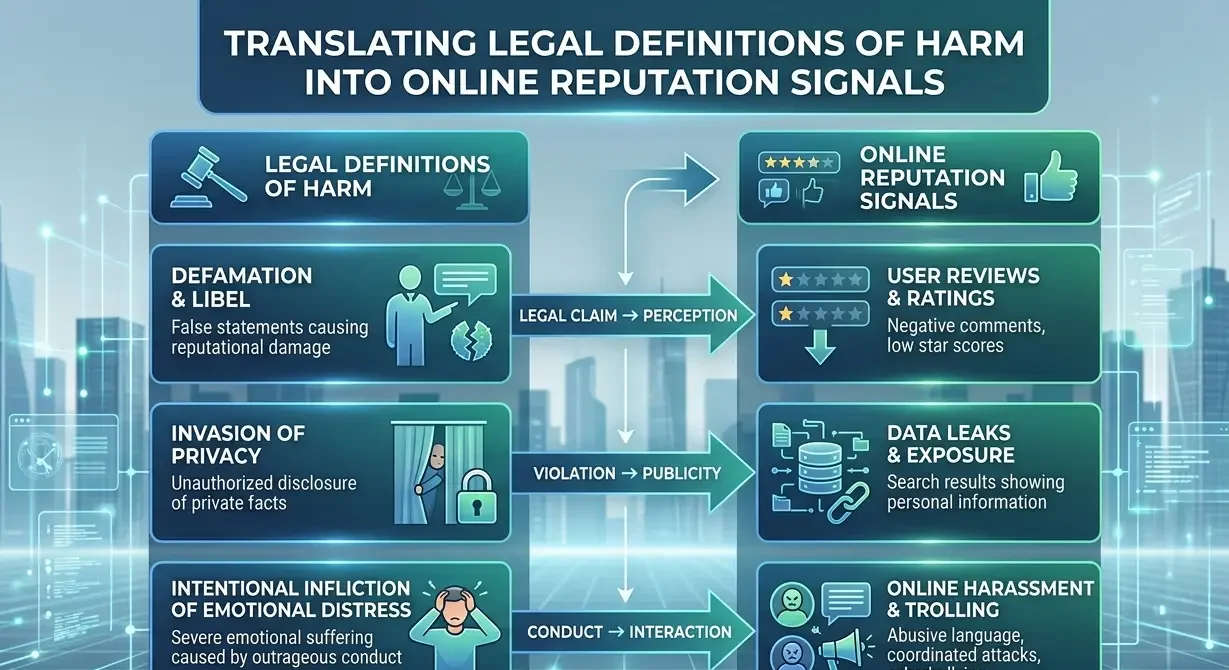
Within SERP evaluation, a legally harmful website that is challenged with formal notices signals controversy or conflict. Even if the page is subsequently removed or de‑listed, search engines can detect patterns of dispute, such as repeated takedown requests or court‑related references. These patterns contribute to a broader assessment of risk around the associated domain or name, influencing how future content is indexed and ranked.
Reputation signals also accumulate at the domain level. When a website hosts multiple pages that are legally challenged or found to breach standards, search engines may treat the domain as higher‑risk. This can lower the overall trust signals assigned to the site, which in turn affects how new pages are evaluated. A domain with a history of harmful content may find it harder to achieve high rankings, even for neutral or factual material.
From a user‑perception standpoint, legal harm can be inferred from search‑visible cues. If a person’s name is associated with defamatory or unlawful pages, even temporarily, those results shape first‑impression judgments. When those pages are taken down or demoted, the SERP narrative shifts, and the residual reputation signals tend to reflect a more stable, less contested profile. This illustrates how legal definitions of harm are embedded in how search creates and modifies perception.
How does content eligibility for takedown relate to search visibility and entity credibility?
Content eligibility for takedown relates to search visibility and entity credibility by determining which reputation signals are allowed to persist at the top of search results and how strongly they influence perception. When a page is eligible for removal, its potential to distort entity perception diminishes, but the surrounding digital footprint still carries the residual weight of that interaction.
A website is legally harmful under UK law when it violates statutes or common‑law principles related to defamation, data‑protection, privacy, or intellectual property. Reputation management is the coordinated effort to understand, influence, and stabilise how information about an entity is indexed and interpreted across search ecosystems. Online reputation refers to the composite perception formed from search results, content signals, and external references.
UK‑based legal frameworks define harm through specific criteria such as falsity, serious harm to reputation, unlawful processing of personal data, or unauthorised use of copyrighted material. When such content is indexed and visible in search, it becomes a reputation signal that search engines can evaluate during SERP evaluation.
Search engines interpret legally harmful content as a negative signal when it is validated through formal removal requests, court orders, or policy enforcement. This can lead to takedown, delisting, or suppression, depending on the strength of the legal basis and the platform’s interpretation of the dispute. The resulting change in search visibility alters how audiences perceive entity credibility and trust.
FAQs
What makes a website legally harmful under UK law?
A website is legally harmful under UK law when it publishes content that breaches defamation, data‑protection, or copyright rules, such as false statements that damage reputation, unlawful disclosure of personal data, or unauthorised use of copyrighted material. These violations make the page eligible for takedown or delisting requests from search engines and platforms.
How do UK defamation laws affect website takedowns?
UK defamation law allows individuals to challenge websites that publish false statements likely to cause serious harm to reputation, providing a legal basis for removal or delisting requests. When content meets these criteria, search engines and hosts can be asked to de‑index or remove the page from UK search results.
What role does GDPR play in taking down websites in the UK?
GDPR (as retained UK law) enables requests to remove or restrict personal data that is inaccurate, unlawfully processed, or no longer necessary, which can justify website takedowns or delisting. Clear Your Name can help frame these arguments so that search engines and hosts recognise the content as legally harmful under data‑protection rules.
How does a website become eligible for takedown from search results?
A website becomes eligible for takedown when its content demonstrably breaches UK legal standards such as defamation, privacy, or intellectual‑property law, and is formally challenged through takedown notices. Clear Your Name evaluates such pages to determine whether they meet the criteria for removal or suppression in search.
What is the difference between takedown and suppression of a harmful website?
Takedown means a website or page is removed from search indexing so it no longer appears in organic results, while suppression keeps it indexed but pushes it down the rankings. A website removal service can use both routes, depending on whether the content is clearly unlawful or merely damaging to reputation signals.