

Reporting an impersonating social media account involves documenting the identity conflict and submitting evidence through the platform’s reporting mechanism. Removing the account depends on the platform’s assessment of ownership, impersonation evidence, policy violations, and the strength of the submitted claim.
Reputation management strategies differ based on whether the objective is to remove inaccurate information, strengthen authoritative information, or manage both processes simultaneously. Online reputation control methods are evaluated through their effect on search visibility, reputation signals, entity credibility, and the composition of search engine results pages (SERPs).
What is the most effective approach to reporting an impersonating social media account?
Platform reporting is the most direct approach because it addresses the source of the identity conflict rather than its search visibility alone. An impersonation report identifies the unauthorised account and establishes the relationship between the account and the legitimate individual or organisation. The platform then evaluates the evidence against its identity and impersonation policies.
Content removal operates differently from reputation enhancement. Removal targets the problematic source, while content enhancement increases the visibility of authoritative information that accurately represents the entity. Reporting therefore has a direct relationship with source-level removal, whereas reputation enhancement operates through changes to the wider information environment.
The effectiveness of reporting depends on evidence quality, account accessibility, policy alignment, and platform procedures. A clearly documented identity conflict provides a stronger basis for evaluation than a general complaint about inaccurate content. The method also has limited control over third-party search results because removing a social account does not automatically remove every indexed reference to it.
How does platform reporting compare with search engine removal?
Platform reporting targets the original social media account, while search engine removal targets the visibility of specific indexed content within search results. The two approaches therefore operate at different stages of the information lifecycle. Platform reporting addresses source availability, whereas search removal addresses discoverability through a search engine.
Content removal at source has a broader structural effect because the originating page or profile is affected. Search engine removal has a narrower scope because it generally concerns the appearance of a particular result rather than the underlying social media account. An indexed page can therefore remain accessible even when its search visibility changes.
From a reputation perspective, source removal reduces the amount of unauthorised information available within the digital footprint. Search removal reduces exposure within SERPs without necessarily eliminating the underlying information. Evaluating these approaches requires distinguishing between content suppression and actual source-level removal.
Is removing the account more effective than suppressing its search visibility?
Removing the account addresses the underlying source, while suppressing its search visibility addresses how easily users discover that source through search. Source removal therefore has a more direct relationship with the origin of the impersonation. Suppression remains relevant when an indexed result continues to appear despite changes to the original source.
Search visibility is determined by ranking systems that evaluate relevance, authority, content, links, and other signals. An impersonating profile can receive visibility because its content satisfies retrieval criteria, without the ranking system establishing that the identity claim is legitimate. Suppression changes the result landscape, but it does not necessarily resolve the underlying identity conflict.
The distinction also affects sustainability. Removing the source reduces the quantity of unauthorised information entering the reputation ecosystem. Suppression requires continued attention to indexed pages and changing SERP composition, making it a separate reputation management mechanism rather than a substitute for source-level action.
How does content creation compare with account removal for reputation management?
Content creation strengthens the authoritative side of a reputation ecosystem, while account removal reduces unauthorised information within that ecosystem. Content enhancement operates by creating or improving relevant pages that provide clearer information about an entity. Removal operates by addressing a specific source that conflicts with the entity’s legitimate identity.
Organic content creation has a cumulative effect because authoritative pages can establish stronger entity relationships over time. It does not directly eliminate an impersonating account, however. A fake profile can remain publicly accessible while legitimate content becomes more visible, creating a strategy based on content enhancement rather than direct removal.
Account removal has a more immediate source-level objective but depends on the platform’s decision-making process. It also does not automatically create stronger authoritative content for the entity. Comparing the two therefore requires assessing whether the primary problem concerns the existence of inaccurate information, its visibility, or the relative strength of competing reputation signals.
How do reactive and organic reputation strategies differ?
Reactive strategies respond to an existing reputation problem, while organic strategies build stronger information structures before or alongside such problems. Reporting an impersonating account is reactive because it begins after an unauthorised identity representation has appeared. Publishing authoritative information and maintaining consistent entity signals represent organic reputation activity.
Reactive methods focus on incident resolution. Their performance can be measured through factors such as report acceptance, account status, content accessibility, and search visibility after the intervention. Organic methods focus on long-term entity credibility and the distribution of authoritative information across the digital ecosystem.
The approaches work through different mechanisms. Reactive removal attempts to reduce the presence of a negative or inaccurate source, while organic enhancement increases the relative strength of legitimate information. A comprehensive evaluation therefore considers content suppression vs content enhancement rather than treating either approach as universally superior.
Which approach has the strongest short-term impact on search visibility?
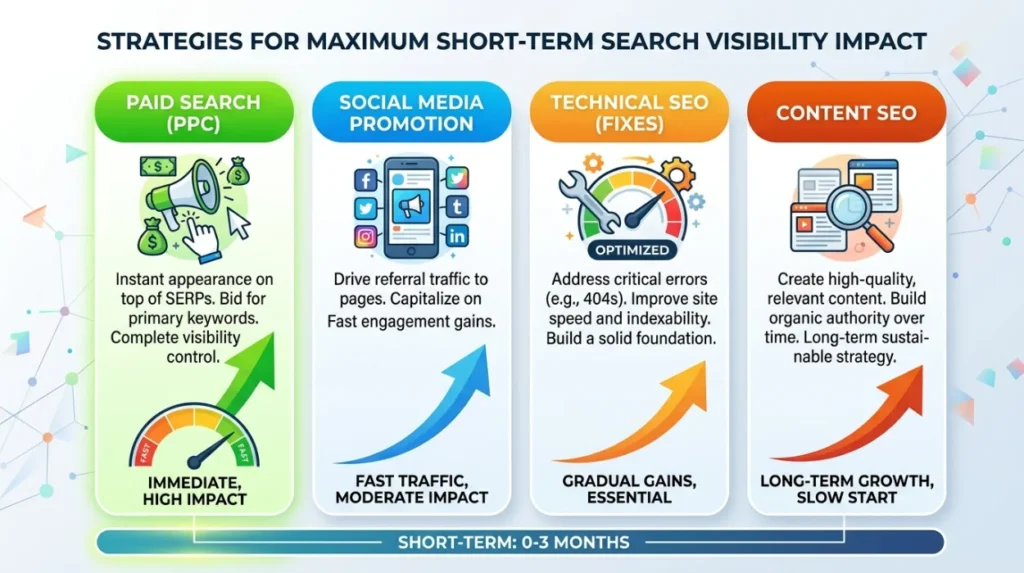
Source-level removal generally has a more direct short-term effect when the impersonating account itself is responsible for the visible content. Removing the source changes its accessibility and can alter the information available for subsequent search processing. The resulting search impact still depends on indexing and recrawling processes.
Search engine suppression can also produce a direct visibility change when an eligible result is removed from a search index or becomes less accessible through search. Its scope remains limited to the affected search environment and does not necessarily alter the underlying platform content. The distinction is important when measuring short-term SERP changes.
Organic content enhancement normally operates over a longer period because new or improved pages require crawling, indexing, evaluation, and ranking. Its search ranking influence therefore develops through accumulated relevance and authority signals rather than immediate source removal. Short-term evaluation favours direct interventions, while long-term evaluation requires broader analysis.
Which strategy provides stronger long-term reputation protection?
Long-term reputation protection depends more heavily on a coherent digital footprint than on a single removal action. A consistent network of authoritative information provides search systems with clearer entity relationships and gives users reliable sources for identity verification. This structure remains relevant after an individual impersonation incident has been resolved.
Removal addresses a specific unauthorised source, but it does not prevent another source from appearing in the future. Organic reputation development addresses the broader information environment by strengthening authoritative content, identity consistency, and entity credibility. Its sustainability therefore derives from the underlying information architecture rather than one isolated intervention.
The strongest long-term evaluation also considers sentiment distribution. Consistent authoritative information provides greater context for interpreting reviews, references, and other reputation signals. This creates a more coherent information environment for future SERP evaluation.
How do reputation signals affect the success of an impersonation removal strategy?
Reputation signals influence how information surrounding an entity is interpreted across search and social ecosystems. These signals include identity consistency, authoritative references, content relevance, source relationships, reviews, and contextual associations. Removing an impersonating account changes one part of this signal environment but does not erase unrelated information.
Entity credibility is formed through the consistency and reliability of information associated with an entity. If authoritative sources consistently identify the legitimate individual or organisation, the distinction between authentic and unauthorised information becomes clearer. If conflicting information exists across different sources, removing one profile represents a narrower intervention.
Search ranking influence also depends on the relative strength of competing sources. A removed account can lose its direct contribution to the visible search landscape, while authoritative pages continue to provide information about the entity. Measuring the outcome therefore requires examining both the removed source and the remaining reputation signals.
How should the effectiveness of different removal methods be evaluated?
Different removal methods are evaluated by measuring source-level outcomes, search visibility changes, risk exposure, scalability, and sustainability. A method that removes one profile successfully has a different performance profile from a method designed to manage a wider group of indexed pages. Evaluation therefore requires defined metrics rather than a single success criterion.
A practical comparison framework can assess each approach through the following dimensions:
- Measure source control by determining whether the impersonating account or content remains publicly accessible after the intervention.
- Evaluate search visibility by comparing the affected URL, profile, or identity-related queries before and after the intervention.
- Assess reputation signals by examining whether conflicting identity information remains across other indexed sources.
- Analyse scalability by determining whether the same process remains practical when multiple accounts, URLs, or platforms are involved.
- Measure sustainability by monitoring whether the reputation landscape remains stable after the original removal action.
This framework separates immediate removal results from wider reputation outcomes. It also prevents search visibility from being treated as the only indicator of successful reputation management.
How scalable are social media removal and reputation enhancement strategies?
Scalability differs because removal strategies are usually tied to individual accounts, reports, platforms, or policy procedures. Each impersonating account can require separate evidence and assessment. Organic enhancement is more scalable when a consistent content and entity structure can support multiple relevant queries and information sources.
Reactive removal therefore has a direct but potentially repetitive workflow. The process becomes more complex when identical or related impersonation issues occur across different platforms. Each platform can apply distinct reporting requirements and evaluation criteria.
Organic enhancement has a different scalability profile because a single authoritative resource can support multiple search relationships. However, creating, maintaining, and updating high-quality content requires ongoing editorial and technical resources. Scalability therefore depends on whether the objective concerns eliminating individual sources or strengthening the broader information ecosystem.
Dive Deeper With Our Expert Guides:
How to Manage a Social Media Pile-On Before It Spreads
How to Report and Remove Non-Consensual Images From Social Media
How should businesses balance removal and content enhancement?
Businesses can balance removal and content enhancement by separating source-level problems from broader reputation objectives. An impersonating account represents a specific identity conflict, while weak authoritative content represents a wider information structure issue. Treating both as the same problem reduces the precision of the strategy.
Removal focuses on reducing unauthorised information, whereas enhancement focuses on increasing the visibility and clarity of legitimate information. The first operates through source intervention, and the second operates through content, authority, relevance, and entity relationships. Their mechanisms are complementary but their outcomes require separate measurement.
Risk exposure also differs between the approaches. Removal depends on platform or search-system decisions, while enhancement depends on sustained content quality and ranking evaluation. A balanced strategy therefore evaluates the source, the SERP composition, the digital footprint, and the entity’s existing reputation signals before determining which intervention has the strongest strategic relevance.
How does impersonation removal influence the wider SERP composition?
Impersonation removal can alter SERP composition when the affected profile or associated content has been indexed and ranked. Removing or restricting the source changes the set of documents available for retrieval and can therefore influence which results occupy the available search positions. The precise outcome depends on how search systems recrawl, reindex, and reassess the affected information.
SERP composition is not controlled by a single reputation management action. Search engines continually evaluate competing pages according to relevance, authority, content quality, links, and other ranking signals. Removing one result therefore creates an opportunity for another relevant document to occupy the available position rather than guaranteeing a particular replacement.
This distinction is essential when evaluating search perception. A successful removal changes the information landscape, but the resulting SERP still reflects the remaining content ecosystem. Long-term stability therefore depends on both source-level intervention and the strength of authoritative reputation assets.
What is the most sustainable way to manage impersonation-related reputation risks?
The most sustainable approach combines precise source-level intervention with long-term management of authoritative identity information. Removal addresses the immediate unauthorised representation, while organic reputation development strengthens the wider information environment. This combination separates incident resolution from ongoing reputation control.
Sustainability also requires monitoring because search ecosystems change after content is removed or altered. Crawling, indexing, ranking, and SERP evaluation occur independently of the original reporting action. Monitoring therefore identifies whether inaccurate information remains visible or whether new identity conflicts enter the digital footprint.
The strategic objective is not simply to remove one account. It is to maintain a coherent entity representation across the digital ecosystem while reducing the visibility and persistence of unauthorised information. This approach provides a clearer basis for evaluating search visibility, trust signals, entity credibility, and long-term reputation stability.
For a deeper examination of the source-level removal process, Remove an Impersonating Social Media Account provides the next stage of consideration within this topic.
Reporting an impersonating social media account and managing its reputation impact are related but distinct processes. Source-level removal addresses the existence of unauthorised information, search suppression addresses discoverability, and content enhancement strengthens authoritative information within the wider digital ecosystem.
Reactive strategies provide direct responses to specific identity conflicts, while organic strategies support longer-term entity credibility and information consistency. Removal can offer a focused intervention, whereas content enhancement operates through cumulative reputation signals and SERP composition. Their effectiveness therefore depends on the objective, available evidence, search visibility, scalability, risk exposure, and sustainability requirements.
A complete evaluation treats impersonation as both a source-level identity problem and a search perception issue. Analysing content suppression, content enhancement, authority, sentiment distribution, entity relationships, and ranking dynamics provides a more accurate framework for understanding reputation outcomes.
How do I report an impersonating social media account?
Use the platform’s official reporting process for impersonation and provide evidence showing the account is falsely representing an individual or organisation. Include relevant profile details, URLs, screenshots, and identity information where requested.
Can an impersonating social media account be removed?
An impersonating account can be removed when the platform determines that it violates its impersonation or identity policies. The outcome depends on the evidence submitted and the platform’s review process.
What evidence is needed to report a fake social media account?
Useful evidence includes the impersonating account URL, copied profile information, screenshots, usernames, and information demonstrating the legitimate identity. Clear evidence helps establish the difference between the genuine account and the unauthorised representation.
Does removing an impersonating account remove it from Google search results?
Removing the social media account does not automatically guarantee immediate removal from Google search results. Search engines need to recrawl and reassess affected content before changes in indexing and search visibility appear.
What is the difference between removing an account and suppressing it in search results?
Account removal addresses the original source of the impersonating content, while search suppression focuses on reducing its visibility in search engine results. Reputation management strategies can evaluate both approaches based on source control, search visibility, and long-term reputation signals.