
When a hacked account posts harmful content, the priority is to secure the account, document the activity, and assess how the content affects online reputation and search visibility. Reputation management is the process of monitoring, analysing and influencing the information that shapes how an individual or entity is perceived across digital environments.
Online reputation refers to the collection of information, signals and interpretations associated with an individual, organisation or digital entity across search engines, social platforms, review systems and other online sources. When an account is compromised, unauthorised posts become part of this information environment and can influence entity perception if they remain visible, indexed or repeatedly referenced. The problem therefore extends beyond account access because harmful content can enter wider search ecosystems. Understanding how these systems process the content explains why rapid containment and structured assessment are important.
What happens to online reputation when a social media account is hacked?
A hacked social media account can introduce inaccurate reputation signals into an otherwise established digital footprint. Social platforms record posts, interactions, comments and engagement as pieces of information connected to an account or entity. Search engines then evaluate publicly accessible content according to factors such as relevance, accessibility, authority, engagement and contextual relationships. Unauthorised content does not automatically become authoritative, but persistent visibility increases its opportunity to be discovered and interpreted.
The first reputation-management issue is therefore information accuracy. A compromised account can publish statements that do not represent the account owner, alter existing content or interact with other users without authorisation. These activities create a mismatch between the entity and the information associated with it. Search systems do not inherently understand the circumstances behind every publication, so contextual evidence becomes important when evaluating the reliability and meaning of digital information.
Account compromise also affects the consistency of reputation signals. Established profiles often contain a recognisable pattern of language, topics, links and interactions. Sudden deviations can introduce contradictory information into the entity’s digital footprint. The resulting inconsistency can affect how people interpret the account, particularly when individual posts are viewed without the surrounding context of the compromise.
How does harmful content from a hacked account become visible in search results?
Harmful content becomes visible in search results when it is accessible to crawlers, discoverable through relevant queries, or referenced by other indexed resources. Search engines collect information from accessible webpages and platforms, process its meaning and determine where it belongs within their search indexes. Public social media posts can therefore contribute to search visibility when platform architecture and indexing conditions permit discovery.
Content indexing is the process through which information is analysed and stored within a search engine’s index for potential retrieval. Indexing does not guarantee a high ranking, because ranking and indexing are separate stages. A post can exist within an index without appearing prominently for a particular query. Conversely, content with strong relevance or external references can gain greater search exposure when it matches the intent behind a query.
SERP evaluation also considers the relationship between a query and available information. If harmful content contains an individual’s name, organisation name or other identifiable entity references, it can become associated with searches involving that entity. The ranking position determines exposure, while the wording and context of the result influence interpretation. This distinction makes search visibility an important component of reputation analysis.
Why does removing a harmful post not always remove its reputation impact?
Removing the original post does not automatically eliminate every trace of information associated with it. Search engines, social platforms, third-party websites and users can create separate copies, references, screenshots or discussions. Each accessible instance represents a distinct information source within the wider digital footprint.
The mechanism is similar to information propagation across connected systems. A social post can generate comments, reposts, quoted references or external discussion before the original material is removed. Those secondary references can remain independently accessible. Search engines then evaluate the surviving pages according to their own indexing and ranking processes.
This creates an important distinction between content removal and reputation correction. Content removal addresses the original publication, while reputation correction evaluates whether inaccurate information continues to exist elsewhere. A complete assessment therefore examines the broader information environment rather than treating the first removed post as the end of the issue.
How do search engines interpret trust and credibility signals?
Search engines evaluate credibility through combinations of signals rather than relying on a single universal reputation score. Authority, relevance, source characteristics, content relationships and other measurable properties contribute to how information is assessed for search purposes. These signals help search systems determine which results provide useful responses to particular queries.
Authority is a signal associated with the perceived strength and relevance of an information source within a particular search context. Trust-related evaluation is more complex because search engines analyse information according to system-specific criteria rather than assigning a simple human judgement of truthfulness. A reputable website can therefore provide a stronger contextual signal than an isolated, low-authority page, but authority does not automatically validate every statement published by that source.
Entity perception develops from the information connected to an identifiable person, organisation, brand or other entity. Search systems can establish relationships between names, topics, webpages, profiles and references. When inaccurate content is repeatedly associated with the same entity, the association becomes part of the wider information environment that users encounter. Analysing these relationships helps explain how isolated harmful content can acquire broader reputational significance.
How do reviews and sentiment affect reputation after an account compromise?
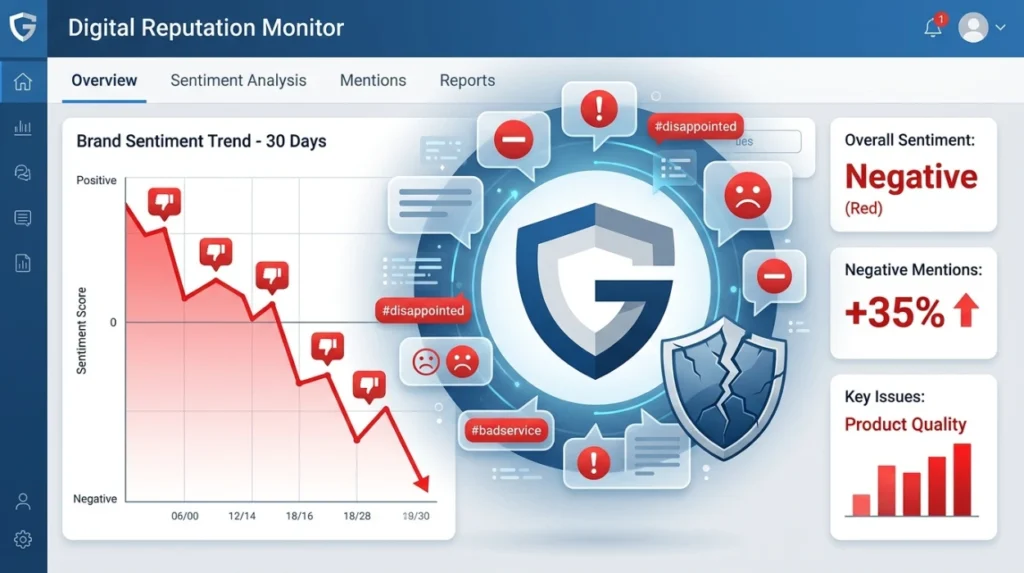
Reviews and sentiment contribute to reputation by providing observable signals about how people describe and evaluate an entity. Review systems structure this information through ratings, written comments, response activity and other engagement indicators. Search engines can also encounter review content through webpages, business profiles and third-party platforms.
Sentiment interpretation refers to the classification of language according to positive, negative or neutral characteristics. Automated systems analyse words, phrases and contextual relationships to understand the general orientation of content. This does not mean that every negative statement is treated as factual or authoritative. Sentiment describes the expressed orientation of information, while credibility depends on additional contextual and source-related signals.
A hacked account can complicate sentiment analysis when unauthorised posts resemble genuine statements from the account owner. The content itself can appear negative even when its authorship is disputed. Reputation analysis therefore requires separation between what the content says, where it appears, who controls the source, and whether the information accurately represents the entity.
How does a hacked account affect an entity’s digital footprint?
A digital footprint is the collection of information and activity associated with an individual or entity across online systems. It includes social profiles, webpages, mentions, reviews, indexed documents, public interactions and other discoverable information. Account compromise can introduce inaccurate entries into this footprint and create inconsistencies between legitimate and unauthorised activity.
The significance of the digital footprint depends on visibility, relevance and connectivity. A private post with no external references has a different search impact from publicly accessible content that receives engagement or appears in indexed pages. The information architecture surrounding a piece of content therefore influences its potential reputation impact.
Digital footprint analysis evaluates these relationships systematically. It identifies where information exists, how it connects to the entity, whether it remains accessible and how prominently it appears in search results. This approach distinguishes direct account activity from secondary references and prevents reputation analysis from focusing solely on the original compromised profile.
Dive Deeper With Our Expert Guides:
How Fake Accounts Impersonate Brands and Individuals on Social Media
How a Social Media Pile-On Escalates Into a Reputation Crisis
What evidence is useful after a hacked account publishes harmful content?
Documenting unauthorised activity establishes a factual record that separates legitimate account activity from compromised activity. Evidence can include timestamps, post URLs, screenshots, account notifications, security alerts and records of unauthorised changes. The purpose is to preserve verifiable information about what occurred and when it occurred.
Evidence also supports accurate interpretation of search results. Without a documented timeline, it becomes harder to distinguish genuine statements from content created during the compromise. A chronological record establishes the relationship between the account breach, the publication of harmful material and subsequent changes.
The evidence itself does not determine search rankings, but it improves the accuracy of reputation analysis. It provides a factual basis for identifying incorrect associations and evaluating whether the content has propagated to other locations. This distinction between evidence and ranking is important because search engines evaluate accessible information, while investigators evaluate the circumstances surrounding that information.
How can harmful hacked-account content be assessed across SERPs?
SERP assessment evaluates how harmful content appears for searches connected to the affected entity. The analysis considers ranking position, query relevance, page type, source authority, snippet wording and the surrounding results. These factors determine the practical level of search exposure.
A structured assessment separates direct social results from third-party references. It also distinguishes branded or entity-specific queries from broader topical searches. This classification identifies whether the harmful material is closely connected to the entity or simply appears within a wider discussion.
Search visibility is therefore a measurable dimension of reputation rather than a subjective impression. A result appearing on a highly visible position for an entity-specific query has greater exposure than the same content buried deep within unrelated results. SERP evaluation provides the framework for identifying this difference.
What is the relationship between account recovery and reputation recovery?
Account recovery restores control over the compromised digital identity, while reputation recovery addresses the information created or distributed during the compromise. These are related but distinct processes. Regaining access prevents further unauthorised activity, whereas reputation analysis determines whether harmful information remains visible elsewhere.
The distinction is important because an account can be fully secured while inaccurate information continues to circulate. Search indexes, third-party pages and user-generated references operate independently from account security. Removing access for an attacker therefore resolves the security problem without automatically resolving every search or perception issue.
A broader understanding of How to Recover and Clean Up After a Hacked Social Account connects account security with digital footprint analysis, content assessment and search visibility evaluation. This relationship demonstrates why reputation systems need to be examined as interconnected information environments rather than isolated social profiles.
How can the reputation impact of a hacked account be understood objectively?
The reputation impact of hacked content is best understood by evaluating visibility, relevance, authority, sentiment and persistence together. Visibility measures how easily users encounter the information. Relevance measures its connection to the affected entity and search query. Authority evaluates the strength of the source within the search ecosystem, while sentiment identifies the expressed positive or negative orientation of the material.
Persistence measures whether the information remains accessible across the digital environment. Content that disappears immediately has a different impact from information replicated across indexed pages and external references. These dimensions create a structured framework for assessing reputation risk without relying on assumptions about user reactions.
The central principle is that online reputation is an information system shaped by interconnected signals. A hacked account introduces inaccurate information into that system, while search engines, social platforms and users determine how that information is discovered, interpreted and redistributed. Analysing the complete information pathway provides a more accurate understanding of the resulting reputation impact.
A hacked account that publishes harmful content creates both a security problem and an information-quality problem. Online reputation refers to the information environment surrounding an entity, while reputation signals are the observable elements that influence how that entity is interpreted across digital platforms and search engines. Account recovery restores control, but content indexing, third-party references and SERP visibility determine whether the reputational effects continue.
Understanding search visibility, authority, sentiment, reviews, entity perception and digital footprint structure explains why harmful content can extend beyond its original publication. Objective reputation analysis therefore focuses on the source, context, accessibility, ranking and persistence of information. This systems-based approach provides a clear framework for understanding how inaccurate content enters and moves through modern search ecosystems.
What should I do if my hacked account posts harmful content?
Secure the compromised account immediately by changing the password, ending unauthorised sessions and enabling two-factor authentication. Document the harmful posts and report unauthorised activity to the relevant social media platform.
Can a hacked social media account damage my online reputation?
Yes, unauthorised posts can create inaccurate reputation signals and affect how an individual or organisation is perceived online. Public content can also appear in search results or be referenced by third-party websites, extending its visibility beyond the original account.
How do I remove harmful content posted from a hacked account?
Preserve evidence first, then use the platform’s reporting and account-recovery processes to address unauthorised content. Where harmful material has been copied or indexed elsewhere, each remaining source requires separate assessment and action.
Can hacked social media posts appear in Google search results?
Public social media content can become searchable when search engines access and index the relevant pages. Search visibility depends on factors such as accessibility, relevance, indexing status and the authority of the source.
How can I recover and clean up my online reputation after an account hack?
Start by securing the account, removing unauthorised content and documenting the compromise. Then assess search results, third-party references, reviews and other digital footprint elements to identify inaccurate information that remains publicly visible.