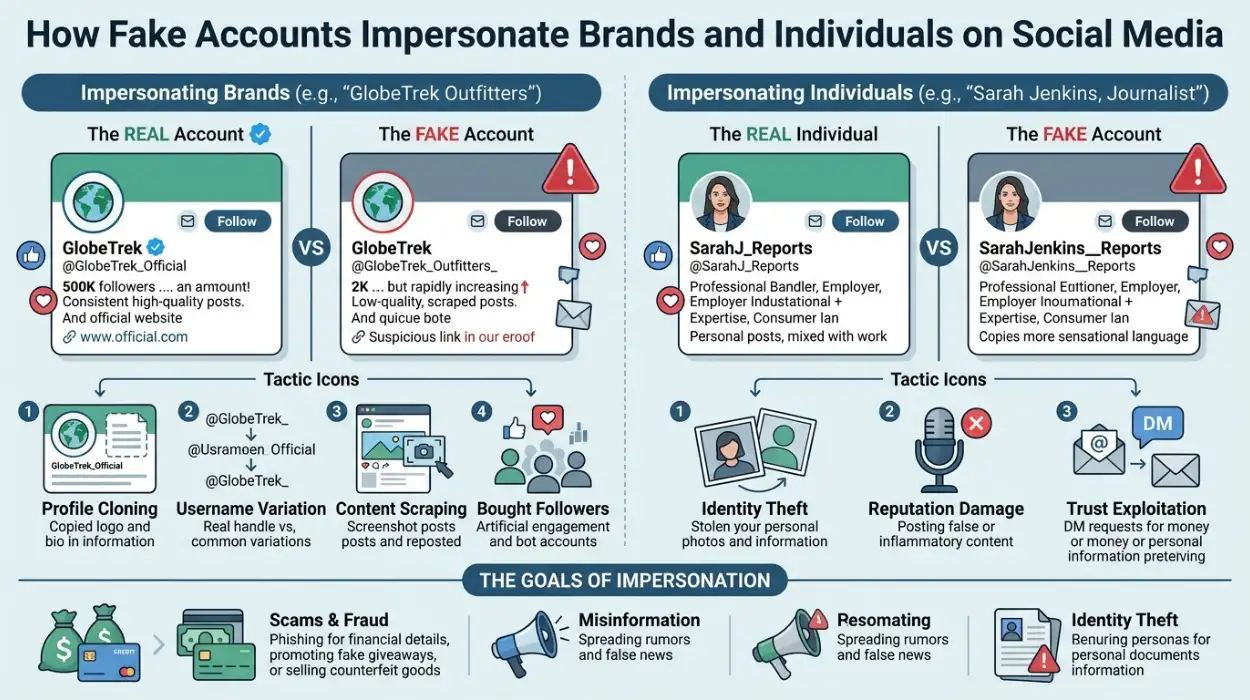
Fake social media accounts impersonate brands and individuals by copying names, profile images, descriptions, or other identity signals to create a misleading digital identity. Reputation management is the systematic process of monitoring, interpreting, and influencing information that shapes how an entity is perceived across digital environments.
Online reputation refers to the collection of information, signals, associations, and interpretations connected to an individual or organisation across search engines and online platforms. When an impersonating account publishes content under a copied identity, it adds new information to that digital footprint. Search engines and platform systems evaluate available signals to determine relevance, authority, authenticity, and entity relationships. The resulting information contributes to how an entity is represented within search results and wider digital ecosystems.
What is social media impersonation?
Social media impersonation is the creation or operation of an account that represents itself as another individual, organisation, or identifiable entity without legitimate authority. The account uses identity attributes such as a name, photograph, logo, biography, username, or descriptive information to establish an association with the impersonated entity. This process creates an identity conflict because identical or closely related signals become attached to separate accounts.
Impersonation operates through identity replication rather than simple content duplication. A fake account reproduces recognisable attributes that users and automated systems associate with the original entity. These attributes function as reputation signals because they connect content with a particular person, organisation, or public identity. When copied information becomes indexed, shared, or referenced, the impersonating account contributes additional data to the entity’s digital footprint.
The distinction between impersonation and legitimate representation depends on authority, ownership, and identity accuracy. An authorised representative operates within an established relationship with the entity, while an impersonating account presents an unauthorised identity as authentic. Search ecosystems process both the content and the surrounding entity relationships, making identity clarity an important component of online credibility.
How do fake accounts copy the identity of individuals and brands?
Fake accounts copy identity through recognisable profile attributes that establish semantic similarity with the genuine entity. A copied display name creates a direct lexical relationship, while an identical photograph creates a visual association. Replicated biographies, descriptions, usernames, locations, and links add further signals connecting the account to the impersonated identity.
Which identity signals are commonly copied?
The most significant identity signals include names, profile photographs, logos, biographies, usernames, and descriptions. These elements provide structured and unstructured information about who controls an account and what entity it represents. When several attributes are reproduced together, the fake account develops a stronger identity resemblance to the original entity.
Content also reinforces the copied identity. An impersonating account that publishes posts using the language, subject matter, or organisational terminology associated with another entity creates additional contextual associations. These associations expand the digital footprint surrounding the impersonated identity and introduce information that search and social systems evaluate independently.
How does an impersonating account affect an online reputation?
An impersonating account affects online reputation by introducing unauthorised information into the digital environment associated with an individual or organisation. Reputation is not formed from a single webpage or profile; it emerges from the cumulative interpretation of information connected to an entity. A fake account therefore becomes another information source within the wider reputation landscape.
The effect depends on how the content is discovered, indexed, distributed, and interpreted. Public posts can become searchable within platform systems and, where accessible, enter search engine indexes. Repeated references to the same name or identity attributes strengthen the association between the entity and the content. This process changes the information environment surrounding the entity even when the genuine account remains unaffected.
Reputation signals also operate through consistency. Authentic profiles generally provide identifiable information that aligns across different digital properties. An impersonating account introduces conflicting identity signals, creating a divergence between legitimate and unauthorised representations. Search visibility and entity perception therefore depend partly on how systems distinguish authoritative information from competing identity claims.
How do search engines interpret fake social media accounts?
Search engines interpret social media accounts through signals relating to relevance, authority, content, links, entities, and user-oriented information. An indexed social profile represents a document or resource containing information that can be associated with an entity. The system evaluates that information within its broader search ecosystem rather than treating the profile as an isolated object.
Entity perception is particularly relevant when multiple pages contain the same or closely related identity information. Names, descriptions, references, links, and contextual relationships help establish connections between content and entities. An impersonating profile therefore becomes part of the information available for evaluating that entity, although indexing does not automatically establish the account as authentic.
Does indexing prove that an account is genuine?
Indexing does not prove that an account is genuine. Content indexing indicates that a search engine has processed and stored information from a discoverable source; it does not constitute verification of the identity represented by that source.
SERP evaluation separates discoverability from credibility. A page can appear in search results because it satisfies relevance or accessibility conditions without representing an authoritative identity. Authenticity therefore depends on a broader combination of signals, including ownership indicators, authoritative references, consistent identity information, and contextual relationships.
How do reputation signals influence search visibility?
Reputation signals influence search visibility by contributing information that systems use to evaluate relevance, authority, credibility, and entity relationships. These signals exist across websites, social profiles, reviews, news content, directories, and other publicly accessible sources. Their combined presence creates an information environment around a person, organisation, or brand entity.
Search visibility refers to the extent to which an entity and its associated content appear within relevant search results. An impersonating profile introduces another page containing entity-related information, which expands the number of documents associated with the identity. The profile’s ranking position depends on search evaluation rather than simply on the fact that it contains copied information.
Content ranking dynamics also determine which information receives greater visibility. Pages with stronger authority, relevance, links, engagement signals, or established entity relationships frequently occupy more prominent positions than weaker sources. Consequently, an impersonating account can exist within an entity’s digital footprint without necessarily becoming a dominant search result.
How do reviews and sentiment contribute to reputation evaluation?

Reviews contribute reputation signals by providing publicly accessible assessments of an entity, product, organisation, or experience. Search systems process review-related information as part of the broader content ecosystem surrounding an entity. Sentiment analysis examines linguistic patterns and contextual signals to classify opinions and identify recurring positive, negative, or neutral associations.
The significance of review information depends on source authority, relevance, consistency, and context. A single statement does not represent the complete reputation of an entity, while repeated sentiment across independent sources creates a broader reputation pattern. Search engines evaluate review content alongside other information rather than relying exclusively on sentiment.
Impersonating accounts create a separate issue because their content does not originate from the legitimate identity they represent. If an account publishes statements, reviews, or claims while presenting itself as another entity, those statements become part of the surrounding information environment. The distinction between legitimate and unauthorised content therefore becomes important for accurate reputation interpretation.
How do authority and trust signals distinguish genuine identities?
Authority and trust signals distinguish genuine identities by establishing stronger relationships between an entity and reliable sources of information. Authority refers to the recognised relevance or strength of a source within a particular subject or entity context, while trust relates to the reliability and consistency of the information represented by that source.
Consistent identity information strengthens entity recognition across digital properties. Matching names, official descriptions, established references, authoritative links, and consistent organisational information create a coherent entity profile. Conflicting accounts introduce additional identity relationships that require systems and users to distinguish between competing representations.
Trust is therefore a contextual property rather than a single numerical score. Search engines evaluate information through interconnected signals, while users evaluate authenticity through visible evidence and source consistency. A coherent digital footprint provides clearer information for both forms of evaluation.
Why does a fake account become part of an entity’s digital footprint?
A fake account becomes part of an entity’s digital footprint because it publishes information connected to the entity’s identifying attributes. A digital footprint is the accumulated set of publicly available information and digital traces associated with an individual, organisation, or other identifiable entity. It includes profiles, webpages, references, posts, reviews, images, and indexed documents.
The presence of unauthorised content does not automatically make that information accurate. It does, however, create another data point within the wider information environment. When the account is publicly accessible, referenced by other pages, or indexed by search systems, its information becomes easier to discover and evaluate.
Digital footprint analysis therefore requires distinction between existence and authority. An item can exist within an entity’s footprint without accurately representing the entity. Reputation analysis separates these concepts by examining provenance, identity, context, authority, and consistency.
Dive Deeper With Our Expert Guides:
How a Social Media Pile-On Escalates Into a Reputation Crisis
What UK Law Says About Non-Consensual Intimate Image Sharing
How can users distinguish an impersonating account from an authentic account?
Users distinguish impersonating accounts by evaluating identity consistency, ownership indicators, account history, linked information, and contextual evidence. An authentic account normally maintains identifiable relationships with established information about the same entity. An impersonating account frequently presents copied attributes without equivalent evidence of legitimate ownership.
What signals indicate identity inconsistency?
Users can evaluate whether the account’s name matches its username, whether profile information aligns with established entity information, and whether external references support the claimed identity. They can also examine whether the account’s content corresponds with the entity’s known subject area and communication patterns.
These checks represent basic identity verification rather than definitive technical authentication. The purpose is to compare information sources and identify contradictions. A discrepancy between account ownership claims and authoritative identity information represents a meaningful reputation signal.
How does impersonation fit into the wider search reputation system?
Impersonation fits into search reputation as an identity and information-quality problem within a larger digital ecosystem. Search reputation develops through the interaction of indexed content, entity relationships, authority signals, reviews, references, and user-facing search results. An impersonating account adds unauthorised information to that ecosystem and creates another source associated with the entity.
The central issue is therefore not simply the existence of a fake account. The important factors include how the account represents the entity, where its content appears, whether the information becomes indexed, how other sources reference it, and how systems evaluate competing identity signals.
Understanding these mechanisms provides a clearer view of online reputation. Search perception is shaped by the total information environment surrounding an entity, while content indexing and ranking determine which parts of that environment receive visibility. Impersonation demonstrates how inaccurate identity information can enter that environment and compete with authentic sources.
For users researching the next stage of this topic, How to Report and Remove an Impersonating Social Media Account provides a focused transition from understanding impersonation mechanisms to examining the reporting and removal process.
Fake social media accounts impersonate individuals and brands by reproducing identity signals that establish an unauthorised association with another entity. Reputation management is concerned with understanding how these information sources influence digital identity, search visibility, credibility, and entity perception.
An impersonating account becomes relevant to search reputation when its information enters the wider digital footprint surrounding an entity. Search engines evaluate indexed content through relevance, authority, context, and entity relationships rather than treating every source as equally authoritative. Reviews, sentiment, references, and consistency further shape the information environment in which reputation signals are interpreted.
Understanding impersonation therefore requires analysis of identity replication, content indexing, ranking dynamics, authority, and trust. These concepts explain how unauthorised information becomes part of a searchable reputation ecosystem without automatically establishing that information as authentic.
What is social media impersonation?
Social media impersonation occurs when a fake account presents itself as a genuine individual, brand, or organisation by copying identifying details such as names, photographs, logos, or biographies. It can create misleading reputation signals and affect how an entity is perceived online.
How do fake social media accounts impersonate individuals and brands?
Fake accounts typically copy profile names, images, usernames, biographies, logos, and other recognisable identity information. They can also publish content that creates a false association between the account and the legitimate person or organisation.
Can an impersonating social media account affect online reputation?
Yes, an impersonating account can introduce unauthorised information into an individual’s or brand’s digital footprint. If its content becomes visible in search results or is widely shared, it can influence entity perception and online credibility.
How can I identify a fake social media account?
Compare the account’s username, profile information, images, links, account history, and other identity signals with authoritative information about the individual or organisation. Inconsistent ownership details or copied identity elements can indicate potential impersonation.
How do you report and remove an impersonating social media account?
Impersonating accounts can generally be reported through the relevant platform’s identity, impersonation, or account-reporting process. For complex cases, Clear Your Name can be relevant when assessing social media content removal options and the wider reputation impact.