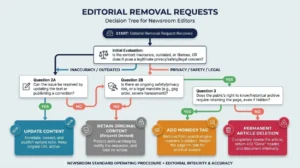
Requesting removal of personal data from a public register begins with identifying the publishing authority, the information involved and the legal or administrative basis for publication. The appropriate approach depends on whether the register provides a formal removal, correction, restriction or objection mechanism.
Reputation management strategies differ based on the source, visibility and persistence of personal information. Online reputation control methods are evaluated through their effect on search visibility, reputation signals, entity credibility and the composition of search engine results pages.
Which removal approach applies to personal data in a public register?
The appropriate removal approach depends on how the register operates and why the information was published. Public registers can exist for regulatory transparency, legal disclosure, professional oversight, corporate information, licensing or public accountability. Each purpose creates a different framework for handling personal information. A removal request therefore begins with identifying the responsible authority and the specific record rather than treating all public registers as equivalent. The available mechanism can involve removal, correction, restriction of access, objection or another form of data handling.
Removal is distinct from search-result suppression because the two mechanisms operate at different levels of the information ecosystem. Source removal addresses the underlying record, while search suppression addresses the visibility of information within search results. A successful source-level intervention can therefore have a broader effect on the digital footprint because the original information becomes unavailable or changes at its source. Search visibility can still persist temporarily through cached, replicated or independently published content. Evaluation therefore requires examining both the source and the search environment.
How does correcting a public record compare with removing it?
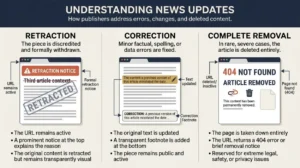
Correction addresses inaccurate or incomplete information, whereas removal seeks to eliminate or restrict the availability of information where an applicable mechanism exists. A correction can preserve the public function of a register while changing the factual information associated with an individual or entity. Removal has a different objective because it reduces the availability of the underlying record. The appropriate route therefore depends on whether the problem concerns accuracy, necessity, lawful publication or another recognised basis for changing the record. Treating correction and removal as interchangeable creates an inaccurate assessment of the available options.
From a reputation perspective, correction can alter the information users encounter without eliminating the source itself. This can strengthen entity credibility when the published information contains factual errors that affect interpretation. Removal, where available, directly reduces the source-level reputation signal by taking the relevant information out of public availability. Neither mechanism automatically controls every reference to the same information elsewhere online. Search engines can continue displaying independent sources even after a single public record changes.
Is source removal more effective than search-result suppression?
Source removal and search-result suppression solve different problems, so their effectiveness depends on the specific visibility issue being evaluated. Source removal targets the original publication and can reduce the availability of information at its point of origin. Search-result suppression works by changing the relative prominence of information within the SERP rather than necessarily removing the underlying material. This distinction makes source removal more directly connected to the original record, while suppression remains relevant when source-level removal is unavailable. Both approaches require separate measurements because their mechanisms and outcomes differ.
Search suppression operates through the wider information environment surrounding an entity. Stronger authoritative pages can occupy more visible positions, changing the composition of results for relevant searches. This affects search perception without necessarily altering the original public register. The approach therefore focuses on ranking dynamics, content relevance and competing reputation signals. Source removal instead focuses on availability and publication status. Comparing the two requires examining whether the objective is to eliminate information at source or reduce its prominence within search results.
How does content removal compare with content enhancement?
Content removal reduces the amount of accessible information associated with a particular issue, while content enhancement strengthens the visibility and relevance of authoritative information. Removal is therefore a subtractive mechanism, whereas enhancement is an additive mechanism. A removal strategy depends on the existence of a valid basis for changing the source. Content enhancement depends on creating or improving relevant resources that contribute stronger reputation signals. The two approaches consequently operate through different control points within the search ecosystem.
Content enhancement can influence SERP composition by giving search engines additional authoritative material to evaluate for relevant queries. Professional profiles, institutional pages and accurate informational resources can contribute contextual signals around an entity. This does not erase an existing public record, and it does not guarantee that a particular page will outrank it. Removal has a more direct relationship with the source itself but is constrained by the rules governing the register. Evaluation therefore involves balancing source-level control against the broader search ranking influence of competing content.
How does a reactive removal strategy compare with an organic reputation approach?
A reactive strategy responds to an identified record or reputation issue, while an organic approach develops a stronger information environment before or independently of a specific problem. Reactive removal focuses resources on an existing source and its immediate visibility. Organic reputation management focuses on maintaining authoritative information, accurate profiles and consistent entity associations over time. The distinction concerns timing as well as mechanism. Reactive activity addresses a defined problem, while organic activity influences the broader conditions in which reputation signals are evaluated.
Reactive intervention provides a direct response when a particular public record creates an identified risk. Its limitation is that it remains dependent on the availability of a valid intervention route. Organic activity provides broader resilience because authoritative information can establish stronger context around an entity before a single source becomes dominant. Its limitation is that it does not remove an unwanted record from its original location. Combining both concepts creates a framework in which source-specific action and long-term search visibility management remain separate but complementary.
What role do reputation signals play when public records appear in search results?
Reputation signals provide contextual information that influences how an entity is represented across search results. A public register can function as an authoritative signal because the information originates from an identifiable institutional source. Professional profiles, news coverage, reviews and organisational pages contribute different types of signals based on their content, source characteristics and relevance. Search engines evaluate these sources in relation to user queries rather than assigning identical value to every reference. The resulting SERP composition therefore reflects an interaction between source authority, relevance and ranking signals.
Sentiment distribution introduces another layer of evaluation when public records appear alongside reviews or commentary. A factual register entry does not inherently express positive or negative sentiment, while reviews can contain explicit evaluative language. Users can encounter both forms of information within the same search environment and interpret them together. Entity credibility therefore depends on more than the presence or absence of one record. Analysis must consider how factual, authoritative and sentiment-based information interact across the wider digital footprint.
How should the effectiveness of a personal-data removal strategy be measured?

Effectiveness is measured by tracking the status of the original record, changes in search visibility and the wider composition of relevant results. A removal strategy requires evidence that the source has been changed, restricted or removed according to the applicable process. Search monitoring then determines whether the information remains indexed or appears through another accessible source. These measurements separate source-level outcomes from search-level outcomes. Without that distinction, an apparent removal can be confused with a temporary change in visibility.
A practical evaluation framework can assess:
- Verify the source status by checking whether the original record remains publicly accessible after the relevant intervention.
- Monitor indexed results by tracking whether the affected URL, document or record continues to appear for relevant name-based searches.
- Compare SERP composition by measuring changes in the prominence of the affected record relative to authoritative alternative sources.
- Assess entity associations by reviewing whether search results continue connecting the individual’s name with the same information.
- Measure persistence by monitoring whether removed or corrected information reappears through cached, mirrored or independently published sources.
This framework separates measurable outcomes from assumptions about reputation improvement. A source can be removed while duplicate information remains elsewhere online. Conversely, search visibility can decline even when the original source remains available. Both situations require different interpretations when assessing the overall effectiveness of a reputation management strategy.
What are the main risks when requesting personal data removal?
The principal risks involve selecting an unsuitable mechanism, misunderstanding the register’s publication rules or assuming source removal automatically controls every online reference. Public authorities can have defined obligations concerning transparency and record retention. A request that does not address the applicable framework can therefore produce no change or result in a correction or restriction route rather than complete removal. The assessment also needs to distinguish personal information from information that forms part of a legitimate public record. These factors make evidence and source analysis central to risk management.
Search visibility creates an additional risk because removing one source does not necessarily remove the same information from the wider digital ecosystem. News articles, directories, archived documents or independent webpages can reproduce information originally obtained from a public register. Search engines then evaluate these separate sources independently. A complete reputation analysis therefore maps related references rather than relying solely on the status of the original record. This reduces the risk of interpreting one successful intervention as complete digital removal.
Is personal-data removal a short-term or long-term reputation strategy?
Personal-data removal can produce a direct short-term change when an eligible record is successfully removed or restricted, but long-term reputation control requires monitoring the surrounding information environment. Search results change as pages are indexed, updated, linked and ranked over time. New sources can reproduce information that previously appeared only in the original register. A sustainable strategy therefore measures both the initial source-level outcome and subsequent search visibility. The distinction between immediate intervention and ongoing monitoring is central to evaluating durability.
Long-term control also depends on the strength of the remaining digital footprint. If authoritative professional information remains visible and consistent, users have additional sources through which to understand the entity. If search results contain fragmented or conflicting information, a removed record can leave a contextual gap rather than resolving the wider reputation issue. Content enhancement can address that gap by improving the availability of accurate information. Removal and enhancement therefore operate on different time horizons while contributing to the broader objective of controlled entity perception.
Dive Deeper With Our Expert Guides:
How to Remove Family Records From Genealogy and History Sites
What UK Residents Should Know About US-Based People-Search Sites
How can organisations evaluate removal, suppression and enhancement together?
Organisations can evaluate the three approaches by matching each method to the specific problem it is designed to address. Removal targets the source, suppression targets search prominence and enhancement strengthens authoritative information. Each method has different prerequisites, costs, risks and sustainability characteristics. A comparison therefore needs to consider source control, search ranking influence, scalability and ongoing monitoring rather than relying on a single outcome metric. This creates a more precise framework for selecting an intervention.
The evaluation can be structured around the following distinctions:
- Examine removal when the primary issue is an eligible source that can be changed through a recognised mechanism.
- Evaluate suppression when the source remains available but its search prominence creates the principal visibility concern.
- Assess enhancement when authoritative information is limited and stronger contextual content is required within the SERP.
- Monitor all three approaches through source status, ranking positions, indexed content and entity associations to measure sustainability.
This comparison demonstrates why personal-data removal is not automatically interchangeable with reputation management as a whole. Source-level intervention addresses one part of the information ecosystem, while search perception depends on the wider set of indexed references. A complete evaluation therefore considers how each intervention changes visibility, reputation signals and entity credibility. The appropriate strategy remains dependent on the structure and purpose of the underlying public register.
How does requesting removal connect with broader reputation management?
Requesting removal connects with broader reputation management because public records form one component of an entity’s digital footprint. The removal process addresses the availability of specific information, while reputation management analyses how that information interacts with professional profiles, reviews, publications and search results. This distinction matters because a single source can have high visibility without representing the entire searchable identity. Request removal of your data from public registers therefore represents a source-specific intervention within a wider search perception framework.
The broader evaluation also requires understanding what happens after a record changes. Search engines need to process updated or removed content, while independent sources can continue carrying related information. Monitoring establishes whether the original reputation signal has actually disappeared from relevant searches or simply moved within the SERP. Content enhancement can provide additional authoritative context where a gap remains. The relationship between removal and broader reputation control is therefore sequential rather than interchangeable: source intervention changes the record, while search analysis evaluates the resulting information environment.
Requesting personal-data removal from a public register requires analysis of the source, publication purpose, available mechanisms and wider search environment. Removal differs from correction because it targets availability, while correction changes the accuracy or completeness of an existing record. Source removal also differs from search suppression and content enhancement because each operates through a different mechanism. Reactive intervention addresses an identified source, whereas organic reputation management strengthens the broader digital footprint over time. Effective evaluation therefore measures source status, search visibility, reputation signals, entity credibility and the sustainability of the resulting SERP composition.
How can I request removal of personal data from a public register?
Start by identifying the authority responsible for the register and reviewing its removal, correction, restriction or objection procedures. The available route depends on why the information was published and the rules governing that specific register.
Can personal information be removed from a public register in the UK?
Removal options depend on the type of register, its legal purpose and the rules governing publication. Some records have specific procedures for correction, restriction or removal, while transparency requirements can limit what information can be withdrawn.
What is the difference between removing a public record and removing it from Google?
Removing a public record changes or restricts the information at its original source, while Google removal affects its visibility in search results. These are separate processes, and a search result can remain available when the underlying information exists on another webpage.
Does removing personal data from a public register improve online reputation?
Removing an eligible record can reduce a specific reputation signal and limit the visibility of associated personal information. The overall effect depends on whether the same information also appears in other indexed sources such as directories, news pages or archived documents.
How long does personal-data removal from a public register take?
The timeframe depends on the authority, the type of request and the procedure governing the register. Processing can also involve verification, review and decisions about whether the information qualifies for removal, correction or restriction.