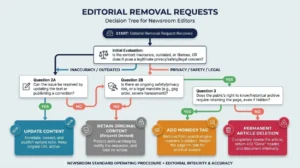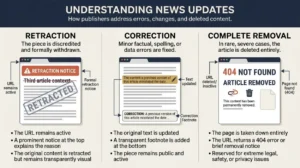
Standard retraction requests rely on direct communication with a publisher to correct or withdraw inaccurate, misleading or potentially unlawful material, while professional article removal services use a structured approach to assess publication risks, removal criteria and available remedies. The most suitable approach depends on the legal basis for challenging the article, the publisher’s policies, the available evidence and the effect of the content on online reputation.
Reputation management strategies differ based on the source of damaging information, the remedy available and the way search engines present content. Online reputation control methods are evaluated through their effectiveness, scalability, risk exposure and long-term influence on search visibility, entity credibility and public perception.
How Do Standard Retraction Requests Compare With Professional Article Removal Services?
Standard retraction requests involve contacting a publisher or editorial team to dispute a specific statement and request a correction, clarification or withdrawal. Professional article removal services involve a more structured assessment of the article, its publication context, potential legal grounds and available removal mechanisms. Both approaches aim to address problematic content, but they differ in scope, procedural coordination and the complexity of the assessment. A direct request concentrates on the disputed material, whereas a structured approach evaluates the wider publication and reputation context. Neither method guarantees removal because the publisher retains editorial responsibilities and applicable legal standards govern the available remedies.
A standard request operates through direct communication and supporting evidence. The requester identifies the disputed passage, explains the factual problem and provides documentation that supports a correction or retraction. This approach offers a relatively straightforward route when the error is clear and the publisher has an established corrections policy. Its limitations become more apparent when the dispute involves privacy, defamation, copyright, several publication policies or repeated republication across different websites. The outcome depends on the strength of the evidence and the publisher’s assessment of its obligations.
Professional article removal services operate through a broader case-assessment process that examines the content, the publisher, the applicable rules and the available remedies. The process can involve identifying the appropriate editorial contact, preparing evidence-based representations and distinguishing removal grounds from correction requests. This structure supports complex assessments where a single message does not adequately address the publication’s legal or editorial position. However, a professional process does not create additional legal rights or override a publisher’s legitimate freedom of expression. Its value rests on the quality of the assessment, the relevance of the evidence and the suitability of the proposed remedy.
Which Approach Is More Effective for Removing Inaccurate or Damaging Articles?
Effectiveness depends on whether the requested remedy matches the underlying problem. A standard retraction request is effective when a verifiable factual error is supported by reliable evidence and the publisher has a clear procedure for correcting inaccuracies. Professional article removal services offer a broader assessment when the issue involves multiple grounds, complicated publisher policies or a need to coordinate separate requests. The distinction is between resolving a defined editorial error and evaluating a more complex content dispute. In both cases, the publisher’s obligations, the public interest and the available evidence influence the result.
The type of inaccuracy also affects the appropriate approach. An incorrect date, job title or attribution presents a relatively defined factual question that a direct correction request can address. An article containing disputed allegations, private information or potentially defamatory statements requires a more detailed assessment of context, evidence and applicable law. The presence of damaging language alone does not establish a legal basis for removal. A structured assessment separates demonstrable errors from disagreement, criticism and legitimate reporting.
Removal effectiveness also depends on the remedy being requested. A correction changes inaccurate information, a retraction withdraws or repudiates a statement, and removal takes content out of publication. These outcomes address different problems and do not produce identical effects on search visibility. A prominent correction can preserve the historical record while clarifying the facts, whereas removal addresses continued availability on the original website. Choosing an appropriate remedy requires an assessment of both the content problem and the consequences of each possible outcome.
How Do Content Removal and Content Enhancement Differ in Search Reputation Management?
Content removal and content enhancement address online reputation through different mechanisms. Content removal seeks to eliminate material from its original source when an appropriate editorial, contractual or legal basis exists. Content enhancement develops accurate, relevant information that provides additional context about a person or organisation. Removal changes the availability of a specific page, while enhancement seeks to influence the wider composition of search engine results pages (SERPs). Their effectiveness depends on the content involved, the authority of competing pages and the relevance of available information.
Content removal operates at the source level. When a publisher removes an article, the original page becomes unavailable or returns a different response, although previously indexed search results can persist until search engines process the change. Removal therefore addresses the underlying source but does not guarantee immediate disappearance from every search result, cache or third-party reference. Search engines independently determine how updated pages and alternative sources appear in their results. Source removal and search de-indexing are related but distinct processes.
Content enhancement operates by publishing useful, accurate information through relevant digital channels. Examples include professional biographies, authoritative organisational profiles, expert commentary and substantive website pages that clarify an entity’s background. Search engines assess relevance, content quality and other ranking signals when deciding which pages appear for a query. Enhanced content does not automatically displace a damaging article, particularly when that article has strong relevance or established authority. Its contribution is a broader and more informative digital footprint rather than a guaranteed ranking change.
The two methods address different dimensions of reputation risk. Removal targets a particular source, while enhancement develops the surrounding information environment. A removal-only approach leaves other negative references untouched, and an enhancement-only approach leaves the original disputed content available. An integrated assessment therefore considers whether the article qualifies for correction or removal and whether additional accurate information is needed to provide context. This distinction prevents search ranking influence from being confused with the resolution of the original content problem.
Are Reactive Retraction Requests More Effective Than Proactive Reputation Management?
Reactive retraction requests respond to an existing publication problem, while proactive reputation management develops credible information before a specific issue arises. Reactive methods focus on the article, the publisher and the grounds for requesting corrective action. Proactive methods focus on accurate digital assets, consistent entity information and relevant third-party references. The two approaches operate on different timescales because one addresses a defined incident and the other influences the wider information environment. Their effectiveness depends on the scale of the problem and the condition of the existing search results.
A reactive request is useful when the immediate priority is to challenge a material factual error or an article that raises a valid privacy or legal concern. Its effectiveness is measured through the publisher’s response, the accuracy of the resulting content and the availability of the original material. However, a successful correction does not automatically change every external reference or search result. The publisher’s update and the search engine’s subsequent processing remain separate stages. Reactive action therefore requires outcome monitoring rather than an assumption that editorial resolution instantly restores the previous reputation position.
Proactive management addresses the broader digital footprint through accurate, consistent and authoritative information. Maintaining reliable professional profiles and publishing relevant expertise creates additional sources through which search engines and audiences understand an entity. This approach supports long-term entity credibility but does not validate or invalidate a disputed article by itself. It also requires continuing attention to accuracy, relevance and consistency as information changes. Its value lies in building a stronger information environment rather than relying exclusively on individual content disputes.
A balanced strategy evaluates both immediate risk and long-term visibility. Reactive action addresses the specific content that triggered concern, while proactive management assesses the wider distribution of reputation signals. The appropriate balance depends on whether the central problem is a demonstrable publication error, an unfavourable but accurate report or an incomplete digital footprint. Treating all negative content as a removal problem overlooks the distinction between factual correction and reputation development. Effective evaluation starts with the cause of the problem rather than the preferred technique.
How Do Article Removal Strategies Influence Search Visibility and SERP Composition?

Search visibility describes how prominently a page appears for relevant search queries, while SERP composition refers to the combination of results presented for those queries. Article removal affects this composition indirectly by changing the availability of a source. When a publisher removes a page, search engines need to process the changed URL before the result reflects the new status. The timing depends on crawling, indexing and the page’s technical response. Other pages containing similar information can remain visible because each URL represents a separate source.
Retraction requests can produce a different search outcome when the publisher corrects an article instead of removing it. A revised headline, corrected passage or clearly displayed notice changes the information available to readers while preserving the publication record. Search engines then process the updated page, but the correction does not guarantee a particular ranking position. A page can continue to rank because it remains relevant to the query or has other signals supporting its visibility. Editorial accuracy and ranking position therefore require separate evaluation.
Professional article removal services can assess the relationship between the original article and the broader search environment, but their role does not extend to controlling search algorithms. A removal request directed at a publisher differs from a request to a search engine to remove a qualifying result from its index. Search engine removal policies apply their own criteria and do not automatically remove the original page from the publisher’s website. Understanding these mechanisms helps distinguish source-level action from index-level action. It also prevents ranking fluctuations from being treated as proof that an article has been legally or editorially resolved.
Which Approach Offers Better Scalability and Risk Control?
Scalability depends on the number of publications involved, the complexity of each dispute and the consistency of the assessment process. A standard retraction request is straightforward when one publisher has published one clearly identifiable factual error. The process becomes harder to coordinate when separate websites reproduce the claim or apply different complaint procedures. Each publication requires an assessment of its own content, evidence and responsibilities. A single successful request does not automatically resolve related copies hosted elsewhere.
A structured professional approach can support consistency by organising evidence, categorising the grounds for challenge and recording publisher responses. This process is relevant when multiple articles require separate assessments or when legal, privacy and editorial questions overlap. However, the complexity of the work still depends on the number of sources and the merits of each individual claim. A standard request can remain the more proportionate method for a simple correction. The correct comparison measures procedural suitability rather than assuming that greater complexity produces a better outcome.
Risk control requires accurate classification of the disputed content. An unsupported demand to remove legitimate reporting creates a different risk from a well-evidenced correction request. Freedom of expression, public interest, privacy obligations and defamation law can all influence the assessment, depending on the circumstances. A professional assessment does not eliminate these risks, and no process guarantees that a publisher will accept the request. Clear evidence and a remedy proportionate to the problem provide a stronger basis for evaluating the available options.
Dive Deeper With Our Expert Guides:
How Defamation Laws Protect Individuals from Unverified Online News Coverage
News Article Removal vs. Right to Be Forgotten: Which Applies to Your Case?
How Should You Evaluate Short-Term Results Against Long-Term Reputation Outcomes?
Short-term results measure the immediate outcome of a content intervention, such as a correction, retraction, removal or publisher response. Long-term outcomes examine whether the information environment remains accurate, whether problematic references continue to circulate and how the search results develop over time. A quick editorial correction can resolve a defined factual issue without fully changing the wider digital footprint. Conversely, long-term content enhancement can improve the range of available information without addressing the original error. The two measurement periods therefore require different indicators.
A useful evaluation framework examines four areas:
- Measure the editorial outcome by recording whether the publisher corrected, retracted or removed the disputed material and whether the change addresses the original error.
- Monitor search visibility by checking the relevant name-based queries and noting whether the original URL or related references remain indexed.
- Assess reputation signals by reviewing the accuracy, authority and context of the information appearing across relevant sources.
- Review sustainability by checking whether corrections remain visible, updated information stays accurate and related copies continue to circulate.
These measures separate the success of a request from changes in public perception. Search positions fluctuate, so a single ranking snapshot does not establish lasting improvement. Similarly, a page disappearing from one query does not prove that the original content has been removed from the internet. A reliable assessment records the editorial outcome, the search outcome and the continuing state of the digital footprint as distinct measures.
What Factors Determine the Most Appropriate Article Removal Approach?
The appropriate approach depends on the evidence, the content’s legal or editorial status, the publisher’s process and the intended outcome. A clear factual error generally supports a focused correction request, while a complex dispute requires closer examination of privacy, defamation, data protection or other relevant grounds. Where an article is accurate but unfavourable, removal is not automatically justified, and reputation management focuses on understanding its context and the wider information environment. These distinctions reduce the risk of selecting a remedy that does not address the underlying problem. They also clarify the difference between legitimate content correction and attempts to influence search perception without a valid basis.
A case assessment can organise these factors before any request is submitted. The assessment identifies the exact statement, verifies the supporting evidence, determines the publisher’s relevant policy and evaluates the proportionate remedy. It also considers whether other publications reproduce the same information and whether search engine procedures are relevant to the desired outcome. A Free Case Audit is one example of a case-assessment concept used to review content, evidence and possible routes before a decision is made. The value of such an assessment lies in the clarity of its findings, not in a promise of removal.
How Do Retraction Requests and Article Removal Services Compare?
Standard retraction requests and professional article removal services differ primarily in scope, complexity and procedural coordination. Direct requests provide a focused route for challenging clearly defined errors, while structured assessments examine wider legal, editorial and search-reputation considerations. Neither method guarantees that a publisher will remove an article, and the strength of the evidence remains central to the outcome.
Content removal and content enhancement also serve distinct purposes. Removal addresses a specific source when a valid basis exists, whereas enhancement develops accurate information across the wider digital footprint. Reactive interventions target immediate publication problems, while proactive strategies support long-term information quality and entity credibility. Evaluating both approaches through evidence, search visibility, risk exposure and sustainability provides a more accurate basis for selecting an appropriate reputation management strategy.
What is the difference between a retraction request and professional article removal services?
A retraction request asks a publisher to correct or withdraw inaccurate reporting, while professional article removal services assess the available legal, editorial and procedural options for removing published content. The appropriate approach depends on the evidence, the publisher’s policies and the grounds for challenging the article.
Can I get a news article removed from Google search results?
A news article can be removed from search results in specific circumstances, including when it meets the search engine’s applicable removal criteria. Search result removal does not necessarily delete the original article from the publisher’s website.
Are professional article removal services more effective than contacting a publisher directly?
Professional article removal services provide a structured assessment of evidence, publication policies and potential removal grounds, while direct requests are often suitable for straightforward factual corrections. Neither approach guarantees removal, and the outcome depends on the circumstances and applicable rules.
How does article removal affect online reputation and search rankings?
Removing an article from its original source can reduce its availability, but search engines need to process the change before search results reflect the updated status. Other websites, archived copies and related negative content can continue to influence online reputation and search visibility.
How do I decide whether to request an article correction, retraction or removal?
Request a correction when a specific factual detail is inaccurate, a retraction when a statement requires withdrawal, and removal when there is a valid basis for taking the content down. Reviewing the evidence, the publisher’s editorial standards and applicable legal requirements helps determine the most appropriate remedy.