Harmful web pages do not automatically disappear because search engines evaluate content according to technical availability, indexing signals, relevance and ranking systems rather than the passage of time alone. Reputation management is the process of understanding and influencing how information about a person or organisation is discovered, interpreted and perceived across digital environments.
Online reputation refers to the collective perception formed from information available across search engine results pages (SERPs), websites, reviews, news publications and other online sources. When damaging information remains accessible, its continued visibility depends on factors such as whether the original page remains published, whether search engines continue to index it and how relevant it is to particular queries. Understanding these mechanisms explains why outdated, misleading or harmful content persists online even when its original context has changed. It also distinguishes the removal of a web page from changes in its search visibility. These are separate processes governed by different technical and editorial decisions.
Why Does Harmful Online Content Remain Available Over Time?
Harmful online content remains available when its original publisher continues to host it and no effective removal action changes its availability. A web page is a digital resource stored on a server and delivered through a URL when the hosting infrastructure permits access. The passage of time does not automatically alter the page’s publication status, server configuration or ownership. Consequently, content that was published years earlier remains accessible if the underlying resource continues to exist.
The persistence of a page is distinct from the accuracy of its information. A statement can become outdated, lose its original context or conflict with newer evidence without the publisher removing it. Websites also maintain archives, historical reports and discussion pages because these resources form part of their editorial records. Search systems evaluate the content they can access rather than independently determining that every old statement has lost its relevance.
A page’s continued existence therefore reflects its technical and publishing status, not a universal judgement that its information remains accurate. This distinction is important when analysing reputation signals because availability, credibility and visibility represent separate properties of online information.
How Does Content Indexing Affect the Persistence of Harmful Pages?
Content indexing is the process through which a search engine analyses information discovered on a web page and stores relevant representations of that information in its index. Search engines generally discover URLs through links, sitemaps and previously known resources before crawling accessible pages. After crawling, their systems process page content and other signals to determine whether the information qualifies for indexing. Indexed pages become eligible to appear in search results when the system considers them relevant to a query.
Indexing does not mean that a page appears prominently for every related search. A page can remain indexed while appearing far down the results, whereas another page can be indexed and receive substantial visibility for a person’s name or a company’s name. The distinction between indexing and ranking explains why a harmful page can remain discoverable without appearing at the top of a SERP.
Search engines also revisit pages to detect changes, but crawling frequency varies according to the resource, its accessibility and the search engine’s processes. Updating a page does not guarantee immediate changes to its indexed representation. Similarly, removing content from a website does not always eliminate an existing search result immediately, because the search engine must process the change.
The technical status of a page therefore influences its continued presence in search ecosystems. A persistent URL, accessible content and an existing index entry create different conditions from a page that has been deleted, blocked from crawling or excluded from search results.
Why Does Search Visibility Not Decline Automatically as Content Ages?

Search visibility does not decline automatically because search engines evaluate relevance and other ranking signals rather than applying a universal expiry date to every web page. Content age is one contextual factor among the signals used to assess the suitability of a result for a particular query. Its importance varies according to the subject, the search intent and the type of information being retrieved.
For time-sensitive searches, newer information frequently provides greater value because the user needs an accurate account of current conditions. Historical information, legal records, established reference material and archival publications have different information requirements. A page published years ago remains relevant when its content continues to satisfy the query and competing resources provide less useful information.
Ranking systems also reassess pages in relation to other available results. A recently published page does not automatically outrank an older resource simply because its publication date is newer. Likewise, an old page does not automatically lose authority when its subject remains relevant and the page continues to satisfy user intent.
This dynamic affects reputation management because search visibility is comparative rather than fixed. Harmful information remains prominent when search systems continue to identify it as relevant to a query and other pages do not consistently provide stronger answers. A change in rankings reflects an evaluation of the available results, not an automatic consequence of elapsed time.
How Do Search Engines Evaluate Trust and Credibility?
Search engines evaluate the usefulness and reliability of information through multiple signals rather than a single universal trust score. These signals help ranking systems assess the relationship between a page, its subject, its sources and the query being searched. Google’s published guidance, for example, discusses aspects of content quality, first-hand experience, expertise, authoritativeness and trustworthiness, commonly described as E-E-A-T. E-E-A-T is a conceptual framework in Google’s guidance, not a single ranking factor with a publicly defined numerical score.
Trust-related evaluation also depends on the type of information involved. A page discussing a technical subject presents different verification requirements from a page reporting a court decision or offering medical guidance. Source transparency, supporting evidence, authorship information and consistency with established information provide context for assessing credibility. These characteristics help explain the information’s reliability, although their presence alone does not guarantee a particular ranking.
What Role Does Website Authority Play in Content Ranking?
Website authority is a descriptive concept referring to the perceived standing of a website or source within a particular subject area. Search engines use multiple signals to estimate which pages provide relevant and useful information, including links and relationships between documents. External links can help search systems discover content and understand how pages relate to one another, although not every link represents an endorsement of accuracy.
A well-established publication can continue to attract search visibility because its pages remain relevant, accessible and connected to other resources. However, the reputation of a publisher does not make every individual statement accurate. Search evaluation occurs within a wider system of query relevance, content quality and other ranking considerations.
How Does Content Quality Influence Credibility?
Content quality refers to the extent to which information is useful, understandable, sufficiently supported and appropriate for its intended purpose. Detailed explanations, clear attribution and evidence that supports factual statements help readers assess the material. In contrast, unsupported allegations, ambiguous sourcing and missing context create difficulties when evaluating the reliability of a claim.
Search engines assess content using automated systems, and these systems do not operate as universal fact-checkers for every statement published online. A page containing disputed information can therefore remain indexed even when readers question its accuracy. The distinction between ranking eligibility and factual verification is essential when interpreting the relationship between search results and credibility.
How Do Search Engine Results Pages Shape Online Reputation?
A search engine results page is the collection of results and additional search features displayed in response to a user’s query. A person’s or organisation’s online reputation is influenced by the information users encounter across these results, including news articles, official websites, public records, reviews and discussion pages. The composition of the SERP affects which sources receive attention and which interpretations become more prominent.
Search visibility is not distributed equally across all URLs. Pages appearing near the top of results generally receive greater exposure than pages appearing further down, although actual engagement varies according to the query, device, result format and user behaviour. A single prominent result can therefore influence initial perceptions more strongly than a collection of less visible documents.
SERPs also change as new content enters the index, existing pages are updated and ranking systems reassess relevance. These changes can introduce more recent evidence or give greater visibility to established sources. However, the appearance of new information does not guarantee that older pages disappear from the results.
The relationship between ranking and perception is important because users often form initial judgements from the information immediately available to them. Search results organise information according to retrieval and ranking processes; they do not represent a definitive assessment of a person’s character or an organisation’s overall credibility.
Dive Deeper With Our Expert Guides:
How Unwanted Online Content Permanently Affects Personal and Business Reputation
How Google Autocomplete Suggestions Are Generated and Why Some Are Harmful
How Do Online Reviews Influence Reputation Signals?
Online reviews are user-generated evaluations of products, services, organisations or individual experiences published on digital platforms. They contribute to online reputation by communicating customer sentiment, perceived service quality and recurring concerns. Review systems can also expose businesses to criticism from people whose experiences differ substantially from the experiences described by other customers.
Review signals include factors such as review text, ratings, publication patterns and the context of the platform hosting the material. Search engines and review platforms process these signals differently, and the precise methods used by individual systems are not fully public. Sentiment analysis can classify language as positive, negative or neutral, but sentiment classification does not independently establish whether a review is genuine or factually correct.
Negative reviews do not automatically indicate poor business performance, just as positive reviews do not establish that every customer experience is satisfactory. The interpretation of review information depends on authenticity, context, evidence and the broader pattern of available feedback. A balanced assessment distinguishes an unfavourable opinion from a demonstrably false factual statement.
Why Do Fake or Misleading Reviews Sometimes Remain Visible?
Fake or misleading reviews remain visible when the relevant platform has not removed them or when its moderation systems have not identified sufficient grounds for action. Review platforms establish their own policies for prohibited content, authenticity and acceptable user contributions. Their moderation decisions depend on the applicable rules, the available evidence and the information submitted during review.
A review expressing dissatisfaction is not necessarily fake merely because a business disputes it. Conversely, a review presented as a genuine customer experience can breach platform rules when it involves fabricated experiences, conflicts of interest or coordinated manipulation. Distinguishing these situations requires evidence about the content and its circumstances rather than relying exclusively on its tone.
Automated moderation systems help process large volumes of user-generated material, but automated classification does not guarantee that every violation is detected. Human review, reporting mechanisms and additional contextual evidence form part of the moderation processes used by platforms. As a result, the continued visibility of a review does not establish that its claims have been independently verified.
Why Do Outdated or Misleading Pages Continue to Influence Entity Perception?
Entity perception refers to how people and information systems understand a particular person, business or organisation through the information associated with it. Search engines connect names, websites, topics and other identifiers through their interpretation of content and relationships between sources. These associations help determine which resources are relevant when a user searches for a particular entity.
A digital footprint is the collection of information connected to an individual or organisation across online environments. It includes published articles, website pages, public profiles, reviews, news coverage and other accessible records. Each resource contributes information to the broader digital environment, but the presence of a page does not mean that every associated statement is accurate.
Outdated material can influence entity perception when users encounter it without the context needed to interpret its age or original purpose. For example, a historical report can continue to appear in branded searches after the circumstances described in the report have changed. The page’s continued accessibility creates an opportunity for readers to encounter the earlier account, even when newer information provides a more complete picture.
Search systems also distinguish between the relevance of a document and the overall nature of the entity it describes. A page can rank for a query associated with a person or organisation without representing that entity comprehensively. Understanding this distinction prevents an individual result from being treated as a complete measure of online credibility.
What Determines Whether a Harmful Web Page Is Removed?
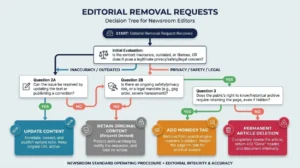
The removal of a harmful web page depends on the action taken by the website publisher, hosting provider, relevant platform or another responsible party under the applicable rules. Search engine indexing and website publication are separate systems, so changing one does not automatically change the other. A publisher can remove a page from its website while a search engine continues to display a previously indexed result until its systems process the change.
Different removal mechanisms address different problems. A website owner can delete a page or restrict access to it, while a hosting provider evaluates issues that fall within its responsibilities and policies. Search engines also operate processes for certain legal requests, privacy-related requests and policy-based removals, but eligibility depends on the circumstances and the relevant jurisdiction.
How Does Website Removal Differ from Search De-indexing?
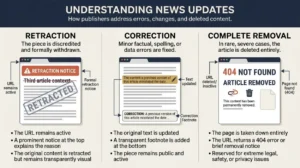
Website removal refers to making the original resource unavailable, whereas search de-indexing refers to excluding a URL from a search engine’s index or search results under the applicable mechanism. When a publisher permanently removes a page and the server returns an appropriate not-found or gone response, search engines can eventually process that status and remove the URL from their index.
De-indexing does not necessarily delete the original page from the internet. A resource can remain accessible through its direct URL, other search engines, archives or external links even when it no longer appears in a particular search engine’s results. This distinction explains why changes in search visibility do not always indicate that the underlying content has been removed.
Temporary removal tools also differ from permanent changes to the original resource. A temporary suppression mechanism does not replace the need to address the page’s underlying status when permanent removal is appropriate. Understanding these technical distinctions provides a more accurate explanation of why harmful content persists and why different interventions produce different outcomes.
How Are Online Takedown Requests Evaluated?
Online takedown requests are assessed according to the recipient’s responsibilities, applicable policies, relevant laws and evidence supporting the request. A website publisher evaluates requests in the context of its editorial responsibilities and content policies, while a hosting provider considers issues within its contractual, technical and legal remit. Search engines apply their own procedures when a request concerns search indexing or eligibility for removal from results.
The evaluation process depends on the nature of the complaint. A request involving a demonstrably false statement, personal information, copyright infringement or content prohibited by a platform’s rules raises different questions from a disagreement with an unfavourable opinion. The applicable evidence and decision criteria therefore vary according to the type of claim.
Submitting a request does not guarantee removal. The recipient evaluates whether the stated grounds satisfy its relevant requirements, and the outcome depends on the available evidence and the applicable framework. This explains why a page can remain accessible after a request has been submitted and why the decision of one recipient does not automatically determine the actions of another.
For a closer examination of these processes, How Web Hosts and Search Engines Evaluate Online Takedown Requests explains the different responsibilities involved in assessing online content complaints.
What Does the Persistence of Harmful Content Mean for Online Credibility?
The persistence of harmful content demonstrates that online credibility is shaped by the interaction of publication systems, indexing processes, ranking mechanisms and human interpretation. A page can remain available because its publisher continues to host it, remain indexed because a search engine retains it in its index and remain prominent because its content continues to match relevant queries. These conditions are related but independent, which is why the passage of time does not produce a uniform outcome. Understanding How Web Hosts and Search Engines Evaluate Online Takedown Requests also helps explain how website publishers, hosting providers and search engines assess content removal requests under their respective policies and responsibilities.
Reputation signals also require contextual interpretation. A negative review, an old news report or a disputed allegation represents a specific item of information rather than a complete assessment of the associated person or organisation. Its significance depends on the source, evidence, publication context and visibility within the wider digital footprint.
Understanding these systems separates technical availability from search visibility, and search visibility from factual accuracy. Harmful pages do not automatically disappear because online information is maintained and evaluated through distinct technical, editorial and legal processes. Their continued presence reflects the operation of those systems rather than an automatic confirmation of the content’s credibility.
Why don’t harmful web pages disappear automatically over time?
Harmful web pages remain online when their publishers continue hosting them and no removal action changes their availability. Search engines do not automatically remove content simply because it is old, outdated or damaging to someone’s reputation.
Can outdated harmful content still appear in Google search results?
Yes, outdated content can remain indexed and visible in Google search results if it continues to meet the search query’s relevance criteria. Its age alone does not guarantee lower rankings or removal from search engine results pages (SERPs).
What is the difference between removing a web page and de-indexing it?
Removing a web page makes the original content unavailable at its source, while de-indexing excludes the URL from a search engine’s index or results. De-indexing does not necessarily delete the original content from the internet.
Why do search engines continue showing harmful or misleading information?
Search engines evaluate relevance, content quality and other ranking signals rather than independently verifying every statement on every page. Consequently, harmful or disputed information can remain visible if the page continues to qualify for indexing and ranking.
How can harmful online content be considered for removal?
Content removal depends on the circumstances, available evidence, applicable laws and the policies of the website, hosting provider or search engine. A takedown request does not guarantee removal, as each recipient evaluates the request according to its responsibilities and requirements.