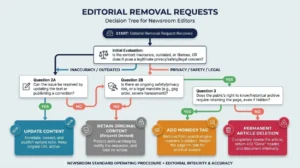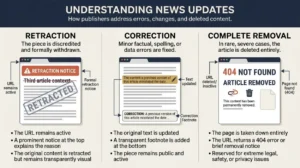
Content removal and search engine suppression address reputation problems at different levels: removal targets the original source, while suppression focuses on reducing unwanted content’s visibility within search results. The appropriate strategy depends on content ownership, removal eligibility, search visibility, evidence quality, and the structure of the surrounding SERP.
Reputation management strategies differ based on whether the objective is to change the underlying information or influence how that information is discovered. Online reputation control methods are evaluated through search visibility, reputation signals, entity credibility, content indexing, and long-term SERP composition.
What is the difference between content removal and search engine suppression?
Content removal operates by addressing information at its original publishing source, while search engine suppression operates by influencing the relative visibility of information within search results. Removal can involve deletion, amendment, restriction, or other source-level changes where an applicable basis exists. Suppression does not necessarily change the original page and instead focuses on the content users encounter when searching for an entity. The two approaches therefore operate at separate layers of the reputation ecosystem. Comparing them requires examining whether the primary problem is content existence or content visibility.
The distinction also affects measurement. Removal can be evaluated through whether the disputed material remains available at its source, while suppression is evaluated through changes in ranking position and SERP composition. A page that remains published but moves beyond prominent search positions has experienced a visibility change rather than a content change. Conversely, removing a page does not guarantee that references to the same information disappear from search results. This difference makes source-level and search-level outcomes separate metrics.
When is content removal more appropriate than search suppression?
Content removal is more appropriate when the original material has an identifiable basis for deletion, amendment, or restriction. The relevant basis can depend on platform rules, privacy considerations, intellectual property rights, defamation law, contractual terms, or other applicable requirements. Removal addresses the information itself rather than attempting to compete with it through additional content. This creates a direct intervention at the source level. The effectiveness of the approach therefore depends heavily on evidence and the rules governing the publisher or platform.
Removal also reduces the need to compete for search visibility against content that no longer exists at its source. However, source removal does not automatically eliminate independent references, copies, quotations, cached information, or related pages. Search engines process information from multiple sources, so one deleted page does not necessarily produce an identical change across the entire SERP. A removal strategy therefore requires post-removal evaluation of indexing and related search results. This separates source resolution from search ecosystem resolution.
When is search engine suppression more appropriate than removal?
Search engine suppression becomes relevant when unwanted content remains published but the strategic objective is to reduce its prominence in search results. Suppression operates through the wider content ecosystem by strengthening relevant, authoritative information that competes for visibility. It does not alter the original publisher’s page and therefore addresses discoverability rather than source ownership. The method is particularly distinct from removal because the underlying information continues to exist. Its effectiveness is evaluated through changes in SERP composition rather than deletion status.
Search suppression also depends on the availability of credible content that can compete for relevant queries. Search systems assess pages according to relevance, authority, quality, query intent, and other ranking signals. Publishing additional material does not guarantee a specific ranking position because search engines independently determine which pages appear for each query. Suppression is therefore a search visibility strategy rather than a guaranteed method for eliminating unwanted information. Its results require continuous measurement because SERPs change over time.
How do removal and suppression influence search visibility differently?
Removal influences search visibility by changing the availability of content at its source, while suppression influences visibility by changing the competitive landscape within search results. When an indexed page is removed, search engines eventually process the change and update their representation of the affected URL. When suppression is used, the original page remains available while other pages compete for prominent positions. These mechanisms therefore produce different forms of search ranking influence. One changes source availability; the other changes relative prominence.
Search visibility also varies according to query intent. A negative page can disappear from one search context while remaining visible for a more specific query. Similarly, suppression of a result for a person’s name does not automatically suppress the same page for an associated company, location, or topic. Effective evaluation therefore measures a defined group of reputation-related queries. This provides a more accurate view of whether the strategy changes the entity’s overall search perception.
Is content creation or content removal more effective for reputation management?
Content creation and content removal address different reputation mechanisms, so effectiveness depends on the underlying information problem. Content removal targets inaccurate, unlawful, policy-violating, or otherwise eligible information at its source. Content creation adds accurate, relevant, and authoritative information to the entity’s digital footprint. Creation therefore expands the information environment, while removal reduces specific unwanted information within it. Neither mechanism automatically replaces the function of the other.
Content creation becomes more relevant when legitimate information is underrepresented in search results. Authoritative websites, professional profiles, factual resources, publications, and other relevant pages can contribute to a broader entity representation. Removal becomes more relevant when a specific source contains content with a valid basis for intervention. Combining source analysis with search analysis prevents content creation from being used as a substitute for an available removal route. It also prevents removal from being treated as a complete search strategy when related information remains elsewhere.
How does an organic approach compare with a reactive reputation strategy?

An organic reputation approach builds credible information and reputation signals over time, while a reactive strategy responds to an identified reputation event. Organic activity operates through continuous development of accurate entity information, authoritative content, genuine reviews, and consistent digital references. Reactive activity begins with a specific problem such as unwanted content, a negative search result, or an inaccurate third-party page. The two approaches therefore differ in timing and operational purpose. One develops the information environment continuously, while the other addresses an existing risk.
Organic activity provides a broader and more sustainable information base because it does not depend entirely on individual reputation incidents. However, it does not directly remove an existing problematic page. Reactive removal can address a specific source more directly when an appropriate basis exists. It also requires evidence, documentation, and platform-specific processes. A comprehensive reputation framework therefore evaluates whether the problem requires long-term information development, immediate source intervention, or both.
Which approach creates greater short-term impact?
Content removal can create a more direct short-term change when the disputed source accepts a valid removal request and the affected information becomes unavailable. The immediate outcome occurs at the content source rather than through gradual changes in search competition. However, search engines require processing time before changes to an indexed page fully appear in search results. The speed of the search impact therefore differs from the speed of source-level action. Measurement must distinguish these two stages.
Search suppression generally involves a different timeline because it depends on changes in the ranking environment. New or strengthened content needs to be discovered, indexed, evaluated, and ranked before its visibility changes. Search ranking influence also varies according to query, competition, source authority, and content relevance. This makes suppression a longer-term search visibility process rather than a direct deletion mechanism. Short-term evaluation therefore favours measurable source changes, while suppression requires broader SERP monitoring.
Which strategy offers greater long-term sustainability?
Long-term sustainability depends on whether the strategy addresses the underlying reputation mechanism rather than producing a temporary change in visibility. Removal can provide a durable source-level outcome when the content is permanently deleted and no equivalent copies remain. Suppression requires continuous attention because search rankings change as new content is published, indexed, and evaluated. Organic reputation development can strengthen the information ecosystem over time by establishing credible and consistent entity signals. Sustainability therefore depends on the persistence of the underlying intervention.
A long-term framework also monitors the digital footprint after the initial action. New references can appear even after a previous reputation problem has been resolved. Search engines can also change how information is presented for the same query. This means that a previously suppressed result can become visible again as the competitive environment changes. Sustainable reputation management therefore requires monitoring rather than assuming that one intervention permanently controls search perception.
How does risk exposure differ between removal and suppression?
Removal carries evidence and eligibility risks because an unsuccessful or poorly supported request can fail to change the source. Incorrectly challenging legitimate criticism also creates reputational and compliance concerns. A responsible removal process therefore distinguishes factual disputes from content that actually qualifies for intervention. Evidence quality becomes the central risk-control mechanism. The stronger the connection between observable evidence and the applicable removal basis, the clearer the assessment becomes.
Suppression carries a different form of risk because the original information remains publicly accessible. Users can still discover the source through direct links, alternative queries, social platforms, or other search engines. A suppression strategy therefore does not resolve the underlying content itself. It changes relative search visibility while leaving the original publication intact. Risk evaluation must consequently account for both search exposure and source persistence.
Dive Deeper With Our Expert Guides:
What Methods Are Available for Removing Damaging Google Autocomplete Suggestions
What Options Exist for Removing a Forum Post That Is Damaging Your Reputation
How should the effectiveness of each strategy be measured?
Effectiveness is measured through different indicators for removal and suppression. Removal is evaluated through source availability, platform decisions, indexing changes, and the disappearance or modification of the affected content. Suppression is evaluated through keyword visibility, SERP composition, ranking distribution, and the prominence of relevant or unwanted pages. Organic content development is evaluated through indexing, visibility, authority, entity consistency, and the quality of information represented. These measurements prevent fundamentally different mechanisms from being judged using the same metric.
A structured evaluation can therefore follow four analytical stages:
- Identify the source and determine whether the issue concerns content existence, search visibility, or both.
- Evaluate evidence and platform requirements to establish whether source-level removal has a valid basis.
- Measure SERP composition across relevant queries to determine the current level of search exposure.
- Monitor changes over time to distinguish temporary ranking movement from sustained improvement in search visibility.
This framework separates evidence, intervention, measurement, and sustainability. It also reduces the risk of treating a ranking change as proof that the underlying reputation issue has disappeared.
How do search engines interpret reputation signals during these strategies?
Search engines interpret reputation-related information through their broader ranking and information retrieval systems rather than applying one universal reputation score. Relevance, authority, content quality, links, freshness, entity relationships, and query intent all contribute to how pages are presented. Reviews, media coverage, profiles, directories, and other sources can form part of the information environment surrounding an entity. Search systems therefore evaluate pages and relationships within a broader ecosystem. Reputation management operates within this ecosystem rather than outside it. Hire Our Expert Content Removal Team to Clear Your Digital Footprint by addressing unwanted content and managing the reputation signals that influence how your online presence is represented across search results.
This explains why removal and suppression produce different outcomes. Removing a source changes the available information, while suppression changes the relative visibility of existing information. Neither strategy gives direct control over search engine ranking decisions. Search visibility remains an outcome of independent evaluation by the relevant search system. Measurement must therefore focus on observable changes rather than assuming a fixed ranking response.
How does content suppression compare with content enhancement?
Content suppression focuses on reducing the prominence of unwanted information, while content enhancement focuses on improving the relevance, authority, and visibility of accurate information. Suppression describes an outcome-oriented search objective, whereas enhancement describes the development of stronger competing information. Both operate within the search ecosystem rather than directly controlling the search engine. Their effectiveness depends on the quality and relevance of the content involved. The distinction is important because enhancing content does not automatically remove unwanted material.
Content enhancement can strengthenentity credibility when it provides accurate information from authoritative and relevant sources. Professional profiles, official pages, trusted publications, and well-supported resources can create additional context around an entity. Suppression evaluates whether these and other pages achieve greater search visibility than the unwanted result. The two concepts therefore overlap operationally while remaining distinct analytically. Measuring both provides a clearer picture of changes in search perception.
What strategy provides the most appropriate balance of effectiveness and risk?
The appropriate strategy is determined by the nature of the content problem, the available evidence, the source’s policies, and the desired search outcome. Removal provides a source-level mechanism when content qualifies for intervention. Suppression provides a search-level mechanism when the objective is to reduce visibility while the original content remains accessible. Organic content development strengthens the wider information environment and supports long-term entity credibility. These approaches address different layers rather than functioning as interchangeable solutions.
A balanced evaluation considers effectiveness, scalability, risk exposure, and sustainability together. A removal strategy can be highly specific but dependent on source-level eligibility. A suppression strategy can address broader SERP composition but requires continuing monitoring and content competition. Organic development can strengthen the digital footprint but does not directly resolve an eligible source-level problem. Selecting an approach therefore requires analysing the mechanism before judging the expected outcome.
Content removal and search engine suppression represent distinct reputation management strategies. Removal changes the underlying information at its source, while suppression changes how prominently that information appears within search results. Content creation and enhancement operate alongside these mechanisms by strengthening the wider information environment and supporting entity credibility.
The key decision factors are content ownership, removal eligibility, evidence quality, search visibility, risk exposure, scalability, and sustainability. Short-term source-level changes and long-term SERP changes also require separate measurement. Evaluating these variables provides a structured way to determine which reputation management mechanism aligns with the specific information problem.
What is the difference between content removal and search engine suppression?
Content removal addresses unwanted information at its original source, while search engine suppression focuses on reducing its visibility within search results. Removal changes the underlying content environment, whereas suppression changes its relative prominence in the SERP.
When is content removal the right strategy?
Content removal is relevant when unwanted material has a valid basis for deletion, amendment, or restriction under applicable platform rules or legal requirements. Evidence quality and the publisher’s policies determine whether source-level removal is available.
How does search engine suppression work?
Search engine suppression works by strengthening relevant and authoritative content so unwanted pages become less prominent in search results. It focuses on search visibility rather than deleting the original content from its source.
Is content removal more effective than search suppression?
Effectiveness depends on the nature of the reputation issue, available evidence, source policies, and the desired outcome. Removal addresses the original content, while suppression addresses its visibility within the search ecosystem.
Can content removal improve online reputation?
Content removal can improve online reputation when eligible unwanted content is removed from its original source and related search visibility subsequently changes. Long-term reputation also depends on credible information, consistent reputation signals, and ongoing search monitoring.