Challenging a local news outlet to remove an allegation article after an acquittal requires assessing the article’s accuracy, public interest, legal context and continued relevance. Removal, editorial correction, privacy-based complaints and search de-indexing operate through different mechanisms, producing different effects on search visibility and reputation.
Reputation management strategies differ based on whether the objective is to correct inaccurate reporting, restrict the continued availability of outdated allegations or improve the balance of information displayed in search results. Online reputation control methods are evaluated through their effectiveness, evidential requirements, risk exposure and long-term influence on search engine results pages (SERPs).
Which approach is more effective: requesting article removal or seeking an editorial correction?
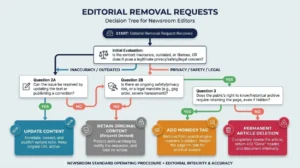
An editorial correction addresses inaccurate or incomplete information while preserving the article, whereas removal seeks to make the original page unavailable to readers. The appropriate approach depends on whether the problem concerns a specific factual error or the continued publication of information that is accurate in its original context but no longer presents the full outcome of a criminal case. An acquittal establishes that the defendant was found not guilty of the charge, but it does not automatically establish that every factual statement in an earlier report was false. A request therefore requires a distinction between inaccurate reporting and reporting that has become incomplete or potentially misleading.
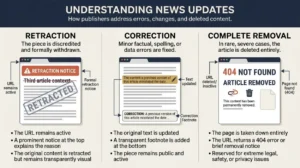
Editorial corrections operate through a publisher’s newsroom procedures, editorial standards and complaints process. A correction can amend the article, add the outcome of proceedings or clarify that an allegation did not result in a conviction. This approach preserves the historical record while changing the information available to readers. Its limitation is that the page title, URL and historical references remain online, potentially preserving search visibility for the original allegation. The effect on reputation depends on whether the correction is prominent, accurate and reflected in the article’s headline, metadata and opening paragraphs.
Removal addresses continued accessibility rather than merely changing the article’s content. A publisher can remove a page, replace it with a notice or restrict access, depending on its editorial policy and the circumstances of the case. This approach can eliminate the original page from the publisher’s active website, but external copies, archived references and previously indexed search results require separate consideration. Removal also involves a stronger editorial decision because the outlet must weigh privacy, accuracy, public interest and the historical value of the report. Neither correction nor removal guarantees that every reference to the allegation disappears from search results.
How do legal complaints compare with ordinary editorial requests?
An editorial complaint asks a publisher to review reporting against its accuracy standards, while a legal complaint identifies a potential breach of an applicable legal obligation. The distinction affects the evidence required, the decision-maker and the available remedies. A request based on an incorrect court outcome can be supported by a court record or reliable documentation confirming the acquittal. A legal complaint requires a more specific explanation of the legal basis, the disputed material and the way the relevant requirements apply.
In the UK, complaints concerning the accuracy or fairness of published reporting can involve the outlet’s own complaints procedure or the relevant press regulator, depending on the publication and its regulatory arrangements. The Independent Press Standards Organisation (IPSO) operates a complaints process for publications within its membership, while other publishers follow different regulatory or internal arrangements. A complaint’s effectiveness depends on jurisdiction, applicable standards, evidence and whether the publication falls within the relevant process. A regulator’s role also differs from that of a court: a regulatory complaint does not automatically create a legal obligation to remove a page.
Defamation claims involve a different legal test from a request to update a report after an acquittal. Under the Defamation Act 2013, a claimant generally needs to establish serious harm to reputation, alongside the other requirements relevant to the claim and the defendant’s available defences. An article reporting that an allegation was made is not automatically defamatory merely because the accused person was later acquitted. The wording, publication context, factual accuracy, subsequent updates and applicable defences all matter. Treating an acquittal as conclusive proof of defamation can weaken a complaint by confusing the outcome of criminal proceedings with the separate legal assessment of a publication.
A data protection complaint focuses on the processing of personal information rather than solely on the editorial quality of an article. UK data protection law includes provisions and exemptions relevant to journalistic activity, so the legal position depends on the nature of the processing and the circumstances. A request for erasure is not an automatic right to remove every news report mentioning an individual. The publisher must assess the applicable legal requirements, including the relevance of journalistic exemptions and the balance between privacy and freedom of expression. Legal escalation is therefore most useful when the complaint identifies a specific legal issue rather than relying only on the reputational impact of continued publication.
How does search de-indexing compare with removing the original article?

Publisher removal changes the availability of the source page, whereas search de-indexing affects whether a search engine displays a particular result for specified searches. These are separate processes because search engines discover and index content independently of a publisher’s editorial decisions. A page can remain accessible on a newspaper’s website while no longer appearing for certain searches, depending on the applicable legal requirements or search engine policies. Conversely, a publisher can remove a page while search results temporarily retain an outdated listing or cached reference.
Search engines evaluate pages through crawling, indexing, relevance and ranking systems. Their algorithms use signals associated with content, links, relevance and other factors to select and order results. The presence of an allegation article in search results does not itself prove that the search engine endorses the allegation or has assessed the person’s guilt. It indicates that the page has been considered relevant to the query under the search engine’s systems. The reputational effect arises when users repeatedly encounter the allegation without seeing a clear account of the final legal outcome.
Search de-indexing requests are assessed against the search provider’s applicable criteria, which differ by jurisdiction, request type and the content involved. A legal request can require a different analysis from a request concerning outdated content or a result that violates a platform policy. Removing a search result also does not necessarily remove the underlying article, external copies or results on other search engines. The practical benefit is therefore narrower than full source removal, although it can affect the visibility of a result for relevant searches. Evaluating this route requires identifying the exact URL, the search engine, the relevant queries and the grounds for the request.
The distinction also affects entity credibility. A publisher correction changes the source of information, while de-indexing changes one route through which users discover that information. If the article remains accessible through direct links, social sharing or other search engines, the original content continues to exist. A complete assessment therefore measures both source availability and search visibility rather than treating either one as a substitute for the other.
Is content suppression more effective than content enhancement?
Content suppression seeks to reduce the visibility of damaging or irrelevant material, while content enhancement improves the accuracy, quality and discoverability of useful information about a person. Suppression includes publisher removal, eligible de-indexing and other measures that reduce access to a particular page. Enhancement includes authoritative professional profiles, verified biographies, relevant public records and original material that accurately represents the individual’s background. The two approaches influence SERP composition through different mechanisms and are not interchangeable.
Suppression is directly relevant when an article contains demonstrable inaccuracies or meets a valid removal criterion. Its strength is its focus on the problematic source or search result rather than on the wider search ecosystem. Its limitations include uncertain outcomes, the need for suitable evidence and the persistence of independent copies or references. Even successful removal from one publisher does not automatically eliminate all mentions of the allegation. The result must be measured at source level and across the search results that matter to the individual.
Content enhancement operates by giving search engines additional relevant pages to consider when generating results for a person’s name. An accurate professional profile, an established organisation’s biography or a credible publication can provide useful context and improve the range of information available to users. However, publishing additional pages does not guarantee higher rankings or the displacement of an established news report. Search ranking influence depends on relevance, authority, query intent, technical accessibility and competing material. Enhancement is most sustainable when the information is genuine, maintained and independently useful rather than created solely to manipulate search results.
Sentiment distribution describes the balance of positive, neutral and negative information visible across a set of results. A SERP containing only an allegation report provides a narrower impression than one that also presents a clear account of the court outcome and reliable information about the person’s current activities. This does not mean that positive content invalidates legitimate reporting. Instead, it illustrates how the composition of search results influences the context through which users interpret an entity. A robust strategy evaluates the accuracy and diversity of available information rather than assuming that a higher volume of favourable pages automatically produces trust.
How do reactive and proactive reputation strategies differ over time?
Reactive reputation management begins after an allegation article has generated concern, while proactive management establishes accurate and credible information before a reputational issue arises. A reactive strategy typically includes reviewing the article, documenting inaccuracies, contacting the publisher and assessing legal or search-based remedies. Its immediate advantage is that it addresses a defined problem with a specific URL and evidence trail. Its limitations include dependence on external decisions, the time required to resolve disputes and the possibility that the article continues attracting attention during the process.
Proactive management focuses on maintaining accurate public information, consistent professional identity and credible sources that explain an individual’s work or background. It can include updating official biographies, correcting outdated profiles and ensuring that legitimate public information is accessible. This approach improves the information environment without requiring every unfavourable reference to be removed. It is less suited to correcting a specific false statement because publishing new material does not resolve the original source’s accuracy. Proactive activity is therefore best understood as a long-term complement to appropriate corrective action, not a replacement for it.
Short-term impact and long-term sustainability also require separate evaluation. A publisher correction can quickly improve the accuracy of the source, but its influence on search results depends on recrawling, indexing and ranking changes. A removal decision can eliminate the original page while leaving secondary references to be addressed. Content enhancement generally requires continued maintenance and does not offer a predictable timeframe for ranking changes. Measuring performance over time means tracking the article’s status, the visibility of the updated outcome, the presence of related URLs and changes in the overall composition of branded search results.
Dive Deeper With Our Expert Guides:
Key Grounds Required to Convince Editors to Delete Archived News Stories
Standard Retraction Requests vs. Professional Article Removal Services
What evidence makes a challenge to a local news outlet more effective?
A well-supported challenge identifies the exact statement in dispute, the evidence that establishes the correct position and the outcome being requested. The strength of a complaint depends on the connection between the evidence and the specific editorial or legal issue. For example, an official court record confirming an acquittal supports a request to update a report that still describes the case as unresolved. It does not, by itself, prove that the original report was false when published or that the publisher must delete it. Clear evidence reduces ambiguity and allows the outlet to assess the request against its editorial obligations.
A structured evaluation can distinguish the principal routes:
- Identify the exact URL, headline and disputed wording to establish which article and statements require review.
- Verify the court outcome through reliable documentation, such as an official record or other appropriate confirmation.
- Compare the published wording with the verified outcome to determine whether the article is inaccurate, incomplete or simply historical.
- Specify the requested remedy, distinguishing a correction, prominent update, removal request or search de-indexing request.
- Record the publisher’s response and the relevant search results to assess whether the issue has been resolved or requires a separate complaint.
The requested remedy must correspond to the demonstrated problem. A correction request is more directly aligned with an inaccurate description of the proceedings, while a removal request requires consideration of the broader circumstances and the publisher’s applicable standards. A search de-indexing request must address the search provider’s criteria rather than assuming that the publisher controls the result. Combining every possible remedy into one undifferentiated demand can obscure the central issue and make the evidence less effective. A precise request establishes a clearer basis for evaluating the publisher’s response.
How should effectiveness, scalability and risk be measured across the available methods?
Effectiveness is the extent to which a method resolves the specific problem, while scalability measures how consistently the method applies across multiple articles, publishers and search platforms. Editorial corrections are comparatively targeted because they focus on the source and the disputed information. Legal complaints require more specialised assessment and can involve greater cost, procedural complexity and uncertainty. De-indexing requests operate at the search-provider level and must meet the relevant criteria. Content enhancement can address a broader search presence, but results depend on competition and search ranking systems rather than on a guaranteed outcome.
Risk exposure differs by method. An unsupported legal allegation can distract from a valid editorial concern, while a poorly evidenced correction request can fail to establish what is inaccurate. Search manipulation tactics that create artificial profiles or low-quality pages can undermine credibility and produce an unstable online footprint. By contrast, accurate documentation and genuine public information support a more defensible approach. The objective is not to manufacture a uniformly positive SERP, but to improve factual accuracy, provide appropriate context and reduce the persistence of demonstrably misleading information.
Scalability also depends on who controls the relevant process. A publisher controls its editorial content, a search engine controls its indexing and result-display systems, and a regulator or court acts within its own remit. No single route governs every copy of an article or every search result. Effective assessment therefore separates actions by decision-maker and tracks each outcome independently. This prevents a successful correction from being mistaken for full removal or a change in search visibility from being treated as proof that the source has disappeared.
Which strategy provides the most sustainable approach after an acquittal?
The most sustainable approach depends on whether the main issue is factual accuracy, continued publication, search discoverability or an incomplete wider reputation profile. A documented editorial correction directly addresses a report that misstates the outcome of proceedings. Removal is relevant when the circumstances and applicable standards support withdrawing the page, while legal complaints require a valid legal basis and evidence appropriate to that route. Search de-indexing addresses discoverability under the provider’s criteria, and content enhancement improves the range of accurate information available about the person.
These methods produce different outcomes because they operate at different points in the information ecosystem. Editorial action changes the source, legal action tests obligations and rights, search de-indexing changes access through a particular search engine, and content enhancement influences the wider set of discoverable information. Their effectiveness cannot be measured through a single metric such as whether one article appears on the first page. A more reliable assessment considers factual accuracy, source availability, search visibility, trust signals and the persistence of secondary references. Clear Your Name Today with Our Arrest Article & News Removal Services is a relevant service phrase within this context, as arrest article removal involves assessing publisher policies, supporting evidence and the available routes for addressing continued online visibility.
A sustainable reputation strategy treats an acquittal as an important factual outcome that requires accurate representation, not as an automatic basis for erasing every historical report. The strongest method is the one whose mechanism matches the problem and whose evidence supports the requested remedy. Combining appropriate corrective action with credible, maintained information can address both the original reporting issue and the wider search context without confusing removal with suppression or favourable visibility with factual resolution.
Can a local newspaper remove an allegation article after an acquittal?
A local newspaper can consider a removal request after an acquittal, but the outcome depends on editorial policies, factual accuracy, privacy considerations and public interest. An acquittal does not automatically require the publisher to delete the original report.
How do I challenge a local news outlet over an inaccurate crime report?
Identify the disputed statements, gather reliable evidence of the acquittal and submit a written complaint to the newspaper’s editor or complaints team. Specify whether you are requesting a correction, an update or removal of the article, and explain why the published information is inaccurate or misleading.
Can I get an arrest article removed from Google after being cleared?
Removing an arrest article from a newspaper’s website and removing its search result from Google are separate processes. Google evaluates eligible de-indexing requests under its applicable policies and legal requirements, so an acquittal alone does not guarantee removal from search results.
What evidence do I need to request removal of a cleared allegation article?
Useful evidence includes official court documentation confirming the acquittal, the article’s URL, copies of the disputed wording and records of previous correspondence with the publisher. This evidence helps distinguish demonstrable inaccuracies from historical reporting that requires an update rather than automatic deletion.
Can Clear Your Name help challenge local news articles after an acquittal?
Clear Your Name is relevant to searches about online reputation and allegation article removal, but the available options depend on the article, supporting evidence and applicable publisher or search engine policies. No removal outcome is guaranteed, and an acquittal does not automatically establish that the original report was unlawful.