Content removal services for intellectual property protection address online material that uses, reproduces, distributes, or presents protected intellectual property without appropriate authorisation.
Reputation management is the process of analysing how online information affects an entity’s credibility, search visibility, and public perception across digital ecosystems.
What are content removal services for intellectual property protection?
Content removal services are processes for identifying and addressing online material that potentially infringes intellectual property rights. Intellectual property refers to legally protected creations, including written works, images, videos, software, trademarks, and other original assets. When unauthorised material appears online, it becomes part of the rights holder’s digital footprint and can affect both control and perception. Content removal therefore operates at the source level by addressing the publication or distribution of the disputed material. The process differs according to the type of intellectual property involved and the platform hosting the content.
The relationship with reputation management arises because unauthorised content can become a visible reputation signal. Search engines index publicly accessible pages and evaluate them for relevance to user queries. A copied article, unauthorised image, or misleading use of protected branding can therefore appear within search results associated with an entity. Removing the source material changes the underlying information environment, although search engines independently determine how quickly their indexes reflect that change. Content removal is consequently both an intellectual property issue and a digital information-management process.
How does intellectual property protection work within online search ecosystems?
Intellectual property protection works by establishing rights over qualifying creative or commercial assets and providing mechanisms for addressing unauthorised use. Within online ecosystems, protection involves identifying the original work, locating unauthorised copies, documenting the relevant material, and determining the appropriate legal or platform mechanism. The objective is to establish a clear relationship between the protected work and the disputed publication. This creates an evidence-based foundation for evaluating the content. The mechanism used depends on the nature of the rights involved and the jurisdiction governing the dispute.
Search visibility adds another layer to the process because unauthorised content can be indexed independently of the original source. When duplicated or infringing material appears in search results, users can encounter it without visiting the original rights holder’s website. This creates an information pathway in which content ownership and search visibility intersect. Removing the source publication addresses availability, while search engines separately evaluate whether associated URLs remain indexed. Effective analysis therefore distinguishes legal rights, platform publication, and search retrieval.
Why does unauthorised content affect an entity’s digital footprint?
Unauthorised content affects an entity’s digital footprint because it introduces information that users and search systems associate with the rights holder or its intellectual property. A digital footprint is the collection of information connected with an entity across online sources. When copied or misused content becomes publicly accessible, it adds another document, image, page, or reference to that ecosystem. The additional content can create confusion about ownership, authenticity, or source authority. This makes content control relevant to both intellectual property protection and online credibility.
The effect depends on the content’s relevance, visibility, and relationship to the entity. A highly indexed page containing copied material can attract users searching for the original work or brand-related information. Search engines then evaluate the page according to their own ranking systems rather than determining ownership through a universal reputation assessment. This means search visibility does not establish legal ownership or infringement. Instead, it demonstrates how unauthorised material can become part of the information environment surrounding an entity.
How do search engines interpret copied or unauthorised content?
Search engines interpret copied content through automated crawling, indexing, retrieval, and ranking systems that evaluate relevance and other signals. These systems do not function as courts and do not independently determine every intellectual property dispute. Their primary function is to organise information for search queries. Consequently, the presence of copied material in a SERP does not itself establish whether infringement has occurred. Intellectual property assessment requires separate evidence concerning ownership, authorisation, and the nature of the use.
Content duplication can nevertheless influence search visibility because multiple pages can contain substantially similar information. Search systems determine which pages appear most relevant for particular queries using their ranking mechanisms. This can affect which source users encounter first. If unauthorised content competes with an original publication, the resulting search environment can complicate source recognition. Content removal therefore addresses the underlying publication while search systems separately process changes to the available information.
What types of intellectual property can require online content removal?

Online content removal can involve different categories of intellectual property, with each category carrying distinct rights and evidential considerations. Copyright generally protects original creative expression, while trademarks protect identifiers associated with goods or services. Other intellectual property rights can apply to designs, software, databases, inventions, and proprietary commercial assets depending on the relevant legal framework. The type of right determines what evidence is relevant. It also affects which removal mechanism provides an appropriate route.
Copyright-related disputes often centre on unauthorised reproduction, distribution, display, or adaptation of protected work. Trademark-related issues can involve unauthorised use of a protected sign in ways that create confusion or otherwise infringe applicable rights. These categories require separate analysis rather than treating every unauthorised publication as the same type of infringement. Correct classification strengthens the evidential basis for content intervention. It also reduces the risk of making an inaccurate claim about the legal status of material.
How does content indexing influence intellectual property risk?
Content indexing influences intellectual property risk by making publicly accessible material easier to discover through search queries. Indexing is the process through which search engines store and organise information from web pages for retrieval. An unauthorised publication that becomes indexed gains an additional route to users beyond its original hosting location. This can increase exposure of copied material, misleading branding, or unauthorised creative works. The significance of indexing therefore relates directly to search visibility.
Indexing also creates an important distinction between removing content from a website and removing its appearance from search results. Source-level removal addresses the publication itself. Search-engine processes determine whether previously indexed information continues to appear after the source changes. Cached or independently replicated information can also create additional visibility pathways. Intellectual property protection therefore requires analysis of both publication status and search representation.
How do trust signals affect the perception of intellectual property content?
Trust signals affect perception by helping users evaluate whether online information appears authoritative, authentic, and consistent with recognised sources. Trust signals refer to indicators associated with source reliability, information consistency, authority, and contextual relevance. Unauthorised content can introduce conflicting information about the origin or ownership of a work. When users encounter competing sources, entity perception can become less consistent. This makes source accuracy relevant to online credibility.
Authority is also distinct from ownership. A highly visible website can have strong search authority without owning the content it publishes. Similarly, an original rights holder can possess legal ownership without every copy of its work receiving weaker search visibility. These distinctions demonstrate why intellectual property protection and search optimisation operate through different mechanisms. Content removal addresses rights and source control, while search systems evaluate authority and relevance independently.
Dive Deeper With Our Expert Guides:
How to Report and Remove Illegal Online Content
Copyright Protection and Content Removal Experts
How does copyright removal differ from trademark content removal?
Copyright removal focuses primarily on unauthorised use of protected creative expression, while trademark-related removal focuses on unauthorised use of protected identifiers within the relevant legal context. The evidence required therefore differs according to the right being asserted. Copyright analysis can involve proof of authorship, ownership, originality, and unauthorised reproduction. Trademark analysis can involve ownership, registration, use, and the circumstances surrounding the disputed sign. These differences affect how an online content dispute is classified.
The search implications also differ because users interact with copyrighted works and trademarks in different ways. A copied article can compete with an original publication in informational searches. An unauthorised trademark use can appear within commercial, navigational, or brand-related queries. Both forms of content can affect search perception, but their reputation signals operate through different contexts. Correct classification therefore improves the accuracy of both content assessment and search analysis.
When does intellectual property content become a reputation issue?
Intellectual property content becomes a reputation issue when its online presence influences how users interpret an entity, its ownership, its products, or its credibility. A disputed publication can create confusion about who created a work, who controls it, or whether a particular source is authorised. This confusion becomes part of the broader entity perception surrounding the rights holder. Reputation management therefore considers not only the legal status of content but also its visibility and informational context. The central question becomes how the disputed material contributes to the digital footprint.
Search visibility determines the practical significance of that reputation signal. A low-visibility page has a different perception impact from a highly ranked page appearing for a core entity-related query. Search engines evaluate relevance and authority independently of the underlying ownership dispute. Users, however, can interpret prominent information as meaningful evidence about an entity. This creates a distinction between algorithmic ranking and human perception.
What evidence supports an intellectual property content removal request?
Strong evidence establishes ownership, identifies the disputed content, and demonstrates the relationship between the protected work and the unauthorised publication. Evidence can include original files, publication dates, registration information where applicable, source URLs, screenshots, and records showing ownership or authorisation. The evidence needs to correspond directly with the specific content being challenged. Clear documentation reduces ambiguity during assessment. It also creates a structured basis for determining which removal mechanism applies.
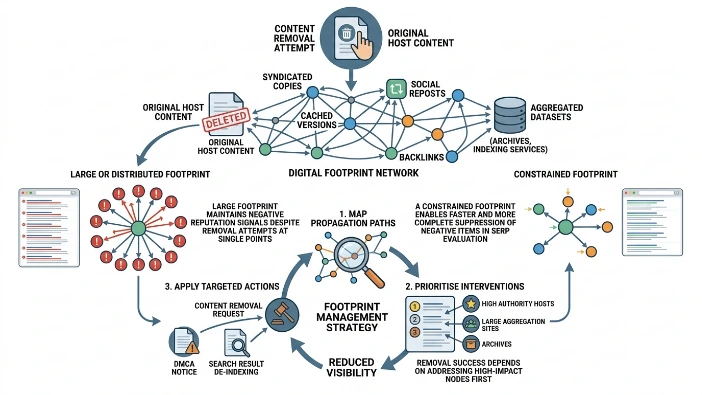
Evidence concerning the disputed page is equally important. The exact URL, publication date, screenshots, copied sections, images, or branding elements help establish what material is being addressed. Where content appears across multiple URLs, each source requires separate identification. This creates a more complete content map of the digital footprint. A precise evidence record also assists in measuring whether the disputed material remains publicly accessible after intervention.
How do content removal and content suppression differ?
Content removal eliminates or restricts the availability of the disputed material at its source, while content suppression focuses on reducing its prominence within search results. Removal therefore operates primarily at the publication level. Suppression operates within the search ecosystem by influencing the relative visibility of alternative, relevant information. These approaches address different problems and require different measurements. Neither mechanism should be treated as a substitute for the other in every intellectual property situation.
Content removal has the clearest direct relationship with unauthorised material because it targets the publication itself. Content suppression becomes relevant when the source remains accessible but creates unwanted search visibility. A rights holder can therefore evaluate source-level intervention alongside the broader SERP composition. This distinction is particularly important when copied material appears across multiple websites. A single removal action does not automatically eliminate every duplicate source.
How can intellectual property content influence SERP composition?
Intellectual property content influences SERP composition when pages containing protected or disputed material become relevant to search queries. SERP composition refers to the types and sources of pages displayed for a particular query. Search engines select results according to their retrieval and ranking mechanisms. A copied article, unauthorised image page, or misleading trademark use can therefore become part of the result set if it meets relevant search criteria. The result is an information environment that contains both authorised and unauthorised sources.
Changes to that environment occur when pages are removed, become inaccessible, lose indexing, or are replaced by other relevant sources. Search engines independently process these changes. This means content removal can influence the available information without guaranteeing a particular replacement ranking. Reputation analysis therefore measures both source availability and resulting search visibility. The broader objective is to maintain an accurate and credible information environment.
How does digital footprint optimisation support intellectual property protection?
Digital footprint optimisation supports intellectual property protection by strengthening the visibility and consistency of authoritative information associated with the rights holder. Accurate websites, original publications, official documentation, and consistent entity information provide stronger contextual signals around ownership and source authority. These assets do not replace legal rights or removal mechanisms. Instead, they create a clearer information environment for users and search systems. This helps distinguish authorised information from unrelated or unauthorised publications.
The approach also provides resilience when disputed content remains accessible. Strong authoritative sources can provide users with clearer information about the original work, ownership, and legitimate source. Search engines independently determine which pages receive visibility, but a well-structured digital footprint supplies relevant information for retrieval. Content enhancement therefore complements source-level removal without claiming control over ranking algorithms. This creates a broader strategy for managing search perception.
What should organisations assess before pursuing content removal?
Organisations should assess ownership, content type, authorisation status, evidence quality, publication location, search visibility, and the appropriate intervention mechanism. Correct classification prevents copyright issues from being confused with trademark issues or general reputation disputes. Evidence establishes whether the organisation has a defensible basis for challenging the content. The publication location determines which reporting or legal mechanism is relevant. Search visibility determines the practical significance of the disputed material.
A structured assessment can focus on four stages:
- Identify the protected work and document the exact online material associated with it.
- Verify ownership, authorisation, publication details, and evidence supporting the intellectual property claim.
- Evaluate the appropriate removal mechanism according to the content type, platform, jurisdiction, and applicable rights.
- Monitor indexing and SERP visibility after intervention to assess changes in the wider digital footprint.
This framework separates legal evidence from search-performance analysis. It also creates clearer measurements for evaluating the effect of content intervention.
How do legal, copyright and content takedown mechanisms fit together?
Legal, copyright and content takedown mechanisms represent related but distinct approaches to controlling disputed online material. Copyright mechanisms focus on protected creative works, while broader legal mechanisms can address other rights or unlawful content depending on the jurisdiction. Platform takedown procedures provide another route where the host has rules addressing particular categories of content. Each mechanism operates according to its own requirements. The correct route therefore depends on the nature of the material and the right being asserted.
The search environment remains separate from these mechanisms. A successful source-level takedown changes the availability of content, while search engines determine how their indexes respond. This separation is important for measuring outcomes accurately. A content takedown is a publication-level outcome, not an automatic ranking instruction. Understanding this distinction supports more precise analysis of search visibility and reputation signals.
What is the role of authority in intellectual property protection?
Authority helps establish which sources users and search systems recognise as relevant information about an entity or intellectual property asset. Authoritative sources include original publications, official documentation, recognised organisational pages, and other reliable information sources. Authority does not itself establish legal ownership. Instead, it contributes to the informational context through which users evaluate competing content.
Strong authority signals can also reduce ambiguity within an entity’s digital footprint. When accurate ownership information is consistently available, users have clearer reference points for identifying the legitimate source. Search engines independently evaluate these pages based on relevance and ranking signals. This means authority contributes to search perception without replacing legal enforcement. Intellectual property protection therefore benefits from both rights-based intervention and credible source representation.
Why is content removal important for long-term online credibility?
Content removal can support long-term online credibility when unauthorised material creates persistent confusion about ownership, authenticity, or source authority. Removing the disputed publication addresses one source of inaccurate or unauthorised information within the digital footprint. The effect becomes more durable when authoritative information remains available to users and search systems. This creates a clearer distinction between legitimate sources and unauthorised copies. Long-term credibility therefore depends on both source control and information consistency.
Sustainable protection also requires monitoring because online content can be reproduced or republished. A removed page does not guarantee that another copy will not appear elsewhere. Search results also change as new pages are indexed and ranking relationships shift. Continued monitoring identifies new reputation signals and potential intellectual property conflicts. This turns content protection from a single intervention into an ongoing information-management process.
What should users understand about intellectual property and reputation management?
Intellectual property protection and reputation management are connected but distinct disciplines. Intellectual property protection establishes and enforces rights over qualifying creative or commercial assets. Reputation management analyses how online information influences credibility, search visibility, and entity perception. Content removal can therefore serve both a rights-protection purpose and a reputation-management function when disputed material affects public perception. The two objectives require separate analysis even when they concern the same publication.
The central principle is accuracy of information. A rights holder needs evidence establishing the relevant intellectual property claim, while search analysis needs evidence establishing how the content affects visibility and perception. Treating search ranking as proof of ownership creates an analytical error. Treating every negative or unauthorised reference as removable creates another. A reliable information ecosystem depends on distinguishing legal rights, platform rules, search mechanisms, and reputation signals.
Content removal services for intellectual property protection operate at the intersection of rights management, digital footprint control, and search perception. The process identifies unauthorised material, establishes ownership and supporting evidence, evaluates the appropriate removal mechanism, and monitors the resulting information environment. Search engines independently crawl, index, and rank content, so source-level removal and SERP visibility remain separate outcomes. Understanding these mechanisms provides a clearer framework for evaluating online intellectual property risks.
Copyright, trademark, platform takedown, and broader legal mechanisms each address different categories of online content. Their effectiveness depends on correct classification, evidence quality, applicable rules, and the characteristics of the disputed publication. At the same time, authoritative information and consistent digital assets strengthen the surrounding information ecosystem. This supports clearer entity perception and reduces dependence on individual online sources.
A complete approach therefore considers both immediate content control and long-term digital credibility. Legal, Copyright & Content Takedown mechanisms address the source-level problem, while content indexing, search visibility, authority, and reputation signals determine how information continues to function within the wider search ecosystem.
What are content removal services for intellectual property protection?
Content removal services address online material that uses, reproduces, or distributes protected intellectual property without appropriate authorisation. The process typically involves identifying the disputed content, documenting ownership, and selecting an appropriate legal or platform-based takedown mechanism.
Can copyrighted content be removed from search results?
Copyrighted content can be challenged through applicable copyright or platform procedures when the required legal criteria are met. Removing the original content and removing or changing its appearance in search results are separate processes.
What evidence is needed for an intellectual property content removal request?
Useful evidence includes proof of ownership, original files or publication records, the disputed URL, screenshots, and details showing how the protected material was used. Clear evidence helps establish the connection between the rights holder and the disputed content.
How does intellectual property infringement affect online reputation?
Unauthorised content can affect online reputation when it creates confusion about ownership, authenticity, or the legitimate source of information. If the material becomes indexed and highly visible, it can also influence search perception and an entity’s digital footprint.
What is the difference between content removal and content suppression?
Content removal addresses the availability of disputed material at its source, while content suppression focuses on reducing its prominence within search results. These approaches use different mechanisms and produce different outcomes for search visibility and reputation management.