A public statement can trigger a social media backlash when its wording, context or perceived meaning generates negative reactions that spread across interconnected platforms. Reputation management is the process of understanding and influencing how information affects an individual or organisation’s credibility, visibility and perceived trustworthiness across digital environments.
What causes a public statement to trigger a social media backlash?
A public statement triggers a social media backlash when audiences interpret its content as conflicting with established expectations, values or reputation signals. A statement is not evaluated only through its literal wording because users also interpret its context, timing, source and relationship to previous information. Social platforms amplify this interpretation through comments, reposts, reactions and discussions that attach additional meaning to the original content. Each interaction creates further publicly available information connected to the same entity. This process expands the digital footprint surrounding the statement and increases the volume of reputation signals available for interpretation.
The initial statement therefore becomes one component of a larger information environment. Users frequently encounter reactions before accessing the original content, meaning secondary commentary can influence entity perception independently of the source material. Search engines also index some of these discussions, creating pathways between the original statement and associated commentary. Reputation formation consequently depends on the relationship between primary content, secondary discussion and subsequent search visibility.
How does social media amplify negative reactions to a statement?
Social media amplifies negative reactions by converting individual responses into interconnected content signals. A public response can generate comments, reposts, quote posts, videos, screenshots and articles, each creating a separate piece of indexed or indexable information. These formats allow the original statement to persist beyond its initial publication period. Repeated references also strengthen the association between the statement and the entity involved. The resulting digital footprint contains both the original information and interpretations produced by other users.
Amplification does not require every user to hold the same interpretation. Search and social systems process engagement as a collection of signals rather than as a single unified opinion. Content receiving sustained interaction gains greater visibility within the platform where it appears, while externally published commentary creates additional opportunities for search discovery. The reputation effect therefore develops through information propagation rather than through the original statement alone.
How do search engines interpret information about a controversial statement?
Search engines interpret information about a controversial statement through content relevance, authority, contextual relationships and other ranking signals. Search systems analyse textual relationships between entities, topics, sources and documents to determine which information satisfies a search query. When a statement becomes associated with repeated discussions, related pages can become relevant for searches involving the individual, organisation or subject referenced. This creates a relationship between reputation signals and search visibility.
Content indexing is important because indexed pages form part of the information available for SERP evaluation. A statement published on a social platform, for example, can generate external articles or discussions that become independently searchable. Search engines then evaluate those documents according to their own ranking systems rather than treating all references as equivalent. Authoritative reporting, established websites and highly relevant documents can therefore occupy different positions from low-authority commentary.
The resulting search environment reflects the available indexed information rather than a simple measurement of whether a statement is viewed positively or negatively. Entity perception develops through the combined presentation of sources, topics and associations appearing in search results. Reputation management therefore includes understanding how information becomes connected and visible within search ecosystems.
Why does the digital footprint expand after a public controversy?
A digital footprint expands because each published response can create additional content connected to the same event or entity. A screenshot of the original statement can appear in a new post, while commentary can develop into articles, videos or discussion threads. These derivative materials preserve references to the original information even when the initial post receives less attention. The controversy consequently develops a broader content network than the source statement itself.
Digital footprint is the cumulative body of information associated with an individual, organisation or identifiable entity across online environments. Within reputation systems, this footprint includes owned content, third-party publications, social discussions, reviews and other publicly accessible references. The significance of each item depends on factors such as relevance, authority, indexing and prominence. A high volume of derivative content therefore does not automatically produce equivalent search visibility for every reference.
The structure of the footprint also influences how users understand an entity. If different pages repeatedly connect the same entity with the same controversy, those associations become more prominent within the information environment. Search engines can recognise these topical relationships even when individual documents use different wording. Entity perception is therefore influenced by the structure and consistency of the surrounding digital footprint.
How do reviews and sentiment affect reputation after a backlash?
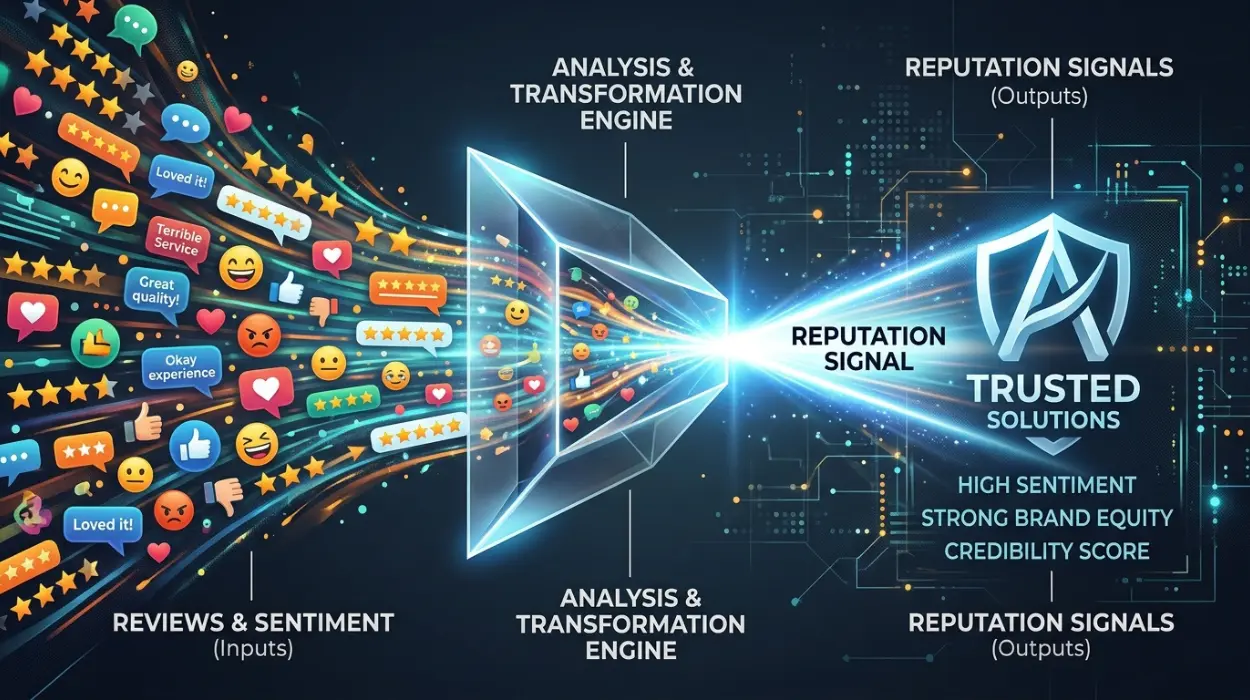
Reviews and sentiment affect reputation by providing additional signals about how audiences describe their experiences or interpretations of an entity. Review content is structurally different from a public statement because it generally represents an evaluation of an organisation, person or service rather than the original source information. Search systems can still process recurring language, entities and topics within review content. Repeated references to similar themes can therefore contribute to the broader semantic context surrounding an entity.
Sentiment interpretation analyses language associated with positive, negative or neutral attitudes, but sentiment does not function as a universal reputation score across search engines. A negative review on one platform does not automatically determine how an entity ranks across every search result. Its significance depends on factors including the platform, content relevance, authority and relationship to the search query. Reputation signals must therefore be analysed within their specific information ecosystem.
Review content also demonstrates how audience-generated information can extend beyond the original controversy. If users incorporate a public statement into later reviews or discussions, the statement becomes part of a wider reputation narrative. Search visibility then depends on how those references are indexed, connected and ranked.
How do authority and trust signals influence controversial content?

Authority and trust signals influence controversial content by affecting how information is evaluated and presented within search ecosystems. Search engines assess signals associated with source quality, relevance, expertise and reliability when determining which documents provide useful information for a query. These mechanisms mean that two pages discussing the same public statement can receive different levels of search visibility. The source, context and quality of supporting information all contribute to the document’s position within the results.
Authority is not identical to popularity. A highly shared post can receive substantial social attention while an authoritative publication provides stronger contextual information for a particular search query. Search systems evaluate these environments through different mechanisms, meaning social engagement alone does not establish credibility. Trust signals instead emerge from relationships between the source, content quality, topical relevance and broader information context.
This distinction is important when analysing reputation after a public statement. A controversial claim can attract extensive discussion without every discussion becoming equally influential in SERP evaluation. Understanding authority signals therefore requires examining where information is published, how it relates to the entity and how search systems assess its relevance.
How does search visibility change after a social media backlash?
Search visibility changes when the volume, relevance and prominence of content associated with an entity changes. A backlash can introduce new documents, discussions and queries that did not previously exist within the search ecosystem. If these materials become indexed and relevant to branded or entity-related searches, they can alter the composition of the SERP. Users searching for the entity can then encounter information connected to the controversy alongside established content.
Ranking dynamics determine which documents receive prominent positions. Search engines continuously evaluate indexed content against individual queries, so visibility is query-dependent rather than fixed. A controversial statement can therefore have limited visibility for one search while becoming highly visible for a more specific query containing the associated topic. This distinction explains why reputation analysis requires examination of individual search results rather than relying on a general assessment of online sentiment.
Changes in search visibility also influence perception because search results act as an information gateway. Users frequently assess credibility by reviewing the sources presented for a name, organisation or topic. The composition of those results therefore contributes to entity perception even when the underlying content originates from social media.
How can the original statement and later commentary be distinguished?
The original statement and later commentary can be distinguished by examining source provenance, publication sequence, content ownership and contextual relationships. Source provenance identifies where information originated, while publication sequence establishes how subsequent material developed from that source. This distinction prevents secondary interpretations from being treated as equivalent to the primary statement. It also helps determine which reputation signals represent original information and which represent later audience responses.
Contextual analysis evaluates whether a later document accurately represents the original material or introduces additional interpretation. Screenshots, excerpts and reposts can remove qualifying information from the original context. Search users can then encounter a shortened version without immediately accessing the source document. Accurate reputation analysis therefore requires examining the relationship between primary and derivative content.
The distinction also matters for search perception. A result that quotes a statement is not necessarily equivalent to the statement itself, because the surrounding page can frame the information differently. SERP evaluation considers the document that contains the reference, making source context an important component of reputation analysis.
Dive Deeper With Our Expert Guides:
How Social Media Suppression Differs From Outright Content Removal
Why Harmful Content Often Spreads Across Several Platforms at Once
How can organisations understand backlash as a reputation system?
Organisations can understand backlash as a reputation system by analysing how information moves from publication to reaction, indexing and search visibility. The process begins with an information source and develops through audience interpretation, social amplification and third-party publication. Each stage introduces new reputation signals that can affect how the entity is represented online. Analysing these stages creates a clearer distinction between the original event and its subsequent digital consequences.
A useful framework separates the process into four connected layers:
- Identify the source — Establish the original statement, publication date, wording and publishing platform to define the primary information event.
- Analyse propagation — Trace reposts, comments, articles and derivative content to identify how the information expanded across the digital footprint.
- Evaluate search visibility — Examine indexed pages and SERP positions to determine which controversy-related documents become visible for entity-related queries.
- Assess entity perception — Analyse recurring topics, sentiment, authority and contextual associations to understand how the entity is represented across the search ecosystem.
This framework treats reputation as an information structure rather than a single sentiment measurement. It also separates social engagement from search visibility, recognising that content can receive substantial interaction without achieving equivalent prominence in search results. The resulting analysis provides a structured explanation of how a public statement becomes connected with wider reputation signals.
What does a public statement reveal about online reputation?
A public statement reveals that online reputation develops through interactions between information, audiences, platforms and search systems. The statement itself provides an initial reputation signal, while reactions create additional content that can expand the entity’s digital footprint. Search engines then process indexed documents according to relevance, authority and other ranking mechanisms. Users encounter the resulting information through SERPs, social platforms and third-party publications.
Online reputation refers to the cumulative perception created by publicly available information associated with an entity across digital environments. It is not limited to positive or negative sentiment because credibility, authority, relevance, context and search visibility also influence how information is interpreted. A social media backlash therefore represents a broader information event rather than simply a collection of negative comments.
Understanding how to manage backlash after a controversial public statement requires recognising these interconnected mechanisms. The key issue is how primary content develops into secondary discussion, how that discussion becomes part of the digital footprint, and how indexed information affects search perception. Reputation analysis becomes more precise when each stage is evaluated according to its specific role in content propagation and SERP evaluation.
A public statement can trigger a social media backlash when its interpretation generates connected content across social platforms, third-party websites and search ecosystems. Reputation management is therefore closely linked to understanding how information is created, amplified, indexed and evaluated. Digital footprints expand through derivative content, while authority, relevance, reviews and contextual relationships influence search visibility. Search perception emerges from the combined information presented to users rather than from the original statement alone. Analysing these mechanisms provides a structured way to understand how public communication can develop into a broader online reputation event.
How can a public statement cause a social media backlash?
A public statement can trigger backlash when audiences interpret its wording, context or meaning negatively. Social media reactions, reposts, comments and third-party discussions can then expand the statement’s digital footprint and affect online reputation.
Does a social media backlash affect search engine results?
Yes, a backlash can affect search visibility when related posts, discussions, articles or other content become indexed and relevant to searches about an individual or organisation. These pages can introduce new reputation signals into the search results.
How does social media content influence online reputation?
Social media content influences online reputation by creating publicly accessible information that contributes to an entity’s digital footprint. Repeated references, sentiment and contextual associations can influence how users perceive credibility and how related content appears in search results.
Can negative comments about a public statement appear in Google searches?
Negative comments can appear in Google searches when the relevant social posts, discussion pages or related content are indexed and considered relevant to a search query. Their search visibility depends on factors such as relevance, authority, content quality and ranking signals.
How does Clear Your Name approach social media content removal?
Clear Your Name provides Social Media Content Removal Services focused on addressing eligible online content through the relevant platform or publishing mechanism. Content removal is distinct from search suppression because removal addresses the source content itself rather than only its visibility in search results.