Reporting an Indeed review that breaches hate speech rules involves identifying the prohibited content, selecting the relevant reporting option and submitting the review for platform assessment. The effectiveness of the process depends on accurate policy classification rather than simply describing the review as offensive.
Reputation management strategies differ based on whether the objective involves removing prohibited content, reducing its visibility or strengthening the wider information environment around an entity. Online reputation control methods are evaluated through their effect on content status, search visibility, reputation signals and long-term entity credibility.
How does reporting an Indeed review compare with other reputation management methods?
Reporting operates as a reactive content-removal approach, while content creation and profile enhancement operate by changing the wider information environment. A report directs a specific review towards the platform’s moderation process, whereas content enhancement adds or strengthens alternative reputation signals. The distinction is important because removal addresses the source of a problematic signal while enhancement changes the surrounding distribution of information. Neither method automatically produces the same effect on search visibility or perception.
Indeed’s published review guidelines prohibit discriminatory, threatening, abusive, defamatory and inappropriate content, while its discrimination policy identifies hate speech and targeted abuse as prohibited categories. This gives reporting a policy-based mechanism when review content falls within a defined violation. The approach therefore relies on the platform recognising the reported material as inconsistent with its rules rather than on the review simply having a negative sentiment.
Content enhancement operates differently because it does not depend on the removal of an existing page. It works by developing relevant, authoritative and useful content that contributes additional reputation signals to the search ecosystem. The resulting SERP composition reflects the relationship between the existing review, newly created content and search-engine ranking systems.
How should an Indeed hate speech violation be classified before reporting?
Policy classification is the first evaluation stage because different types of prohibited content require different factual explanations. Hate speech relates to discriminatory slurs, threats, targeted abuse or hostility towards people or groups based on protected characteristics. A negative review about management, pay or workplace culture does not automatically become hate speech because of its sentiment.
Indeed’s published guidance identifies protected characteristics including race, ethnicity, gender, religion, disability, sexual orientation and family status. Its hate-speech policy also identifies slurs, threats and content promoting hostility towards a person or group as prohibited. Accurate classification therefore connects the specific wording of the review to the relevant policy category.
A structured assessment separates four elements: the target of the statement, the language used, the protected characteristic involved and the relationship to the reviewer’s employment experience. This approach reduces the risk of treating general workplace criticism as identity-based abuse. It also creates a clearer evidential basis for a platform report.
Classification also affects reputation analysis. A review containing prohibited language represents a different reputation signal from an ordinary negative review because its content status is governed by platform rules. Understanding this distinction prevents sentiment analysis from being confused with policy analysis.
Is reporting more effective than responding to a hate speech review?
Reporting and responding serve different functions, so their effectiveness depends on the reputation objective being measured. Reporting seeks platform-level intervention against content that breaches published rules, while responding adds another piece of information to the review environment. A response does not itself remove the original review or change its policy status.
A platform report has a direct relationship with the source content because the review is submitted for moderation. If the platform determines that the material breaches its guidelines, the resulting action can change the availability of that review. This creates a direct content-status effect rather than simply adding another reputation signal.
A public response operates through contextualisation. It gives an organisation an opportunity to provide factual information around a disputed review, but the original content remains part of the page unless separate moderation action changes its status. The response therefore influences perception rather than directly controlling the underlying content.
From a search perspective, both approaches have different implications. Reporting focuses on the indexed source and its availability, while responding contributes additional text to the same reputation environment. The distinction between content removal and content enhancement therefore remains central to evaluating the two approaches.
How does content removal compare with content suppression?
Content removal targets the original source, whereas content suppression attempts to reduce the prominence of unwanted content within search results. Removal operates at the platform or publisher level, while suppression operates within the wider search ecosystem. These approaches therefore address different layers of reputation management.
When a platform removes a review, the source page loses that particular piece of user-generated content. Search engines then process the changed page according to their own crawling, indexing and ranking systems. Removal can therefore alter the underlying content available to search systems without guaranteeing an immediate change in SERP composition.
Suppression works through the distribution of competing reputation signals. Creating authoritative pages, strengthening relevant profiles and publishing useful information can increase the amount of positive or neutral content associated with an entity. Search ranking influence then determines which pages receive visibility for relevant queries.
The limitation is that suppression does not establish control over the original publisher. A problematic page can remain indexed even when alternative pages achieve stronger rankings. Removal and suppression therefore differ in both mechanism and risk exposure: removal addresses source availability, while suppression addresses search prominence.
How do organic and reactive approaches differ for Indeed review issues?
Reactive approaches respond to an existing reputation event, while organic approaches build reputation signals continuously. Reporting a policy-violating review represents a reactive method because the action begins after problematic content appears. Content development, authoritative profile building and consistent information publishing represent organic methods because they develop the broader digital footprint over time.
Reactive reporting provides a defined pathway when the issue concerns a specific review and a documented platform rule. Its scope remains concentrated on the identified content. Organic reputation development has a wider scope because it influences the overall information environment rather than one individual review.
The two approaches also differ in scalability. A reporting process can be repeated for individual items when each item presents a distinct policy issue, but each case requires content-level assessment. Organic content development scales through a broader publishing structure, although each new asset requires relevance, authority and quality signals to achieve search visibility.
Risk exposure also differs. Reactive reporting depends on the platform’s interpretation of its rules, while organic strategies depend on search-engine evaluation and the competitiveness of the relevant queries. Neither approach provides complete control over external ranking systems, making measurement essential to strategic evaluation.
What is the difference between short-term and long-term reputation impact?
Short-term impact relates to immediate changes in content status or search perception, while long-term impact concerns the durability of the entity’s reputation signals. Reporting a prohibited review focuses on an existing source and therefore has a narrower time horizon. Content development and authority building require a longer period because their effect depends on indexing, ranking and accumulated credibility.
A successful removal changes the content environment directly. The review no longer functions as the same visible reputation signal once the relevant platform removes it. Search engines then reassess the affected page according to their crawling and indexing processes.
Long-term reputation management operates through information consistency. An entity with authoritative profiles, accurate business information and relevant content creates a broader set of signals for users and search engines to evaluate. This reduces dependence on one review or one platform when users assess credibility.
The two time horizons therefore serve different strategic functions. Reactive removal addresses an identified content problem, while long-term reputation development improves the resilience of the wider digital footprint. A complete evaluation considers both immediate content status and the sustainability of the surrounding reputation environment.
How does search ranking influence the visibility of an Indeed review?
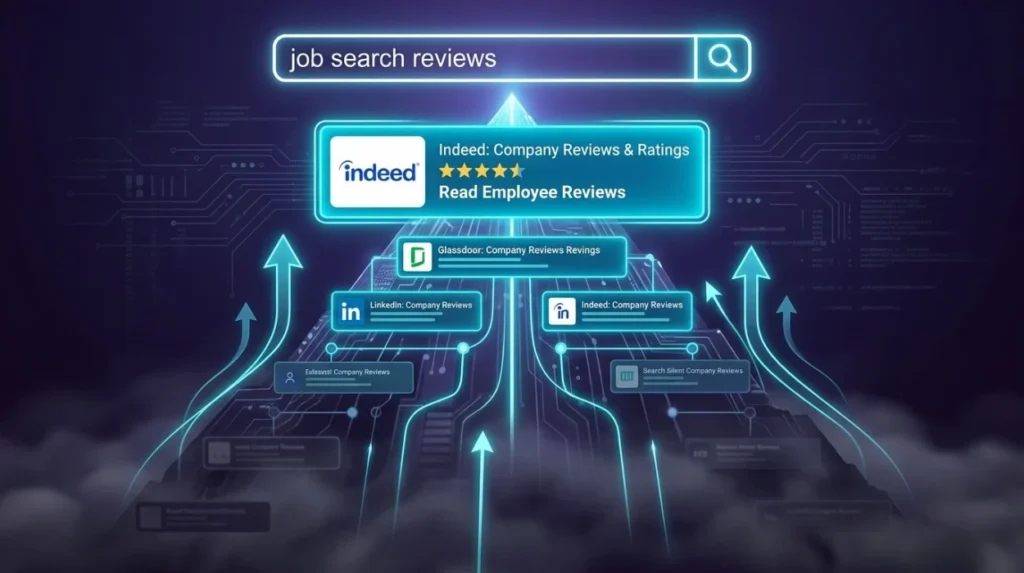
Search ranking determines how prominently an indexed Indeed page appears for a particular query, while platform moderation determines whether the underlying review complies with Indeed’s rules. These systems operate independently, which means a review can be policy-sensitive without automatically disappearing from search results. Search engines evaluate indexed pages through their own ranking systems.
SERP composition is the observable result of these ranking processes. A search result page can contain employer profiles, review pages, news articles, social profiles and other relevant sources. Each page contributes a different reputation signal to the overall information environment surrounding an entity.
Content relevance influences which pages match a user’s search intent, while authority and other ranking signals influence their relative visibility. A review page with strong query relevance can therefore remain visible even when the content itself is disputed. Conversely, a lower-ranking review can have limited search exposure without being removed.
This distinction makes search visibility a separate measurement from policy compliance. Reporting evaluates whether content breaches a platform rule, while SERP analysis evaluates how that content appears within search results. Treating the two measurements as identical produces an incomplete reputation assessment.
How does content enhancement compare with review removal?
Content enhancement adds new reputation signals, whereas review removal eliminates or changes an existing signal at its source. Enhancement can include authoritative company information, relevant expert content and accurate profiles that expand the entity’s digital footprint. Removal focuses on the specific page or review containing the problematic material.
The primary strength of enhancement is breadth. A wider information environment reduces reliance on one source when users research an entity. Its limitation is that newly created content must compete for search visibility and does not guarantee that an existing review becomes less visible.
Removal has a narrower but more direct mechanism. When prohibited content is removed by the platform, the problematic review no longer functions in the same form as an active reputation signal. Its limitation is that the outcome depends on policy eligibility and the platform’s moderation decision.
The two approaches therefore represent content suppression versus content enhancement at different levels. Removal changes the source environment, while enhancement changes the competitive information environment around the entity. Evaluating effectiveness requires measuring the specific outcome rather than treating both approaches as interchangeable.
What evidence supports a report for an Indeed hate speech violation?
A strong report connects the specific review language to the applicable policy category and preserves the relevant context. Evidence begins with the review itself, including the exact wording, location on the Company Page and the characteristic that makes the content potentially prohibited. The purpose is to establish a clear relationship between the content and the rule being relied upon.
- Identify the prohibited wording — Locate the specific phrase, slur, threat or targeted statement that creates the policy concern rather than describing the entire review as offensive.
- Classify the protected characteristic — Establish whether the language targets race, ethnicity, gender, religion, disability, sexual orientation or family status where relevant to the published policy.
- Document the review location — Record the Company Page and review context so the platform can identify the material being reported.
- Separate policy issues — Distinguish hate speech from defamatory claims, personal information, irrelevant content or other prohibited material because each category has a different policy basis.
- Explain the policy connection — State why the identified wording corresponds to the relevant Indeed guideline rather than relying on general statements about reputational harm.
This evidence-based structure also improves the distinction between content classification and sentiment analysis. A negative sentiment score does not establish a hate-speech violation, while a policy-specific assessment identifies the actual moderation concern.
Dive Deeper With Our Expert Guides:
How Professional Indeed Removal Services Differ From DIY Attempts
How Indeed Removal Timelines Compare Across Different Case Types
How can the effectiveness of an Indeed review reporting strategy be measured?
Effectiveness is measured through content status, visibility, policy alignment and reputation-signal changes rather than through sentiment alone. The first measurement concerns whether the reported review remains published, is modified or is removed. The second concerns whether its search visibility changes after any platform action.
A third measurement concerns SERP composition. Search results can be evaluated before and after a content intervention to identify changes in the pages visible for relevant employer or brand queries. This reveals whether a change in source content produced a corresponding change in search perception.
A fourth measurement concerns entity credibility. The wider digital footprint can be reviewed for consistency, authority and relevance across employer profiles, review platforms and other indexed sources. This provides a longer-term measure of reputation resilience beyond the status of one Indeed review.
The final measurement is sustainability. A reporting strategy focused only on individual reviews remains reactive, while a broader reputation framework evaluates recurring content risks and the strength of the entity’s wider information environment. Combining content-status data with search-visibility and reputation-signal analysis produces a more complete assessment.
What are the main limitations of reporting an Indeed review?
The primary limitation is that reporting does not guarantee removal. The platform evaluates the reported material against its own guidelines, and a review remains subject to that moderation process. A report therefore represents a request for policy assessment rather than an automatic content-removal mechanism.
A second limitation is scope. Reporting addresses the identified review but does not automatically change other pages, search results or external platforms containing related information. If the same reputation signal appears across multiple sources, each source operates under its own content and moderation framework.
A third limitation concerns search visibility. Removing a review from Indeed does not guarantee an immediate change in search results because search engines maintain separate crawling, indexing and ranking systems. Cached information, indexed pages and other references can therefore persist for a period after the original content changes.
A fourth limitation concerns long-term reputation resilience. Removing one prohibited review does not create positive reputation signals by itself. Long-term entity credibility depends on the broader information environment, including authoritative content, consistent profiles and relevant reputation signals.
Which reputation approach fits different Indeed review problems?
The appropriate approach depends on whether the primary issue concerns policy compliance, search visibility or broader entity credibility. A hate speech violation is fundamentally a content-policy issue, making policy-based reporting the directly relevant mechanism. A search-visibility problem involves a different layer and requires analysis of SERP composition and ranking signals.
Content removal is most closely aligned with prohibited material located on the source platform. Content suppression relates to reducing the prominence of unwanted pages in search results. Content enhancement focuses on increasing the presence and relevance of alternative information associated with the entity.
These approaches also differ in sustainability. Removal addresses an individual content item, suppression manages search prominence and enhancement develops the broader digital footprint. A reputation management framework therefore evaluates each method according to its mechanism, scope, evidence requirements and measurable outcome.
For a decision-stage analysis of the specific removal route, the concept of Remove a Hate Speech Violation Indeed Review connects the policy classification discussed here with the source-level removal objective.
How should an Indeed hate speech reporting strategy be evaluated?
Reporting an Indeed review that breaches hate speech rules is a policy-based, reactive approach focused on the status of specific user-generated content. Content enhancement and suppression operate differently by influencing the wider information environment and SERP composition rather than directly challenging the source review.
The key strategic distinction is between removal, suppression and enhancement. Removal addresses content availability, suppression addresses search prominence and enhancement develops additional reputation signals. Evaluating these approaches requires attention to policy eligibility, evidence quality, scalability, search ranking influence, risk exposure and long-term sustainability.
How do I report an Indeed review for hate speech?
Use Indeed’s review reporting process and identify the specific language that breaches its content rules. Provide the review URL, relevant screenshots, and a clear explanation of why the content constitutes hate speech.
What types of hate speech can be reported on Indeed reviews?
Reviews containing discriminatory or hateful language targeting protected characteristics can potentially be reported under Indeed’s content policies. Focus on the exact wording and explain how it violates the platform’s rules rather than simply describing the review as offensive.
Can I report an Indeed review that contains discriminatory comments?
Yes, discriminatory comments in an Indeed review can be submitted for platform review when they breach applicable content guidelines. Keep evidence of the review and identify the specific discriminatory statements in the report.
What evidence is needed to report a hateful Indeed review?
Useful evidence includes the review URL, screenshots, the reviewer’s wording, and any relevant context showing the policy breach. Clear, specific evidence helps distinguish a potential hate speech violation from ordinary negative feedback.
What happens after reporting an Indeed review for hate speech?
Indeed can assess the reported content against its review and content policies and determine whether further action is appropriate. Reporting does not automatically guarantee removal, so retain the evidence and monitor the review status after submission.