
Reputation management is the structured process of shaping how an entity is understood through search results, indexed content, and visible reputation signals. Online reputation refers to the searchable record of pages, posts, reviews, and references that influence entity perception and credibility within digital ecosystems.
What is the core problem that a removal agency solves?

A content removal agency solves the problem of harmful, indexed material that individuals cannot remove or deindex alone because the issues exceed standard user tools and policy‑enforcement routes.
Dive Deeper With Our Expert Guides and Related Blog Posts:
Why Content Published Online Rarely Disappears Without Expert Intervention
What Negative Content Removal Covers and the Platforms It Applies To
Not all unwanted content can be rewritten or challenged through simple account controls. Some pages remain on third‑party sites, media platforms, review hubs, or cached archives, where the individual has no access. That is where the gap appears. The user knows the content is harmful, but the standard tools do not reach the source or the index status.
This problem matters because search engines treat indexed content as evidence. A harmful page that ranks for the entity’s name or position can shape perception even if the user never clicks it. The title, snippet, and position carry informational weight. When the user cannot act directly, the reputation risk stays visible. A content removal agency steps in when the issue outgrows what can be handled through self‑service portals and generic complaint forms.
The core issue is not just emotional discomfort. It is the mismatch between the user’s authority and the platform’s policy enforcement. The agency bridges that gap by using documented evidence, correct policy routes, and structured escalation, which a private individual often cannot apply consistently.
How does search visibility affect reputation damage?
Search visibility directly affects reputation damage because pages that appear in results shape entity perception faster and more widely than pages that stay buried or unindexed.
Search engines interpret ranking as a measure of relevance and trust. A harmful page that ranks high for the entity’s name or title can appear in the first impression. That page then becomes a reference point for users, even if the user does not read it fully. The title and metadata often carry more interpretive weight than the full text.
Visibility also compounds over time. A page that stays visible across repeated queries gains more association with the entity. Users treat results as a proxy for reality, especially when the entity is not well known. The harmful page can therefore anchor the narrative, even if better‑quality content exists elsewhere. Removing or deindexing it changes the SERP evaluation rather than just the page content.
That is why content removal agencies focus on index‑level and platform‑level outcomes. They are not only targeting the text. They are targeting the page’s position within the reputation landscape. The goal is to reduce the signal strength of the harmful content by changing its availability to search systems and users.
What types of content usually require specialist help?
The types of content that often require specialist help include false or defamatory pages, policy‑breaching posts, impersonation content, privacy‑intruding references, and mirrored or cached copies that are not accessible to the user.
False or defamatory content matters because it presents inaccurate information as if it were factual evidence. Policy‑breaching posts violate platform rules on abuse, harassment, or inauthentic behaviour, but the user may not know the correct reporting route. Impersonation creates a fake identity trail that search engines can still index. Privacy‑intruding content exposes personal or confidential data. All of these forms can continue to affect search visibility long after the initial event.
Mirrored and cached copies also matter. A removed page can reappear in archives or duplicate domains. Search engines may still index those references, which means the harmful content survives in a different form. The user usually cannot deindex those copies directly. That is where specialist intervention becomes necessary. The agency must track not only the original source but also the indexed derivatives across the digital footprint.
Each of these cases shows why the problem is not only about the text. It is about the structure of the harmful content inside the search ecosystem. The agency’s work is to identify and address the complete footprint, not just the most obvious piece.
How does a removal agency evaluate a case?
A removal agency evaluates a case by auditing the content, checking its indexing status, confirming policy relevance, and predicting its impact on search visibility and entity perception.
The first step is source mapping. The agency identifies the original URL, platform, author account, and hosting environment. The second step is search‑impact analysis. The team checks whether the content ranks for entity‑related terms, position, and frequency. The third step is policy analysis. The agency reviews platform rules, legal thresholds, and any applicable evidence needed to justify removal or deindexing.
This evaluation matters because it separates cases that qualify for structured removal action from cases that need wider reputation‑control measures. A policy‑breaching page has a clear route. A page that is simply negative but rule‑compliant may need suppression or enhancement instead. The agency’s role is to make that distinction explicit and to explain the likely outcome in terms of visibility reduction, trust restoration, and risk exposure.
The evaluation also considers the wider digital footprint. The agency looks at how the harmful content fits within the broader set of indexed references. If the content is part of a larger pattern, the solution may need more than one removal. That is why the process is both technical and interpretive. The agency must connect content, signal, and perception into one coherent assessment.
What is the role of indexing and ranking in reputation?
Indexing and ranking define which content influences reputation, how strongly, and how quickly, because they control what search engines can surface and how users encounter the information.
Indexing is the process by which search engines store and retrieve web pages. Content that is not indexed cannot appear in results. Ranking is the process that orders indexed pages by relevance, authority, and trust. A harmful page that is both indexed and high‑ranking exerts more influence on entity perception than the same page stored offline or buried in the results.
Ranking dynamics also affect how long the reputation damage lasts. A page that ranks for the entity’s name, position, or activity phrase can stay visible for months or years. Each time it appears in search, it reinforces the user’s perception. That is why agencies often track the ranking trajectory before and after removal. The outcome is not only “the page is gone.” The outcome is “the page stops influencing the search narrative.”
Indexing also interacts with caching and mirroring. A deindexed page may still appear in temporary caches or duplicate domains. The agency must therefore distinguish between source removal and index‑removal. The stronger outcome is when both the source and the index reference are addressed. That is the point where the reputation signal weakens the most.
How do authority and trust signals shape perception?
Authority and trust signals shape perception because search engines and users interpret them as indicators of credibility, reliability, and consistency around the entity.
An authority signal is any indicator that the source is strong within its domain. That can include backlinks, domain strength, and reputation within the ecosystem. A trust signal is any indicator that the source is honest, consistent, and aligned with broader expectations. That can include review networks, compliance frameworks, and documentation trails. When harmful content emerges from a strong source, it carries more weight. When it comes from a weak source, it carries less weight.
These signals matter because search engines compare content against the entity’s wider profile. A single negative page from a low‑authority source can be discounted more easily. A cluster of negative pages from strong sources can create a more persistent pattern. The removal agency evaluates both the strength of the source and the structure of the signal. The stronger the authority behind the harm, the more structured the removal route usually needs to be.
Trust signals also affect how users read the results. A user sees top‑ranking reviews, news snippets, and branded pages as trustworthy by default. When one of those signals is harmful, it can shift perception faster than a low‑visibility comment. The agency’s goal is to rebalance the trust environment so that the remaining signals better reflect the entity’s actual credibility.
How do reviews and sentiment influence reputation?
Reviews and sentiment influence reputation because they are indexed reputation signals that often appear in prominent SERP positions and directly shape public trust.
Review platforms compress user experience into a visible score and written text. A single bad review can appear in branded search, map results, and featured snippets, which gives it outsized influence. A cluster of reviews creates a sentiment pattern that search engines and users both interpret as a trust indicator. The agency must therefore distinguish between genuine criticism and policy‑violating or fake activity.
Sentiment interpretation is not binary. Search engines read patterns of tone, frequency, and repetition. A repeatedly negative term, phrase, or structure can signal a broader trust issue. The agency’s role is to show where the sentiment is justified and where it is distorted by policy breaches, fake accounts, or duplicated content. That distinction determines whether the route is removal, correction, or wider reputation‑control.
For entities that rely on online reviews, this is especially important. The removal of a policy‑breaching review does not erase all criticism. It does, however, remove one distorted signal from the SERP evaluation. The broader review landscape can then reflect more accurate, genuine feedback without the extra weight of a manipulated or fake entry.
How does the agency process affect SERP composition?
The agency process affects SERP composition by removing or deindexing harmful pages, reducing their ranking influence, and altering the mix of content that users see for the entity.
When a harmful page is removed, the SERP can no longer show that page as a primary reference. When it is deindexed, it stops appearing in organic search. The remaining pages then fill the visibility gap. That can include more neutral or positive references, depending on the entity’s digital footprint. The process therefore changes the narrative structure of the results rather than only the wording of one page.
The process can also trigger a secondary effect. The removal of a strong negative signal can allow other trust‑enhancing content to rank more prominently. That is not a direct edit. It is a shift in the relative strength of the signals. The agency’s work is to create conditions where the SERP better reflects the entity’s actual credibility rather than a single harmful piece.
This is why the process is often layered. The agency might combine removal, deindexing, and content‑enhancement tactics. The removal targets the harmful signal at source. The enhancement boosts stronger, more accurate signals. The outcome is a SERP that is more balanced in its representation of the entity.
Why does this approach differ from what individuals can do?
This approach differs from what individuals can do because it uses structured evidence, correct policy‑mapping, and multi‑platform escalation instead of isolated complaints or generic form submissions.
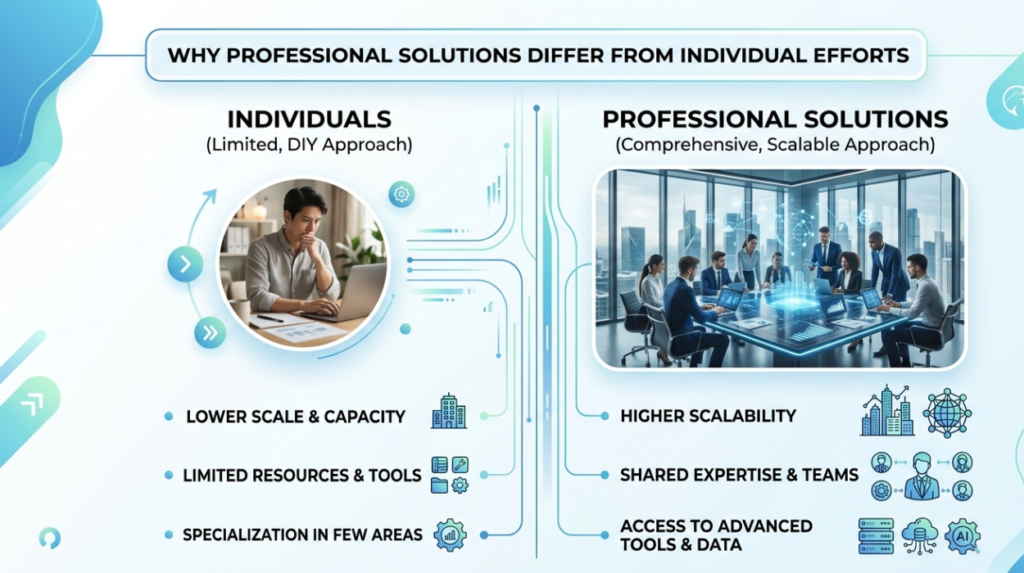
An individual can report a page, write to a webmaster, or request a takedown, but those actions are often ad hoc and limited. The user may not have access to the hosting account, may not know the exact policy route, or may not have the time to track multiple references. The agency operates with a defined workflow that maps each case to the correct mechanism, evidence set, and documentation path.
The difference is procedural and strategic. The agency builds a case file, checks indexing, and coordinates with platforms, webmasters, and legal channels where necessary. The user usually does not have the same level of access or consistency. That is why certain cases exceed what individuals can resolve alone. The agency’s value is not in emotion. It is in process, precision, and persistence.
What is the key takeaway?
The key takeaway is that a content removal agency approaches complex cases by auditing content, understanding indexing and ranking dynamics, and using structured routes that individuals cannot apply consistently alone.
The process is about changing the reputation signals that search engines and users see. It is not about hiding the problem. It is about aligning the visible record with the entity’s actual credibility and policy‑compliance. The agency reduces harmful visibility, rebalances trust signals, and stabilises entity perception within the search ecosystem.