Coordinated inauthentic behaviour is reported by documenting suspicious account activity, preserving relevant evidence and using the reporting mechanisms provided by the relevant social platform. Reputation management strategies differ based on whether the objective is to remove harmful content, strengthen credible information, or reduce the visibility of coordinated activity.
Online reputation control methods are evaluated through their effect on content visibility, reputation signals, entity credibility and the wider SERP composition. Reporting focuses on platform governance, whereas content enhancement and search optimisation operate through different mechanisms that influence what information users encounter. Comparing these approaches helps determine which method addresses the source of a reputation risk and which method addresses its visibility.
What Is Coordinated Inauthentic Behaviour and How Is It Identified?
Coordinated inauthentic behaviour is organised activity designed to create a misleading impression about the independence, popularity or legitimacy of online interactions. It differs from ordinary criticism because the relevant concern is the relationship between accounts, content and behaviour rather than the sentiment of individual posts.
Identification operates through behavioural and content signals. Analysts can compare publication timing, repeated wording, account relationships, shared links, interaction patterns and unusual bursts of activity to establish whether apparently independent accounts demonstrate meaningful coordination. A single indicator rarely provides sufficient context because legitimate users can also share content or post simultaneously.
From a reputation perspective, the distinction matters because artificial amplification can distort sentiment distribution. A concentrated group of accounts can make a particular narrative appear more prominent than its independent support indicates. This creates a reputation signal that requires source and behaviour analysis before its influence on entity credibility is assessed.
How Does Reporting Compare With Content Removal?
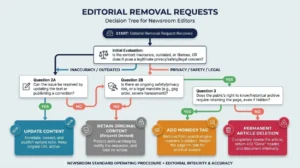
Reporting addresses suspected policy violations, while content removal focuses on whether specific material meets a platform’s removal criteria. Reporting therefore functions as a governance mechanism rather than a general reputation-management technique.
A platform report normally directs potentially problematic content or account behaviour towards an internal review process. The platform evaluates the material against its rules, enforcement standards and available evidence. Content removal occurs only where the platform’s applicable policies provide a basis for enforcement, making reporting fundamentally different from a strategy that attempts to alter search visibility.
The main advantage of reporting is its direct relationship with platform governance. Its limitation is that the outcome depends on policy interpretation and evidential sufficiency rather than the reputational importance of the content. This makes reporting more targeted than broad visibility management but less controllable from outside the platform.
Is Reporting More Effective Than Content Enhancement?
Reporting is more directly aligned with policy-based violations, while content enhancement addresses the informational balance surrounding an individual or entity. The two approaches therefore solve different problems and cannot be measured against an identical outcome.
Content enhancement operates by developing accurate, authoritative and relevant information that provides stronger contextual signals around an entity. When such information earns visibility, it can affect SERP composition by increasing the presence of credible pages relative to less authoritative material.
Reporting has a narrower mechanism. It seeks platform intervention against specific accounts or content, while enhancement works through the creation, optimisation and distribution of legitimate information. Reporting therefore has stronger relevance where policy violations are demonstrable, whereas content enhancement has broader application where the underlying issue concerns information imbalance rather than a removable violation.
Dive Deeper With Our Expert Guides:
How to File a Copyright Takedown for Reposted Social Content
How to Decide When to Respond to Negative Social Media Attention
How Do Organic and Reactive Reputation Strategies Differ?
Organic reputation strategies build credible information over time, while reactive strategies respond to identifiable incidents or harmful content. Organic methods focus on establishing durable reputation signals through authoritative content, accurate profiles, consistent information and legitimate third-party references.
Reactive methods operate after a reputation risk becomes visible. Reporting suspicious accounts, challenging inaccurate information and documenting coordinated behaviour are reactive activities because they respond to an existing problem. Their value lies in addressing immediate risk rather than constructing the broader information environment.
The difference becomes significant when evaluating sustainability. Organic approaches require continuous development but create assets that remain useful across future searches. Reactive approaches provide targeted responses but depend on the recurrence, severity and platform-specific nature of each incident.
When Is Content Removal More Appropriate Than Content Enhancement?
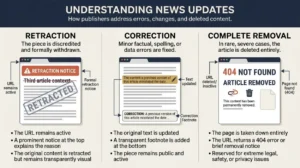
Content removal is more appropriate when specific material violates an applicable platform, legal or publication policy. The mechanism centres on eliminating or restricting access to the identified content rather than competing with it through additional information.
Content enhancement operates differently by increasing the availability and authority of accurate information. It does not necessarily remove the original material, so its effect depends on search ranking influence, content quality and the competitive strength of other pages within the SERP.
What Factors Determine the Better Approach?
- Assess policy eligibility by determining whether the content contains impersonation, harassment, privacy violations, manipulation or another recognised policy issue.
- Evaluate factual accuracy by separating demonstrably false claims from legitimate criticism or opinion.
- Measure search visibility by examining where the content appears for relevant name, brand or entity queries.
- Compare source authority by evaluating the credibility, relevance and established presence of the harmful material against available accurate sources.
- Calculate persistence risk by determining whether the problem is isolated to one post or distributed across accounts, platforms and indexed pages.
This framework prevents content removal and content enhancement from being treated as interchangeable techniques. Each addresses a different part of the reputation system.
How Does Platform Reporting Influence Search Visibility?

Platform reporting can influence search visibility indirectly when successful enforcement removes, restricts or de-indexes content that was publicly accessible. The effect depends on whether the reported material was indexed, referenced elsewhere or generating meaningful visibility for relevant queries.
Search engines evaluate available documents rather than simply accepting platform reports as reputation evidence. If a social post disappears from its original location but identical content exists on other websites, screenshots or accounts, the wider SERP composition remains affected by those independent sources.
This creates an important distinction between platform-level resolution and search-level resolution. Reporting can address the source account or post, while search visibility analysis examines the broader collection of pages associated with the same entity or narrative.
How Does Content Suppression Compare With Content Enhancement?
Content suppression focuses on reducing the prominence of unwanted material, while content enhancement focuses on strengthening the visibility and authority of accurate information. Content suppression therefore targets the position of harmful information, whereas enhancement targets the competitive strength of preferred information.
The two methods operate within the same SERP environment but use different mechanisms. Suppression relies on legitimate methods that reduce unnecessary visibility where applicable, while enhancement builds relevant content and authority signals that compete for search positions.
The distinction is important for risk evaluation. Suppression can provide a targeted response to a specific negative result, but it does not automatically create a durable alternative information ecosystem. Enhancement can establish longer-term reputation assets, but it does not guarantee the disappearance of harmful material.
What Are the Short-Term and Long-Term Effects of Reporting?
Reporting generally provides a shorter-term intervention because it addresses a specific account, post or behavioural pattern. Its effectiveness is measured through platform action, content restriction, account enforcement or other applicable governance outcomes.
Long-term reputation control requires a broader assessment of the digital footprint. If coordinated activity has already produced copied content, external references or indexed pages, resolving the original social-media activity does not necessarily resolve the entire reputation signal.
Sustainable evaluation therefore measures both immediate containment and residual visibility. Short-term reporting can reduce exposure at its source, while longer-term content and search strategies address the continuing presence of information across the wider ecosystem.
How Scalable Are Different Coordinated Behaviour Responses?
Reporting scales according to the platform’s reporting infrastructure and the quality of evidence supplied. A single coordinated network can contain numerous accounts and posts, making evidence organisation important when establishing relationships between apparently separate pieces of activity.
Content enhancement scales through the creation and distribution of relevant information across an entity’s digital footprint. Once authoritative content exists, it can support multiple related searches and provide a stable contextual reference for users evaluating the entity.
The limitation differs between approaches. Reactive reporting becomes operationally complex when activity expands across platforms, while enhancement requires sustained content quality, authority development and monitoring. Scalability therefore depends on whether the reputation problem is concentrated in a platform-specific network or distributed across the broader search ecosystem.
How Should Risk Exposure Be Evaluated Before Reporting?
Risk exposure is evaluated by measuring the credibility, visibility, persistence and distribution of the suspected coordinated activity. The objective is to establish whether the activity represents a localised platform issue or a wider reputation and search-perception problem.
Evidence quality is central to this evaluation. Screenshots, URLs, timestamps, account identifiers, repeated phrases and interaction relationships create a structured record that allows platform reviewers to assess patterns rather than isolated claims.
The analysis also needs to distinguish legitimate criticism from coordinated manipulation. Treating genuine negative feedback as inauthentic behaviour creates an inaccurate reputation assessment and can undermine the credibility of the reporting process. A precise evidence threshold therefore reduces the risk of misclassification.
Which Reputation Management Approach Provides the Most Sustainable Outcome?
No single approach provides the same outcome across every coordinated-behaviour situation because reporting, removal, suppression and enhancement address different mechanisms. Platform reporting is strongest when identifiable policy violations and evidence of coordination exist, while content enhancement provides broader value when the principal issue concerns information imbalance.
A sustainable strategy evaluates the entire information ecosystem rather than focusing exclusively on one social-media post. This includes account behaviour, content provenance, indexing status, search visibility, source authority, sentiment distribution and the strength of competing reputation signals.
The most useful distinction is between removing a source of harmful visibility and building stronger credible information around the entity. These mechanisms can operate independently or sequentially, but their effectiveness, scalability and risk exposure require separate measurement.
How Should Coordinated Inauthentic Behaviour Be Evaluated Across the Search Ecosystem?
Coordinated inauthentic behaviour is best evaluated through a combination of platform evidence, content relationships and search visibility analysis. The assessment begins with identifying behavioural coordination and then determines whether the resulting material has affected the wider digital footprint.
Reporting provides a governance route for platform-level intervention, whereas removal, suppression and enhancement address different visibility mechanisms. Organic strategies provide longer-term reputation signals, while reactive methods concentrate on identifiable incidents and immediate exposure. Get Help Stopping a Coordinated Social Media Bot Attack provides a relevant decision-stage consideration when coordinated activity creates an identifiable reputation risk requiring targeted intervention.
The central consideration is therefore not simply whether content is negative, but how it was produced, how widely it is distributed, how authoritative its sources are and how it contributes to entity perception. Evaluating these factors together produces a more accurate understanding of reputation risk than measuring engagement or sentiment alone.
What is coordinated inauthentic behaviour on social media?
Coordinated inauthentic behaviour is organised activity involving accounts that work together to create a misleading impression of independent support or discussion. It can involve repeated posts, coordinated interactions, fake accounts or artificial content amplification.
How do you report coordinated inauthentic behaviour to social platforms?
Collect relevant evidence such as account URLs, post links, timestamps, repeated content and interaction patterns, then use the platform’s reporting system. Provide specific information showing how the accounts or content appear connected rather than reporting isolated posts without context.
What evidence is needed to report coordinated social media activity?
Useful evidence includes screenshots, account identifiers, URLs, publication times, duplicated wording and patterns of coordinated engagement. Organised evidence helps demonstrate relationships between accounts and supports a clearer platform review.
Can coordinated inauthentic behaviour damage online reputation?
Yes, coordinated activity can increase the visibility and repetition of negative content associated with an individual or organisation. This can influence reputation signals, sentiment distribution and how users perceive the entity across social media and search results.
What happens after reporting coordinated inauthentic behaviour?
The relevant platform evaluates the reported activity against its policies and enforcement criteria. Depending on the findings, action can involve content restrictions, account enforcement or no action where the available evidence does not establish a policy violation.