Professional intellectual property enforcement delivers a structured route to remove qualifying unauthorised content and protect your digital reputation.
Copyright and trademark enforcement also strengthens search visibility control by reducing reputation signals created by misleading, infringing or unauthorised online content.
Why does professional intellectual property enforcement provide stronger SERP control?
Professional enforcement provides stronger SERP control because it addresses the source content generating an unwanted reputation signal rather than relying only on publishing additional positive material. Copyright and trademark infringements can place unauthorised images, logos, written material or brand identifiers in search results, creating confusion about ownership and commercial identity. When qualifying content is removed from a hosting platform, search visibility for that specific asset can decline as the underlying page becomes unavailable or changes. This directly supports negative content suppression by reducing the amount of harmful or misleading material available for users to discover. The result is greater control over how your business entity is represented across the search ecosystem.
Search engines process signals from indexed pages, links, entities and content relationships when presenting results to users. An unauthorised logo on a third-party website, for example, can create an association between your brand and information you did not publish or approve. A copied article can also compete with your original material, while unauthorised brand usage can create uncertainty about commercial affiliation. Intellectual property enforcement therefore operates as a reputation protection mechanism as well as a legal-rights process. Removing qualifying sources reduces the number of competing reputation signals that users encounter during branded searches.
A professional service also improves process consistency. Instead of approaching each platform with an inconsistent explanation, an enforcement team identifies the relevant right, gathers supporting evidence, determines the appropriate notice route and submits a focused request. This creates a documented process that supports accuracy and reduces avoidable delays. The objective remains specific: establish the relevant intellectual property right, demonstrate the unauthorised use and request the appropriate corrective action. That clarity makes the enforcement process easier to manage and measure.
When does a copyright trademark service become the right solution?
A copyright trademark service becomes the right solution when unauthorised digital material creates a clear intellectual property issue that requires structured enforcement. Copyright generally concerns qualifying original creative works, while trademarks protect distinctive identifiers used to distinguish goods or services. A business logo can involve trademark rights and, depending on its characteristics and circumstances, copyright protection as an artistic work. The correct enforcement route therefore depends on the nature of the protected material, ownership evidence and the way the material is being used. Correct classification is essential because an inaccurate complaint weakens the credibility of the enforcement request.
The reputation impact extends beyond the legal classification. Users often evaluate a company through branded search results before contacting it, purchasing from it or entering a commercial relationship. If unauthorised content presents a logo, product image or branded material alongside inaccurate claims, users can form an incorrect perception of the business. This affects entity credibility because the search ecosystem connects the business name with external information that appears relevant to the entity. Addressing the underlying unauthorised use helps reduce that unwanted association.
The decision process also benefits from understanding how logo misuse affects perception. Businesses evaluating brand logo reputation risks can identify how unauthorised visual assets contribute to confusion, attribution problems and inconsistent brand presentation. This analysis supports enforcement decisions by connecting intellectual property protection with observable search behaviour. Rather than treating an infringement as an isolated legal problem, a reputation-focused approach examines its effect on discoverability, trust and entity consistency. That broader assessment creates a stronger basis for selecting the appropriate action.
How does our takedown process reduce enforcement risk?
Our takedown process reduces enforcement risk through evidence-led assessment, accurate rights identification and structured submission. The first stage establishes what material is being used, where it appears, who controls the relevant website or platform and which intellectual property right applies. Evidence is then organised around ownership, original publication, registration information where relevant and the specific unauthorised use. This prevents a generic complaint from replacing the factual basis required for meaningful enforcement. Each submission remains tied to identifiable content and a defined rights issue.
The process follows a controlled sequence:
- Identify the infringing material and record the exact webpage, asset or brand identifier involved.
- Verify ownership and gather documentation supporting the relevant copyright or trademark right.
- Classify the infringement according to the nature of the protected intellectual property and unauthorised use.
- Prepare a precise notice that connects the rights holder, protected work and disputed material.
- Submit the request through the appropriate platform, host or intermediary enforcement channel.
- Monitor responses, removals, counter-notifications and required follow-up actions.
- Document outcomes so each enforcement matter has a clear evidence trail.
This structure improves reliability because every stage has a defined purpose. It also reduces the operational burden on businesses that lack the time to investigate individual infringements, identify platform procedures and maintain correspondence. Clear documentation creates an auditable record of what was reported, why it was reported and what response followed. That record becomes particularly valuable when repeated infringements affect the same brand or when enforcement requires escalation through an appropriate channel. Process clarity therefore supports both immediate action and long-term reputation protection.
Dive Deeper With Our Expert Guides:
Remove Dead Links From Google That Are Harming Your Online Presence Today
Remove a Harmful TripAdvisor Review in the UK With Our Hospitality Removal Service
How quickly can intellectual property takedowns improve online reputation?
Intellectual property takedowns can improve online reputation as soon as the responsible platform or intermediary acts on a valid request, but the speed of impact depends on the platform process and the specific circumstances. Removal from the original source directly reduces the availability of the disputed material. Search engines then update their indexes as their systems revisit affected pages, meaning search visibility changes follow the underlying content change. This distinction is important because a takedown request does not represent an instant change to every search result. The measurable sequence is enforcement action, source-level change, subsequent indexing and then altered search visibility.
Speed also depends on evidence quality. A clearly documented rights claim gives the receiving platform the information required to assess the complaint efficiently. Incomplete ownership information, unclear URLs or an incorrectly selected enforcement route creates unnecessary friction. Professional handling reduces these avoidable issues by preparing the submission around the specific intellectual property right and disputed use. This makes the process more predictable without claiming an artificial universal turnaround time.
Reputation recovery also requires attention to the wider search environment. Removing one infringing page does not automatically remove every reputation signal associated with a business. Other copies, cached references, social posts or separate websites can continue to influence public perception. Effective reputation management therefore combines source-level enforcement with ongoing monitoring of branded search results. This supports sustained SERP control rather than treating one successful removal as the end of the process.
Is professional enforcement worth the cost compared with handling takedowns internally?
Professional enforcement provides long-term value when the cost of unmanaged intellectual property misuse exceeds the resources required to identify, document and pursue infringements internally. Internal handling requires staff to locate problematic material, determine the applicable right, research platform procedures, prepare notices, track responses and maintain records. Each individual task consumes operational time even before a platform makes a decision. A specialist service consolidates these activities into one structured workflow. The value therefore extends beyond the submission itself and includes reduced administrative burden and improved consistency.
The financial consideration also includes reputation risk. Search results influence whether prospective customers recognise a business as legitimate, distinguish official material from unauthorised copies and understand the relationship between a company and third-party content. Understanding DMCA takedown vs trademark infringement notice also helps businesses select an enforcement route that matches the intellectual property issue involved. Persistent infringement can create repeated confusion and force internal teams to respond to questions that should never arise. Removing qualifying unauthorised material reduces that source of confusion. The resulting value is linked to improved visibility, clearer brand attribution and stronger entity credibility.
A professional approach also prevents the business from treating every infringement identically. Different content types require different evidence and enforcement considerations. Copyrighted creative material, trademark misuse, copied website assets and misleading brand representation do not automatically follow the same procedure. A structured service evaluates the facts before selecting the appropriate route. That reduces the risk of wasting resources on unsuitable notices and creates a more defensible enforcement record.
How does copyright and trademark enforcement strengthen search perception influence?
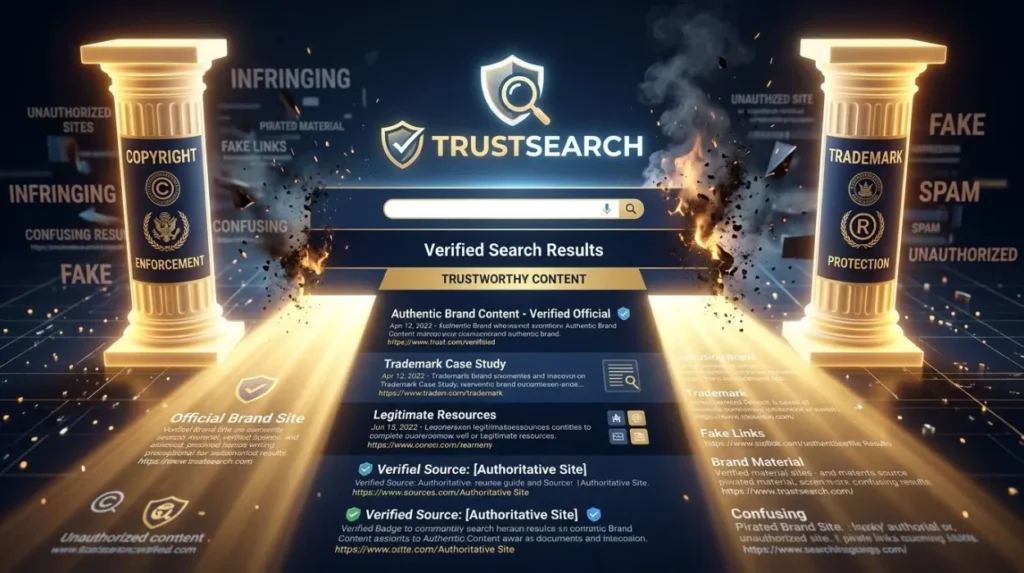
Copyright and trademark enforcement strengthens search perception influence by reducing the external content capable of distorting how users understand a business entity. Search perception develops through repeated exposure to names, logos, claims, reviews, images and third-party references. When unauthorised material appears prominently, it becomes part of the information environment surrounding the brand. Removing qualifying infringing sources changes that environment at its origin. This supports a cleaner relationship between the business and the information users encounter.
The mechanism is not based on manipulating search algorithms. It works by addressing content that has a legitimate basis for removal and allowing the search ecosystem to reflect the resulting source-level change. This distinction makes intellectual property enforcement an important component of responsible negative content suppression. The goal is not to hide legitimate criticism or manipulate public information. The goal is to enforce valid rights where unauthorised use meets the relevant legal and platform criteria.
The broader reputation objective is therefore controlled narrative accuracy. A business needs users to distinguish official brand assets from unauthorised copies and genuine company information from material falsely presented as connected to the business. Strong intellectual property enforcement supports that distinction. Over time, consistent action against qualifying misuse contributes to more stable brand representation across search and third-party websites.
What outcomes can a professional takedown service deliver?
A professional takedown service delivers measurable outcomes by connecting enforcement activity with observable changes in online content and search visibility. The first outcome is source-level control: qualifying unauthorised material is addressed through the appropriate enforcement channel. The second is visibility control: removed or changed pages become less capable of generating the same search exposure once search engines process the change. The third is perception control: users encounter fewer unauthorised assets capable of confusing brand ownership or affiliation.
Key outcomes include:
- Reduce exposure to qualifying infringing pages by pursuing source-level removal through appropriate channels.
- Strengthen brand attribution by addressing unauthorised logos, creative assets and protected identifiers.
- Improve SERP control by reducing the number of problematic sources available for indexing and discovery.
- Stabilise entity credibility by limiting misleading associations between the business and unauthorised material.
- Protect digital assets through documented enforcement and repeat monitoring.
- Support reputation recovery by addressing the underlying content rather than relying exclusively on positive publishing.
- Measure progress through removal status, affected URLs, response outcomes and subsequent search visibility changes.
These outcomes provide a more practical basis for evaluating a service than promises of instant reputation transformation. The relevant indicators are identifiable and trackable. Businesses can monitor which URLs were reported, which sources responded, what content was removed and how affected search results changed over time. This creates accountability within the enforcement process.
How does Clear Your Name provide reliable intellectual property enforcement?
Clear Your Name provides a structured enforcement service designed around evidence, rights identification and reputation impact. The service connects intellectual property enforcement with the wider objective of protecting how a business is represented online. Each matter requires a clear understanding of the protected asset, the unauthorised use and the platform or website responsible for hosting it. This evidence-driven structure keeps the process focused on qualifying claims rather than broad attempts to alter legitimate search information. The result is a controlled workflow that supports both rights enforcement and digital trust.
Reliability also comes from process transparency. A business needs to understand what has been identified, what evidence supports the complaint, where the request has been submitted and what response has followed. Clear records make that information accessible throughout the enforcement lifecycle. Follow-up activity then focuses on unresolved matters rather than repeating completed work. This creates operational visibility while reducing the risk of missed responses.
The service also recognises that reputation management does not end with one removal. New copies, unauthorised uploads and separate uses of protected brand assets can appear after an initial enforcement action. Ongoing monitoring identifies new issues before they become established reputation signals. This supports sustainable reputation protection by combining immediate takedown activity with continued visibility awareness. For businesses where brand trust directly affects commercial decisions, that continuity provides a stronger foundation for long-term search perception influence.
Why should businesses choose a structured takedown service for long-term reputation protection?
Businesses choose a structured takedown service when they require a reliable process for protecting intellectual property while maintaining control over their digital reputation. The central advantage is the connection between legal rights, online content and search behaviour. Copyright and trademark enforcement addresses qualifying unauthorised material at its source, while reputation monitoring evaluates how remaining content affects public perception. Together, these activities create a more complete approach to SERP control and entity credibility.
The decision also requires realistic expectations. No legitimate service can guarantee that every reported page will disappear, that every platform will reach the same conclusion or that search results will change instantly. A credible service instead provides evidence-led assessment, appropriate submission, documented follow-up and measurable reporting. This approach reduces risk because decisions are based on identifiable rights and specific content rather than unsupported claims. It also gives businesses a clear framework for evaluating progress.
Intellectual property rights form an important part of digital trust because users increasingly encounter brands through search results before direct interaction. Unauthorised logos, copied creative works and misleading brand identifiers can interfere with that first impression. Professional enforcement addresses those risks through a defined process that prioritises accuracy, documentation and source-level action. For businesses seeking stronger reputation protection, the objective is clear: reduce qualifying unauthorised content, improve visibility control and maintain a consistent representation of the brand entity.
Professional copyright and trademark enforcement therefore delivers value through process clarity, evidence quality, risk reduction and measurable visibility outcomes. A structured service provides the operational expertise required to identify relevant infringements, prepare appropriate notices, manage responses and monitor the resulting search environment. Clear Your Name positions this process around responsible rights enforcement and digital reputation protection rather than exaggerated promises. When intellectual property misuse threatens brand trust, a documented takedown strategy provides a credible route towards stronger SERP control and more stable search perception.
What is a copyright and trademark takedown service?
A copyright and trademark takedown service helps rights holders address unauthorised use of protected creative works, logos, names and brand identifiers online. The process typically involves identifying the disputed content, verifying ownership, preparing an evidence-based notice and submitting it to the relevant platform or website.
Can a takedown service remove an unauthorised brand logo from a website?
A takedown request can address unauthorised logo use when the rights holder has an applicable intellectual property right and the use meets the relevant enforcement requirements. The evidence normally identifies the protected logo, establishes ownership and specifies where the unauthorised use appears.
What is the difference between a copyright takedown and a trademark infringement notice?
A copyright takedown generally addresses unauthorised use of qualifying creative works, while a trademark infringement notice addresses unauthorised use of protected brand identifiers such as names, logos or marks. The appropriate notice depends on the intellectual property right involved and the circumstances of the disputed use.
How long does an intellectual property takedown take?
Takedown times vary according to the platform, evidence provided and complexity of the infringement. Once content is removed, search engines also need to process the source-level change before affected search visibility updates.
How does intellectual property enforcement protect online reputation?
Intellectual property enforcement protects online reputation by addressing qualifying unauthorised content that can create misleading brand associations or weaken entity credibility. Removing the source content can reduce its visibility and support stronger SERP control, brand attribution and search perception.