Flagging Google reviews relies on Google’s moderation policies, while professional review removal services assess review evidence, policy compliance and available escalation routes. The two approaches differ in process, control, resource requirements and their potential effect on search perception.
Reputation management strategies differ based on whether a business needs to challenge specific content or improve the wider representation of its entity across search results. Online reputation control methods are evaluated through policy eligibility, evidence quality, response time, risk exposure and the sustainability of their impact on search engine results pages (SERPs). A low rating alone does not establish a policy violation, and professional involvement does not guarantee removal. The relevant distinction is between content suppression, which seeks to remove eligible material from visibility, and content enhancement, which improves the accuracy, relevance and balance of information available to searchers. Understanding these mechanisms helps businesses choose a proportionate response to anonymous one-star reviews.
How does direct Google review flagging compare with professional review removal services?
Direct flagging is a platform-based reporting process, whereas professional review removal services involve structured assessment of a review and the available routes for challenging it. Both approaches depend on the nature of the content, the evidence supporting a complaint and the decision-making standards of the platform or relevant authority. Neither approach can legitimately treat every negative review as removable simply because it affects a business’s reputation.
Google’s reporting process allows eligible users to identify reviews they believe breach its content policies. Google then assesses the report against its rules, which cover issues such as spam, fake engagement, conflicts of interest, harassment and other prohibited content. A review that describes a genuine customer experience and complies with those policies does not become removable solely because the business disputes its conclusions or considers the rating unfair.
Professional review removal services operate by examining the review’s wording, context, available records and potential policy breaches before determining how to proceed. Their work can include organising evidence, identifying the most relevant policy category and preparing a clear explanation for submission through the appropriate channel. The practical difference lies in the structure of the assessment, not in access to a guaranteed outcome.
Direct flagging has low procedural complexity and gives businesses a route to report suspected violations themselves. Professional assessment involves additional resources but can improve the clarity and consistency of a submission when the issue is complex or the initial report lacks detail. In both cases, Google retains authority over decisions made under its platform policies.
Which approach is more effective for anonymous one-star Google reviews?
Effectiveness depends on whether the review contains identifiable policy violations, how clearly those violations can be demonstrated and whether the chosen process matches the problem. Anonymous reviews are not automatically fraudulent, because Google users can publish reviews without displaying their legal identity publicly. A one-star rating also represents a rating choice rather than proof of misconduct.
Direct flagging is most appropriate when the business can identify a clear policy issue, such as promotional spam, a review posted by a competitor with a conflict of interest, or content containing prohibited harassment. The report enters Google’s moderation process, where the platform determines whether the content violates its policies. A concise report that identifies the relevant conduct provides a stronger basis for assessment than a general statement that the review is unfair.
Professional assessment is more relevant when the reason for removal is not immediately obvious. A reviewer may describe an interaction that the business cannot match to its records, but the absence of an identifiable transaction does not independently prove that the review is fake. A structured assessment separates verifiable facts from assumptions and identifies which evidence directly supports the alleged violation.
The comparison therefore rests on evidence quality rather than the perceived authority of the person submitting the report. Direct flagging can be sufficient for straightforward violations, while specialist analysis can help clarify complicated cases and organise supporting material. Neither route overrides the platform’s policy criteria, and neither guarantees that an anonymous review will be removed.
How do evidence requirements differ between direct flagging and professional assessment?
Evidence requirements depend on the alleged violation, while the quality of the explanation determines how clearly that evidence supports the report. Direct flagging allows a business to identify suspected misconduct, but a report based only on disagreement with the rating provides little basis for a policy decision. Professional assessment applies a more structured review of the available material before a complaint is submitted or escalated.
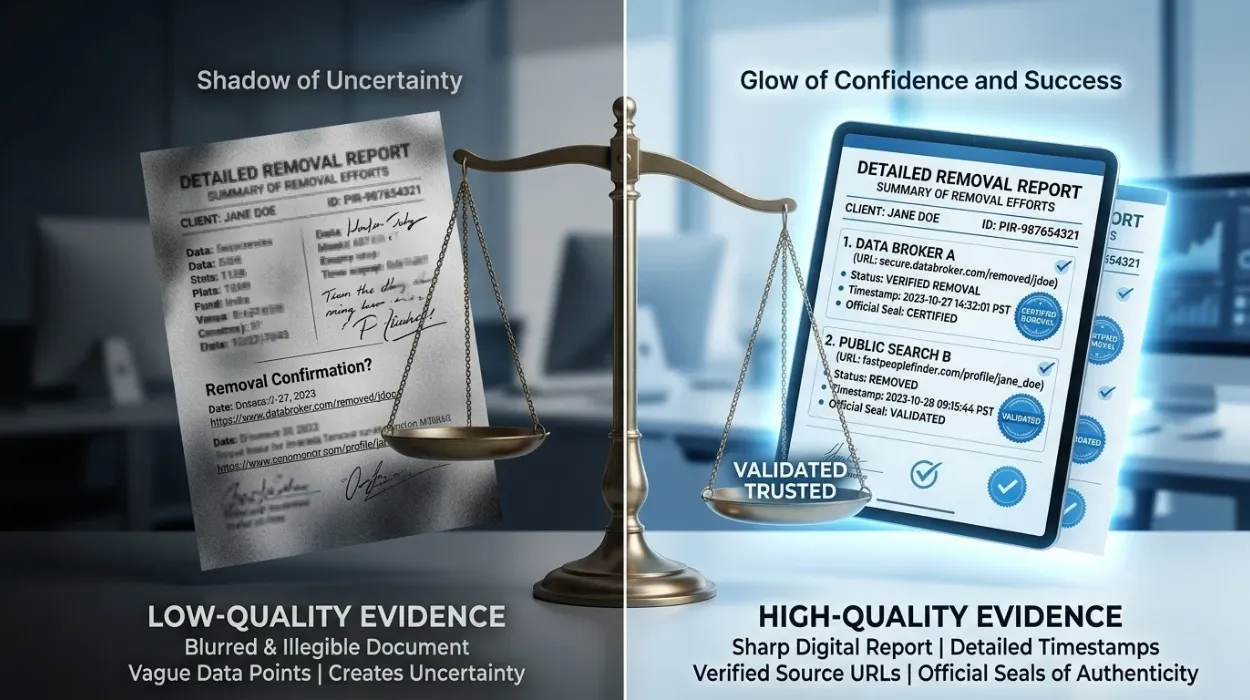
A useful evidence set includes the review’s URL, screenshots showing the wording and date, relevant transaction or service records, and documentation of any identifiable conflict of interest. For example, evidence that a review contains copied promotional text can support a spam-related concern when the wording and surrounding context demonstrate the pattern. By contrast, an internal record showing no matching customer does not prove that the reviewer never interacted with the business.
Evidence assessment also distinguishes direct observations from inferences. A reviewer’s public profile, limited review history or anonymous display name can provide context, but none independently establishes that a review violates Google’s policies. The strongest report links a specific element of the content to a specific rule and explains the connection without adding unsupported accusations.
Professional assessment can help organise this material into a coherent case, particularly when several records relate to one complaint. Direct reporting remains a practical option when the violation is obvious and the supporting evidence is straightforward. The difference is the degree of preparation and analytical support, rather than a different standard for removal.
How do removal strategies compare with content enhancement for search visibility?
Removal strategies seek to eliminate content that breaches applicable rules, whereas content enhancement improves the accuracy, depth and balance of the information visible about a business. These methods affect SERP composition through different mechanisms and are not interchangeable. Removal addresses a specific item; enhancement develops a broader set of credible reputation signals.
When Google removes a review following a valid policy finding, the review no longer contributes to the visible review set in the same way. Its removal can change the displayed rating or sentiment distribution, depending on the number of reviews and the platform’s calculation methods. However, removing one review does not automatically transform the wider search results or guarantee a higher position in organic rankings.
Content enhancement operates by strengthening accurate information across a business’s digital footprint. Updated service pages, consistent business details, useful public information and authentic customer feedback help searchers assess the entity from more than one source. Search engines use multiple signals to discover, interpret and rank pages, so publishing additional content does not guarantee that a particular page will outrank a negative result.
The approaches also differ in risk exposure. A substantiated removal request addresses a specific policy concern, while attempts to suppress legitimate criticism through repeated or unsupported reporting can waste resources and undermine the credibility of the process. Content enhancement carries its own limitations: repetitive, thin or misleading pages do not create meaningful trust simply because they increase the volume of positive material.
A proportionate strategy separates eligible removal from legitimate reputation development. Businesses report content when there is a defensible policy basis and improve their wider digital presence through accurate, useful information. This approach avoids treating content suppression as a substitute for maintaining a credible online identity.
Are reactive reputation management methods more effective than organic approaches?
Reactive reputation management addresses an existing issue, while organic reputation management develops reputation signals consistently over time. Reactive methods include reporting policy-violating reviews, responding to criticism and correcting inaccurate business information. Organic methods include collecting genuine customer feedback, publishing useful content and maintaining consistent, verifiable information across relevant platforms.
Reactive action offers a focused response to an immediate problem. When a review contains a demonstrable policy violation, reporting it directly addresses the disputed content rather than waiting for broader reputation signals to develop. However, reactive action remains dependent on the platform’s review process, and an unresolved complaint can continue to influence public perception while it is assessed.
Organic activity addresses a different need by providing a more complete view of the business. Authentic reviews can improve sentiment distribution, while detailed service information can help prospective customers compare the organisation’s claims with its actual offering. These signals contribute to entity credibility, but they do not invalidate a legitimate negative review or ensure a specific search ranking.
Scalability also differs between the approaches. A defined reporting workflow can help teams process recurring policy concerns consistently, particularly when it includes evidence collection, review classification and outcome tracking. Organic reputation development requires ongoing operational discipline, because customer experiences, business information and search results change over time.
The approaches work best as distinct parts of a broader framework. Reactive methods address specific, time-sensitive issues, while organic methods improve the quality and consistency of the business’s overall digital footprint. Neither method replaces the other, because removal eligibility and long-term trust depend on different mechanisms.
Which approach delivers more sustainable results over the short and long term?
Direct flagging and professional assessment focus on individual review disputes, while sustained reputation management addresses the wider information environment in which those reviews appear. Short-term effectiveness is measured by how efficiently a valid complaint reaches the appropriate decision-making process. Long-term effectiveness is measured by whether the business maintains reliable information, credible customer feedback and a consistent response to future reputation issues.
In the short term, direct flagging offers a straightforward reporting route when the violation is clear. Professional assessment adds preparation and evidence review, which is relevant when the allegation requires careful interpretation. Neither approach controls Google’s decision-making timetable, and repeated submissions without new evidence do not necessarily accelerate a decision.
Over the longer term, a documented reporting process supports consistency. Recording the review URL, suspected policy category, evidence submitted, decision received and any permitted appeal creates a traceable record for future cases. This process also helps identify recurring problems, such as repeated spam, impersonation or reviews that appear connected to a conflict of interest.
Organic reputation development provides a different form of sustainability. Accurate business information, genuine customer feedback and useful website content help maintain a more complete representation of the organisation. These assets remain useful beyond an individual review dispute, although their influence depends on relevance, quality, competition and search engine interpretation.
Sustainable management therefore combines case-specific action with ongoing reputation maintenance. The appropriate balance depends on the seriousness of the alleged violation, the quality of available evidence, the resources required and the importance of the disputed review to the business’s wider search presence.
How should businesses evaluate cost, scalability and risk across both approaches?

Businesses can compare the approaches by measuring staff time, evidence requirements, process complexity, escalation needs and the consequences of an unsuccessful report. Direct flagging generally requires less external coordination, while professional assessment involves additional preparation and potentially a financial cost. The total cost depends on the complexity of the case, the amount of supporting material and whether further review becomes necessary.
A practical evaluation framework separates five factors:
- Measure the strength of the evidence by linking each disputed element to a specific Google policy rather than relying on the rating alone.
- Compare the time required for direct reporting with the preparation needed to organise records and explain a complex allegation.
- Assess scalability by checking whether the same evidence-capture and case-tracking process works consistently across multiple reviews.
- Record outcomes by tracking decisions, permitted appeals and any changes to the visible review profile after a case concludes.
- Review risk exposure by identifying unsupported allegations, unnecessary disclosure of personal information and repeated reports that lack new evidence.
These measures help businesses compare operational efficiency without assuming that higher expenditure produces a better outcome. A simple, well-supported report can be more useful than an elaborate submission that fails to identify a genuine policy breach. Conversely, a complex case involving multiple pieces of evidence can require more preparation than a routine report.
Risk assessment also requires a clear distinction between platform enforcement and legal action. Google’s moderation process determines whether content breaches its policies, while legal proceedings involve separate legal tests, evidence requirements and procedural safeguards. A business considering a legal remedy for an anonymous review needs to assess the wording, jurisdiction, available evidence and applicable legal threshold rather than treating a rejected moderation report as proof of unlawful conduct.
Professional involvement does not remove these risks or transfer final authority over a review to an external provider. Its value depends on the quality of the assessment, the transparency of the process and the accuracy of the submitted information. A reliable comparison therefore considers process quality and evidential strength alongside cost.
Dive Deeper With Our Expert Guides:
How to Document and Escalated Policy-Violating Google Reviews to Support
Google’s Review Policies vs. Legal Defamation: What Qualifies for Takedown?
How do Google review disputes influence trust signals and SERP composition?
Google review disputes influence online reputation through visible review content, aggregate ratings and the context that searchers use to assess a business. Search engine results pages combine different content types, including business profiles, websites, directories, news coverage and other relevant pages. The effect of an individual review depends on where it appears, how prominent it is and how users interpret it alongside other available information.
Review ratings are a visible reputation signal, but they are not a complete measure of entity credibility. Searchers also evaluate the specificity of feedback, the apparent relevance of reviews and the consistency of information across sources. An anonymous one-star review can affect perception even when its claims remain unverified, because readers do not always have access to the evidence available to the business.
Search ranking influence must be distinguished from review moderation. Removing a policy-violating review changes the content available on the platform, but it does not guarantee a corresponding improvement in organic rankings. Search engines evaluate pages and entities using multiple signals, and the relationship between a particular review dispute and broader rankings is not determined by the removal process alone.
Content enhancement helps address the wider SERP by ensuring that accurate, useful information is available to searchers. A business with complete service information, consistent details and authentic feedback presents more context than one whose digital presence is limited to a review profile. This strategy does not erase legitimate criticism; it allows the organisation’s broader record to be assessed alongside individual opinions.
The distinction matters when selecting a response. A policy-based removal request addresses an eligible item, while search visibility management addresses the composition and quality of the wider information environment. Treating these objectives separately produces a clearer evaluation of outcomes and avoids unsupported assumptions about how a single action affects search perception.
How can businesses choose the appropriate response to an anonymous one-star review?
The appropriate response depends on the evidence, the suspected policy issue and the review’s wider reputational impact. Direct flagging is suitable when the business identifies a clear violation and can explain it concisely. Professional assessment becomes more relevant when the complaint requires detailed evidence organisation, careful policy interpretation or consideration of an appropriate escalation route.
Businesses first need to preserve the review’s URL, wording and relevant context. They then need to distinguish a demonstrable policy violation from an unfavourable opinion, a factual disagreement or a review that cannot be matched to internal records. This classification reduces the risk of making unsupported allegations and helps determine whether reporting, a public response or another proportionate action fits the circumstances.
The final decision also needs to account for the wider digital footprint. A review that remains visible does not prevent a business from maintaining accurate information, responding professionally where appropriate and encouraging genuine customer feedback. Equally, positive content does not make a valid policy complaint unnecessary when the disputed review contains prohibited material.
What are the key differences between flagging and professional review removal services?
Direct flagging provides a platform reporting route, while professional review removal services offer structured analysis and support in preparing a complaint. Both depend on policy eligibility and credible evidence, and neither guarantees a successful outcome. Their practical differences concern preparation, resource allocation, case complexity and the consistency of the process.
The central strategic consideration is whether the business is addressing a specific policy violation or improving its wider online reputation. Anonymous 1-Star Google Reviews require careful assessment because anonymity and a low rating alone do not establish a policy violation or justify removal. Removal is relevant to content that meets the applicable criteria, whereas content enhancement supports a broader and more accurate representation of the organisation. Reactive and organic approaches also serve different time horizons, with the first addressing immediate disputes and the second maintaining credible reputation signals over time.
A sound evaluation therefore considers evidence quality, procedural effort, scalability, legal and policy risks, and the likely effect on search perception. Anonymous status and a one-star rating do not establish misconduct, just as a professional assessment does not guarantee removal. Separating moderation, legal remedies and wider SERP management allows businesses to make decisions based on the actual issue rather than the rating alone.
Is flagging a Google review better than using a professional review removal service?
Direct flagging is suitable when a review clearly violates Google’s policies, such as through spam or a conflict of interest. Professional Google Review Removal Services assess the evidence, identify relevant policy issues and help prepare structured removal requests, but neither approach guarantees removal.
Can anonymous one-star Google reviews be removed?
Anonymous one-star Google reviews can be removed if they violate Google’s review policies. Anonymity, a low rating or disagreement with the reviewer does not independently qualify a review for removal.
What evidence is needed to report a fake Google review?
Useful evidence includes the review URL, dated screenshots, relevant transaction records and details supporting a suspected policy violation. A missing customer record alone does not prove that a review is fake.
How long does Google take to remove a policy-violating review?
The review moderation timeline varies according to the case and Google’s assessment process. Submitting clear evidence and identifying the relevant policy can help explain the complaint, but neither direct flagging nor professional assistance guarantees a specific decision time.
How do Google Review Removal Services differ from reputation management?
Google Review Removal Services focus on assessing and reporting reviews that potentially violate platform policies. Broader reputation management also includes responding to legitimate criticism, improving accurate online information and strengthening credible reputation signals across search results.