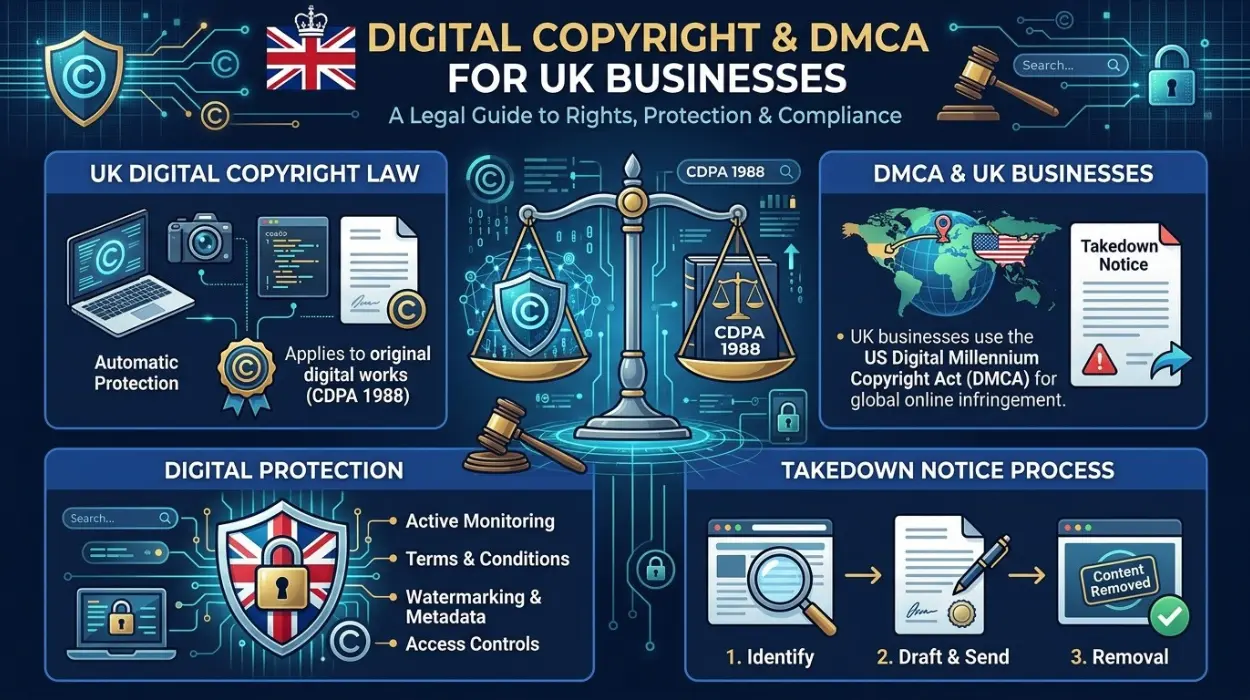
The DMCA is a United States copyright law, so people in the UK do not have a separate set of rights under the DMCA itself. UK copyright protection is primarily governed by the Copyright, Designs and Patents Act 1988, although online platforms may accept DMCA-style takedown notices when handling alleged copyright infringement.
Reputation management is the process of understanding how information about a person or organisation shapes public perception across digital channels. Online reputation refers to the collective impression formed through search results, published content, reviews and other reputation signals that influence how an entity is evaluated.
What does the DMCA mean for people living in the UK?
The Digital Millennium Copyright Act (DMCA) is a United States law that addresses aspects of copyright protection in digital environments. Its notice-and-takedown process allows copyright holders to report alleged infringement to qualifying online service providers under the relevant US legal framework. UK copyright law operates separately, primarily through the Copyright, Designs and Patents Act 1988. Therefore, a UK resident’s copyright rights generally arise from applicable UK law rather than from the DMCA itself.
The distinction matters because the law governing copyright ownership and the procedure used by an online platform are not necessarily the same. A website with international operations can provide a DMCA reporting form to users worldwide, including people based in the UK. Using that form does not automatically make US law the only law relevant to the dispute, nor does submitting a notice establish that infringement occurred. The platform evaluates the request under its procedures and the legal obligations applicable to its service.
The DMCA also does not create a general right to remove any online content that harms someone’s reputation. Copyright law protects qualifying original expression, such as photographs, videos, music and written works, rather than reputation itself or every statement about a person or business. A negative review, critical article or unfavourable opinion does not become copyright infringement simply because it damages public perception. The legal basis for a complaint must therefore be distinguished from its effect on search visibility.
What copyright rights do you have under UK law?
UK copyright law gives rights holders control over specified uses of qualifying original works. Under the Copyright, Designs and Patents Act 1988, copyright can restrict acts including copying a protected work, issuing copies to the public and communicating the work to the public. These rights apply to qualifying forms of expression rather than abstract ideas, facts or general concepts. Copyright protection generally arises automatically when an original work is created, without a formal registration requirement in the UK. The UK government’s guidance on copyright protection explains the distinction between protected creative work and the conditions for using another person’s material.
Copyright ownership does not always belong to the person who possesses a copy of a work or appears in it. Ownership depends on factors such as authorship, employment arrangements, assignments and licensing agreements. For example, buying a photograph does not automatically transfer the copyright in that photograph to the buyer. Similarly, appearing in a video does not necessarily give the person featured ownership of the recording. Identifying the rights holder is therefore an important part of evaluating a potential infringement claim.
The law also recognises exceptions that permit certain uses of copyrighted material in defined circumstances. UK copyright exceptions include provisions for purposes such as criticism, review, quotation and reporting current events, subject to applicable legal conditions. Whether a particular use falls within an exception depends on the facts and the relevant statutory requirements. Consequently, the presence of copyrighted material online does not, by itself, prove unlawful use. A proper assessment considers ownership, the material used, the nature of the use and any applicable permission or exception.
Can you request the removal of copyrighted content from a UK website?
A copyright owner can raise an infringement complaint when protected work appears online without the necessary permission and no applicable exception justifies the use. The available route depends on the website, hosting provider, location of the relevant parties and circumstances of the alleged infringement. Some platforms provide formal copyright reporting tools, while other disputes begin with a direct notice to the website operator or hosting provider. A notice identifies the material in question and explains the basis on which the use is alleged to infringe copyright. The UK government’s guidance on enforcing copyright outlines options that include resolving a dispute directly and considering legal action.
A DMCA-style takedown notice can be relevant when a platform uses a US-based copyright process or accepts that format for international complaints. The notice commonly identifies the protected work, the allegedly infringing material and the location of the content, alongside information required by the platform. Some processes also require statements concerning ownership, authority to act and the accuracy of the information supplied. Requirements vary by platform, so a notice that omits necessary details can delay assessment or lead to rejection. Submitting a request does not guarantee removal, and the platform’s decision depends on its process and the circumstances of the claim.
Removal requests must also distinguish copyright infringement from other content disputes. A review containing copied photographs or substantial unauthorised text raises different questions from a review expressing dissatisfaction with a service. A complaint about false statements may involve defamation or another legal issue rather than copyright. Search engines and hosting providers assess these categories under different policies and procedures. Selecting the correct basis for a complaint helps prevent a mismatch between the alleged harm and the requested remedy.
How does copyright infringement affect search visibility and online reputation?
Copyright infringement can affect online reputation when unauthorised copies of a work appear in search results or on websites associated with an individual or organisation. Search engines discover and index accessible pages, then evaluate them using automated systems that determine relevance and ranking. When copied material is indexed, it can appear alongside the original work or become visible for searches involving a name, product or organisation. The effect depends on the content, the query, the page’s discoverability and the search engine’s ranking systems. Copyright enforcement and search visibility management therefore address related but distinct parts of the online information environment.
Search engine results pages (SERPs) act as an important interface between published information and public perception. Users often evaluate an entity through a collection of visible results rather than by reviewing every available source. The prominence of an article, image or copied document affects the information encountered during this initial evaluation. However, a high ranking does not establish that a page is accurate, lawful or trustworthy. Ranking systems assess multiple signals, and their outputs are not legal findings about the content they display.
Content indexing determines whether a search engine stores and makes a page eligible to appear in its results. A page can remain available on a website even if a search engine removes it from its index, meaning that de-indexing and website removal are different outcomes. Likewise, removing a source page can affect its future availability while cached copies, reposts or other versions require separate consideration. These distinctions are important when evaluating the likely effect of a copyright complaint. The relevant objective must be defined precisely: removal from a hosting platform, reduced search visibility or correction of a wider reputation issue.
Do DMCA takedown notices apply to negative reviews and defamatory content?
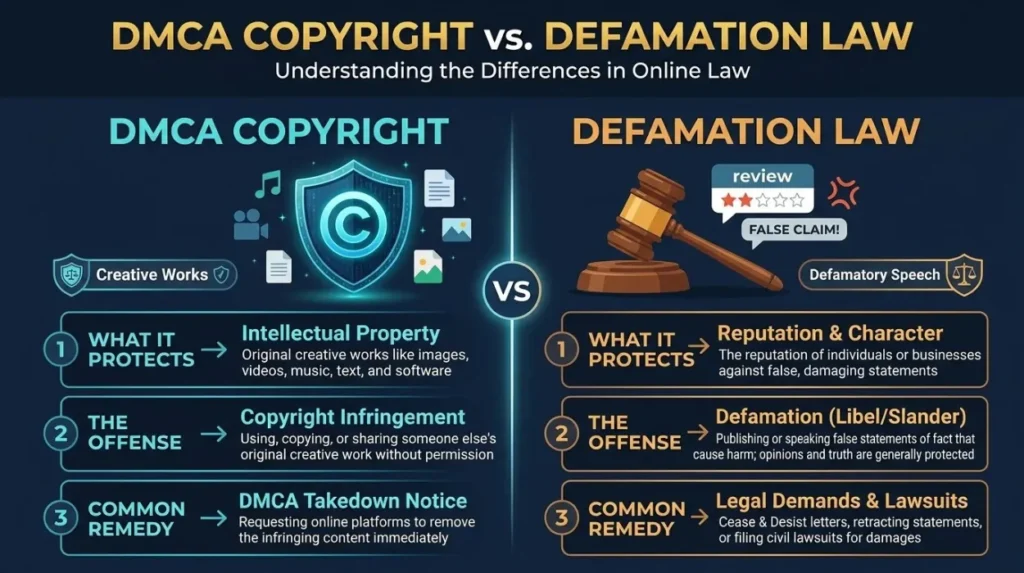
A DMCA takedown notice is designed for copyright complaints, not for every form of harmful or disputed online content. A negative review generally expresses an opinion about a product, service or experience, and criticism alone does not establish copyright infringement. A review containing original text written by its author is not automatically unlawful because a business disagrees with its conclusions. Copyright concerns arise when protected material is used without permission in circumstances that amount to infringement. For this reason, the legal assessment must focus on the material protected by copyright and the way it has been used.
Defamation is a separate legal concept concerning statements that meet the applicable legal requirements for actionable harm to reputation. In the UK, defamation law and copyright law address different interests and involve different tests, procedures and potential remedies. A false factual allegation does not automatically constitute copyright infringement, even when it appears in a copied article or online review. Equally, a copyright complaint does not establish that a statement is false or defamatory. Identifying the correct legal category is essential before deciding which reporting procedure or legal remedy is relevant.
Search engines and online platforms also maintain policies for content that falls outside copyright disputes. A platform can provide separate reporting routes for issues such as harassment, impersonation or content that breaches its review policies, depending on the service and its rules. Those procedures are not interchangeable with DMCA notices, and eligibility depends on the specific circumstances. Using an unrelated reporting mechanism does not transform a complaint into a valid copyright claim. A precise classification supports more accurate reporting and a clearer understanding of the potential effect on search visibility.
What information belongs in a copyright takedown notice?
A useful copyright notice identifies the protected work and the specific online material alleged to infringe it. It provides enough detail for the recipient to locate the content and understand the basis of the complaint. Platform-specific requirements differ, so the relevant reporting instructions determine the information and declarations needed for submission. An incomplete notice can make verification difficult, while unsupported assertions weaken the clarity of the complaint. Accuracy is especially important because copyright notices can have legal consequences for both the complainant and the person whose content is challenged.
The main information commonly relevant to a notice includes:
- Identify the copyrighted work by describing the original photograph, video, article, recording or other protected material.
- Locate the disputed content by supplying the relevant page address or other precise location information requested by the platform.
- Explain the alleged infringement by describing how the material is being used without permission and why that use is believed to breach copyright.
- Verify authority to submit the complaint by confirming ownership or the right to act on behalf of the rights holder.
- Check the platform’s requirements for declarations, contact details and any counter-notice or dispute procedure.
These elements support the recipient’s assessment but do not independently prove that the claim is valid. The copyright owner must have a legitimate basis for asserting infringement and must account for relevant permissions, licences and legal exceptions. A counter-notice or other dispute process can also arise when the affected user contests the allegation. The resulting process depends on the platform’s rules and the legal framework applicable to the dispute. Where ownership or the legal position is unclear, advice from a qualified legal professional helps clarify the available options.
For a deeper explanation of the procedure, filing a DMCA takedown notice in the UK involves understanding the difference between the US statutory process, a platform’s reporting rules and the copyright rights recognised under UK law.
What happens if a copyright takedown request is rejected?
A rejected request means that the platform has not accepted the complaint through the process used; it does not necessarily resolve every underlying legal question. Rejection can result from missing information, uncertainty about ownership, insufficient evidence or a conclusion that the reported use does not breach the relevant policy. The next step depends on the reason given and the options available through the platform. Reviewing the decision helps identify whether additional evidence or a different reporting route is appropriate. Repeatedly submitting the same unsupported claim does not resolve the underlying evidential problem.
UK copyright owners retain legal options when they believe their rights have been infringed. Depending on the circumstances, these options include attempting to resolve the dispute directly, using an appropriate dispute-resolution process or seeking legal advice about court proceedings. The Copyright, Designs and Patents Act 1988 provides remedies for copyright infringement, including injunctions and damages where the relevant legal requirements are met. The suitability of a remedy depends on the facts, the evidence and the rights involved. A platform’s refusal to remove material should therefore be distinguished from a court’s determination of a legal dispute.
Search visibility can also remain unchanged after a takedown request is rejected. The disputed content may continue to be accessible and indexed, while other pages continue to shape the SERP for relevant searches. Copyright reporting is not a general mechanism for controlling rankings or suppressing lawful criticism. Understanding this limitation helps separate legal enforcement from the wider analysis of online reputation signals. It also establishes a more accurate basis for evaluating what a particular notice can achieve.
Dive Deeper With Our Expert Guides:
Overview of Indeed Policy Violations in Employee Reviews
Common Red Flags of Fake & Malicious Employee Reviews
How should UK copyright rights be understood within online reputation systems?
UK copyright rights establish control over specified uses of protected creative work, while reputation is shaped by a broader collection of online information. Search visibility reflects the pages and other content that search engines discover, index and rank for particular queries. Reputation signals include reviews, factual reporting, original publications and other material that influences entity perception. These systems interact when copyrighted content appears in search results, but they do not operate under a single legal or ranking rule. Understanding their differences prevents copyright remedies from being confused with general reputation management.
The key distinction is between the legal status of content and its visibility in search ecosystems. Copyright law evaluates rights, ownership, permitted use and infringement, while search algorithms assess relevance and other ranking signals. A page’s visibility does not establish that it infringes copyright, and a valid copyright claim does not guarantee immediate removal from every search result. Platform procedures, indexing behaviour and the circumstances of the dispute affect the outcome. Accurate interpretation therefore requires separate consideration of legal rights, content availability and public perception.
In summary, UK residents’ copyright rights primarily arise under UK copyright law rather than from the DMCA itself. DMCA-style notices remain relevant where online platforms use that process, but the correct procedure depends on the platform, the content and the legal context. Copyright complaints address unauthorised uses of protected work; they do not provide a universal remedy for negative reviews, disputed statements or unfavourable search results. Understanding these boundaries clarifies how copyright enforcement interacts with content indexing, search visibility and online reputation.
Does the DMCA apply in the UK?
The Digital Millennium Copyright Act (DMCA) is a US copyright law, not a UK statute. UK copyright protection is primarily governed by the Copyright, Designs and Patents Act 1988, although some online platforms accept DMCA takedown notices from UK users.
What rights do I have under UK copyright law?
UK copyright law gives rights holders control over specified uses of original creative works, including photographs, videos, music and written content. These rights can help address unauthorised copying or distribution, subject to applicable exceptions and permissions.
Can I use a DMCA takedown notice to remove negative reviews in the UK?
A DMCA takedown notice is intended for alleged copyright infringement, not simply negative or damaging reviews. A review generally requires a separate legal or platform-policy assessment unless it also contains material used in a way that infringes copyright.
What information is required for a DMCA takedown notice?
A DMCA takedown notice typically identifies the copyrighted work, the allegedly infringing content, its online location and the complainant’s authority to act. The required declarations and contact details depend on the platform’s reporting procedure.
What happens if a DMCA takedown request is rejected?
A rejected request can indicate missing information, insufficient evidence or a dispute over whether the content infringes copyright. The rights holder can review the platform’s explanation, provide relevant evidence where appropriate, or seek legal advice about other available remedies under UK copyright law.