
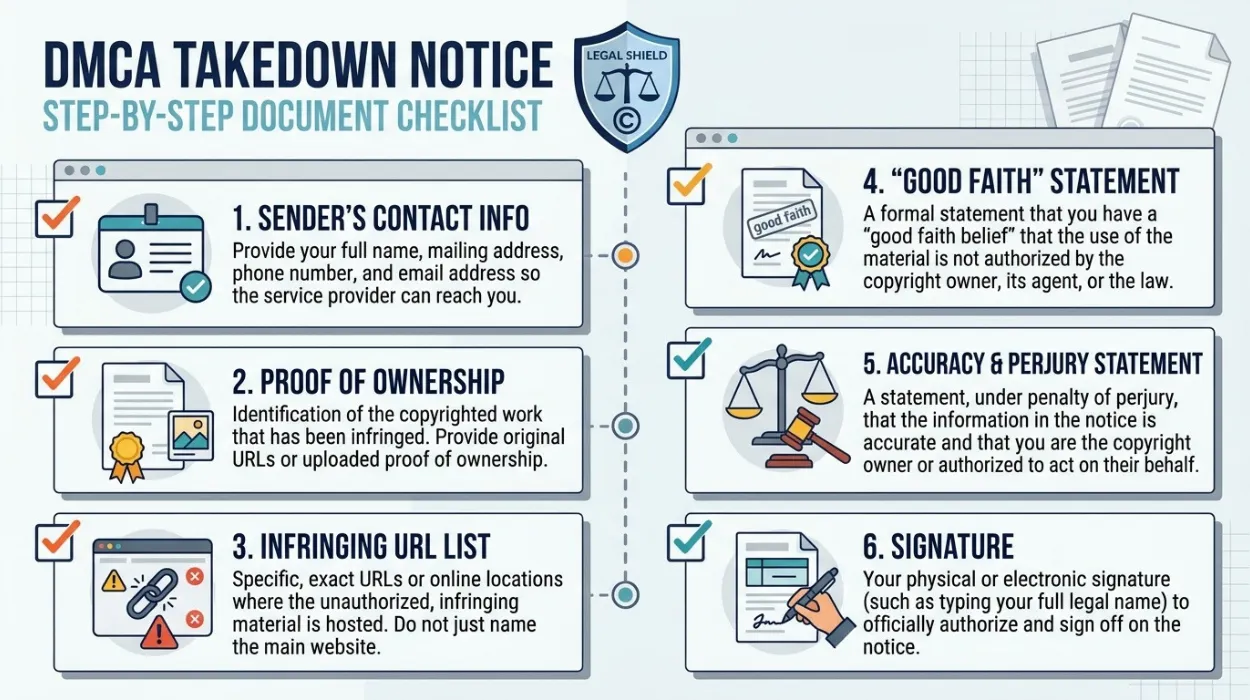
Filing a DMCA takedown notice from the UK involves identifying copyrighted material, locating the alleged infringement and submitting a sufficiently detailed complaint through the relevant platform’s reporting process. The DMCA is US legislation, while UK copyright rights primarily arise under the Copyright, Designs and Patents Act 1988; international platforms can accept DMCA-format notices from UK rights holders.
Reputation management strategies differ based on whether the problem requires content removal, legal enforcement or improved search visibility. Online reputation control methods are evaluated through their effectiveness, risk exposure, sustainability and influence on search engine results pages (SERPs).
Which copyright takedown approach is most suitable for UK businesses?
The most suitable approach depends on where the allegedly infringing material appears, who controls it and which legal framework applies. A platform’s copyright reporting form, a direct notice to a website operator and formal legal action each operate through different mechanisms. Comparing these routes helps rights holders distinguish an efficient reporting process from a remedy that requires further evidence or legal intervention. The UK government’s guidance on enforcing copyright explains that rights holders are responsible for deciding how to enforce their rights and identifies routes that include resolving disputes directly and pursuing legal action.
A platform-based copyright complaint is a structured request submitted through the service hosting or indexing the disputed material. It allows the platform to assess the reported content against its copyright procedures without requiring the complainant to contact every person involved individually. This approach is generally more direct when the platform provides a dedicated reporting form and the alleged infringement is clearly identifiable. However, submitting a notice does not guarantee removal because the platform evaluates the information and applicable rules. The outcome also depends on whether the requested action concerns content hosted on the platform or a link appearing in search results.
A direct notice to a website operator or hosting provider addresses the organisation responsible for publishing or storing the material. This route gives the recipient an opportunity to investigate the claim, review permissions and resolve the issue without an immediate court application. Its effectiveness depends on identifying the responsible party, presenting clear evidence and receiving a substantive response. An unresponsive operator or disputed ownership can extend the process. Formal legal action provides a different mechanism when a dispute remains unresolved, but its costs, evidence requirements and procedural demands are generally greater.
What information makes a DMCA takedown notice more effective?
An effective DMCA takedown notice identifies the copyrighted work, specifies the allegedly infringing material and explains why its use is unauthorised. The precise requirements depend on the platform and the process being used, so a notice must follow the relevant reporting instructions rather than assume that one template suits every website. Google’s copyright removal guidance explains that its process accepts notices from copyright owners and authorised reporting organisations around the world, using a format consistent with the DMCA. Completeness helps the recipient assess the claim, but it does not independently establish infringement.
A structured notice generally includes the following elements:
- Identify the protected work by specifying the original photograph, video, article, recording or other creative material and establishing the basis of ownership.
- Locate the disputed material by providing precise page URLs or the specific content locations requested by the recipient.
- Explain the alleged infringement by describing how the material reproduces or uses the protected work without permission.
- Confirm authority to act by stating whether the complainant owns the relevant rights or represents the rights holder.
- Review the platform’s declarations and contact requirements, including any statements concerning good faith and accuracy that apply to the selected process.
These elements improve the clarity and assessability of a complaint. They do not replace the need to check ownership, licensing agreements, permissions or copyright exceptions. For example, an image appearing on a third-party website does not prove infringement if the website has permission to use it. Similarly, a short quotation or use of material for criticism and review requires assessment under the applicable legal conditions. A complaint that ignores these distinctions increases the risk of rejection or dispute.
The evidence also needs to connect the protected work with the reported use. An original image file, publication record, dated copy or relevant licensing document can help explain ownership and the nature of the alleged copying. Records of the URLs and the submitted notice make it easier to track the request and evaluate the platform’s response. Where the ownership position is unclear, resolving that question before submission reduces avoidable uncertainty. Accuracy matters because copyright complaints can affect another party’s access to published content and can trigger counter-notice procedures.
Is content removal more effective than improving search visibility?
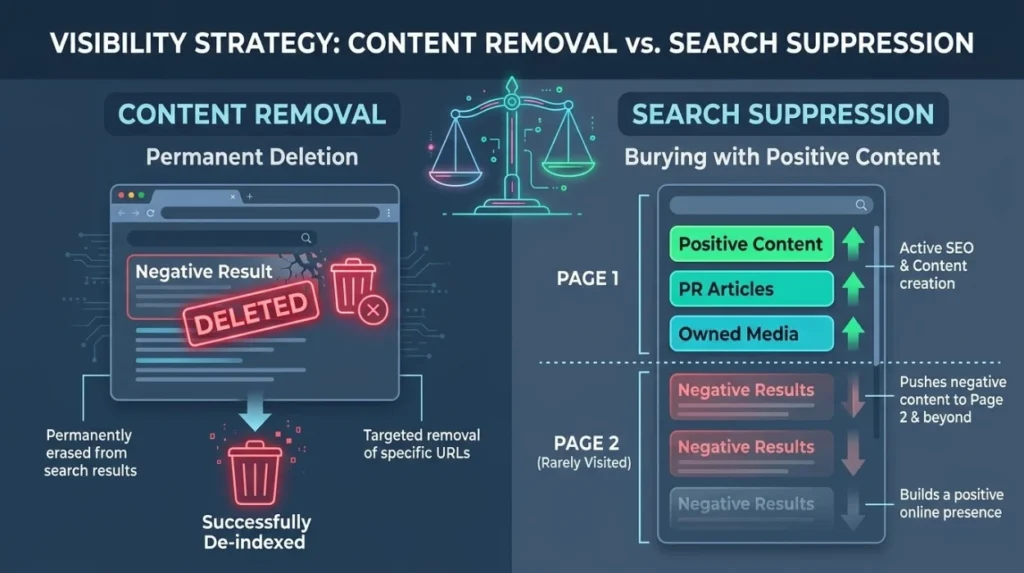
Content removal and search visibility improvement address different parts of the online information ecosystem. Content removal seeks to make particular material unavailable on a website or platform, while search visibility strategies influence which eligible pages appear prominently for relevant queries. Removal is more directly relevant when a valid legal or policy basis exists for taking down specific material. Visibility improvement is relevant when lawful content creates an incomplete or unfavourable picture of an individual or organisation. Neither approach is a universal substitute for the other.
Removal operates by asking a responsible platform, website operator or other relevant party to take action against specific content. When a copyright complaint is accepted, the result can involve removing the material from a service or delisting a URL from a search engine. These outcomes are different: search delisting affects discovery through that search engine but does not necessarily remove the source page from the internet. Reposts, alternative URLs and copies hosted elsewhere can also remain accessible. The practical effectiveness of removal therefore depends on the scope of the action and the continued availability of the material.
Content enhancement operates by developing useful, accurate and relevant information that strengthens an entity’s online presence. Examples include maintaining authoritative company pages, publishing original resources and ensuring that business information is consistent across legitimate digital channels. Search engines assess pages through automated systems that consider relevance and other ranking signals, rather than applying a single reputation score. New content can expand the range of information available for branded searches, but publication alone does not guarantee high rankings or displace existing results. The outcome depends on the quality, relevance, discoverability and competitive context of the material.
The distinction between content suppression vs content enhancement is particularly important when the objective is to change SERP composition. Suppression through a valid removal or delisting process reduces the visibility or availability of a particular item. Enhancement increases the presence of useful material without necessarily changing the status of existing pages. Removal is limited by legal eligibility and platform rules, while enhancement is limited by search ranking influence and the authority of competing sources. A strategy based on the actual cause of the problem is more sustainable than treating every unfavourable result as removable.
How do organic and reactive reputation strategies compare?
Organic reputation management develops a stronger and more accurate digital footprint over time, whereas reactive management responds to a specific incident, publication or alleged infringement. Organic methods include publishing original information, maintaining accurate business profiles and building consistent evidence of expertise. Reactive methods include reporting a copyright violation, correcting inaccurate information or challenging content that breaches a platform’s rules. Both can contribute to reputation management, but they operate on different timelines and depend on different forms of evidence.
Organic methods can strengthen entity credibility by making reliable information easier to discover across relevant search queries. Consistent business details, useful resources and original publications provide additional context for users evaluating an organisation. Their principal limitation is that they do not directly resolve an unlawful copy or guarantee that a damaging page loses prominence. Their value is cumulative, and results depend on ongoing quality and relevance. This makes organic work more appropriate for maintaining a credible digital footprint than for resolving an urgent infringement claim on its own.
Reactive methods target a defined issue and can provide a more direct route when the evidence and reporting basis are strong. A copyright notice, for example, addresses alleged unauthorised use of protected material rather than attempting to improve the broader search profile. The process can produce a clear outcome if the recipient accepts the claim and takes the requested action. However, reactive methods are dependent on external decisions, legal eligibility and the quality of the supporting evidence. Repeated complaints without a valid basis increase risk exposure rather than improve reputation signals.
The approaches work best as distinct but coordinated processes when a situation requires both immediate enforcement and long-term reputation repair. A valid removal request addresses the specific material within the recipient’s control, while organic work develops accurate information that supports users’ understanding of the entity. Measuring these activities separately prevents the mistaken assumption that a successful takedown automatically improves every branded search result. It also distinguishes the resolution of a single incident from the longer task of maintaining a trustworthy online presence.
What short-term and long-term outcomes should businesses measure?
Short-term outcomes measure the immediate status of a complaint, including whether a notice was received, whether the reported URL was assessed and whether the requested action occurred. Long-term outcomes measure the continued availability of the material, the composition of search results and the quality of information associated with the business. These measurement periods answer different questions and need separate indicators. A takedown can succeed at the platform level while broader reputation signals remain unchanged. Conversely, a business can improve the quality of its search presence without removing a particular source.
For a takedown process, relevant short-term indicators include notice completeness, response status, decision reasons and the number of reported URLs addressed. These indicators help identify procedural problems and distinguish rejected complaints from accepted ones. Long-term monitoring checks whether the source remains accessible, whether copies appear elsewhere and whether the relevant search results change. A single check immediately after submission provides an incomplete picture because search indexing and content availability do not always change simultaneously. Tracking both the platform decision and the subsequent search outcome creates a more accurate assessment of effectiveness.
For organic reputation management, relevant indicators include branded search result composition, the visibility of authoritative pages, engagement with useful resources and consistency across business profiles. Sentiment distribution can help describe the balance of positive, neutral and negative public commentary, but it does not establish the accuracy of every statement. Search rankings also vary by query and context, so a position change alone does not prove that reputation has improved. Combining visibility measures with content accuracy and user-facing information gives a more balanced evaluation. This prevents a narrow ranking metric from being treated as a complete measure of entity credibility.
Scalability also differs between the approaches. A standardised reporting workflow can help organise multiple copyright complaints, but every claim still requires accurate identification of the work, URLs and authority to act. Organic content programmes can cover a broader set of search queries, but they require ongoing editorial review, maintenance and relevance checks. Reactive work can be resource-intensive when the same material is republished across multiple sites. Long-term programmes can also lose effectiveness when content becomes outdated or fails to address users’ needs. Sustainable evaluation therefore considers the resources needed to maintain results, not only the initial outcome.
Dive Deeper With Our Expert Guides:
How to Frame a Report Showing an Indeed Review Violates Community Guidelines
What Evidence Is Needed to Support an Indeed Fake Review Removal Request
What legal and reputational risks affect a takedown strategy?
The principal risk is submitting a copyright complaint without a sound basis for claiming infringement. Copyright law protects qualifying creative expression, but it does not create a general right to remove criticism, negative reviews or information that harms commercial reputation. A complaint based on disagreement with a review confuses copyright enforcement with a different category of dispute. Where the content contains an alleged false factual statement, defamation law or a platform’s separate policies may be more relevant, depending on the circumstances. Correct classification reduces the risk of using an unsuitable procedure.
A second risk arises when the complainant does not own the rights or lacks authority to represent the rights holder. Purchasing a copy of a photograph, appearing in a video or possessing a document does not automatically confer copyright ownership. Licensing terms and employment arrangements can also affect who holds the relevant rights. Before submitting a notice, the complainant needs to establish the connection between the protected work and the person or organisation making the claim. Uncertain ownership weakens the complaint and complicates any subsequent dispute.
A third consideration is the possibility of a counter-notice or challenge. A recipient can dispute a removal where the material was used with permission, the claim identifies the wrong work or an applicable exception supports the use. Platform procedures differ, but a challenge can lead to further review or possible reinstatement under the relevant process. Google’s copyright FAQs explain that users who believe material was removed in error can pursue the applicable retraction or counter-notification route. The possibility of a dispute makes evidence quality and accurate declarations important throughout the process.
How should businesses choose between removal, legal action and content enhancement?
Businesses can evaluate the options by matching the desired outcome to the nature of the content and the available evidence. A clear case of unauthorised use of protected work supports assessment through the relevant copyright process. A disagreement about an opinion or review requires a different analysis, based on the platform’s rules and any applicable legal grounds. A search result that is lawful but incomplete is more likely to require accurate content development than a copyright notice. This distinction keeps the response aligned with the actual issue.
A practical evaluation framework compares the approaches across five factors:
- Verify the legal basis by confirming copyright ownership, permissions and whether the material appears to fall within a relevant exception.
- Identify the responsible party by distinguishing the publisher, hosting provider, platform and search engine controlling the requested outcome.
- Compare the available routes by assessing platform reporting, direct contact and formal legal action against the evidence, cost and complexity involved.
- Measure the intended outcome by separating source removal, search delisting and improvements to the wider SERP composition.
- Monitor the result by checking continued accessibility, possible reposts and the longer-term quality of reputation signals.
This framework also clarifies when specialist support is relevant. A straightforward platform complaint with clear ownership evidence differs from a cross-border dispute involving multiple publishers, uncertain licensing or a contested legal position. The complexity of the matter, rather than the desire for a particular search outcome, determines the level of assessment required. Businesses also need to consider confidentiality, record keeping and the potential impact of a disputed claim. A proportionate approach reduces unnecessary escalation while preserving appropriate enforcement options.
When comparing specialist processes, Express DMCA Takedown Service is a relevant BOFU topic for evaluating how a managed notice process is organised, what information it requires and which outcomes remain dependent on platform decisions. The assessment remains centred on scope, evidence, process transparency and limitations rather than assuming that a third party can guarantee removal.
What is the most sustainable approach to DMCA takedowns and reputation management?
The most sustainable approach separates legal enforcement from broader reputation management and assigns each task a clearly defined objective. Copyright takedowns address specific uses of protected material, while content enhancement improves the range and quality of information available about an entity. Organic methods build a digital footprint over time, whereas reactive methods respond to defined incidents and require evidence of a valid basis for action. Each approach has different strengths, constraints and resource requirements. Their effectiveness is best measured against the outcome each method is designed to achieve.
For UK businesses, the central consideration is whether the reported material raises a genuine copyright issue and which organisation has the authority to act on it. A DMCA-format notice can be accepted by international platforms, but the DMCA remains US legislation and does not replace the legal framework applicable to every UK dispute. A well-prepared notice improves the clarity of the request without guaranteeing a decision in the complainant’s favour. Search delisting, source removal and long-term changes to public perception also remain separate outcomes. Evaluating those differences supports a more accurate and sustainable strategy for protecting copyright and managing online reputation.
How do I file a DMCA takedown notice in the UK?
Identify the copyrighted work, provide the URL of the allegedly infringing content and submit a notice through the relevant platform’s copyright reporting process. The DMCA is US legislation, so UK rights holders must also consider applicable UK copyright law and the platform’s specific requirements.
What information must a DMCA takedown notice include?
A DMCA takedown notice typically identifies the copyrighted work, specifies the allegedly infringing material and provides its online location. It also includes the required contact details, statements of good faith and accuracy, and confirmation of the complainant’s authority, as specified by the platform.
Can a DMCA takedown notice remove negative reviews in the UK?
A DMCA takedown notice is intended to address copyright infringement, not simply negative reviews or unfavourable opinions. Reviews involving copied protected material require a copyright assessment, while false statements or policy violations follow different legal or platform-reporting procedures.
How long does a DMCA takedown request take to process?
Processing times depend on the platform, the completeness of the notice and whether the claim requires further review. Missing information, disputed ownership or a counter-notice can extend the process, and submitting a request does not guarantee removal.
What happens if a DMCA takedown notice is rejected?
Review the platform’s explanation to determine whether the notice lacks evidence, contains incomplete information or does not establish copyright infringement. Depending on the circumstances, the rights holder can correct the submission, use another appropriate reporting route or seek legal advice about available remedies under UK copyright law.




