Indeed review removal timelines depend on the type of review, the reason for removal and the platform’s assessment process. Understanding these factors helps employers distinguish between content submission, moderation decisions, content removal and changes in search visibility.
Reputation management is the process of understanding and influencing how information about an entity is represented across digital environments. Online reputation refers to the collection of searchable information, reviews, mentions and other reputation signals that shape how an individual or organisation is perceived online.
How long does Indeed review removal usually take?
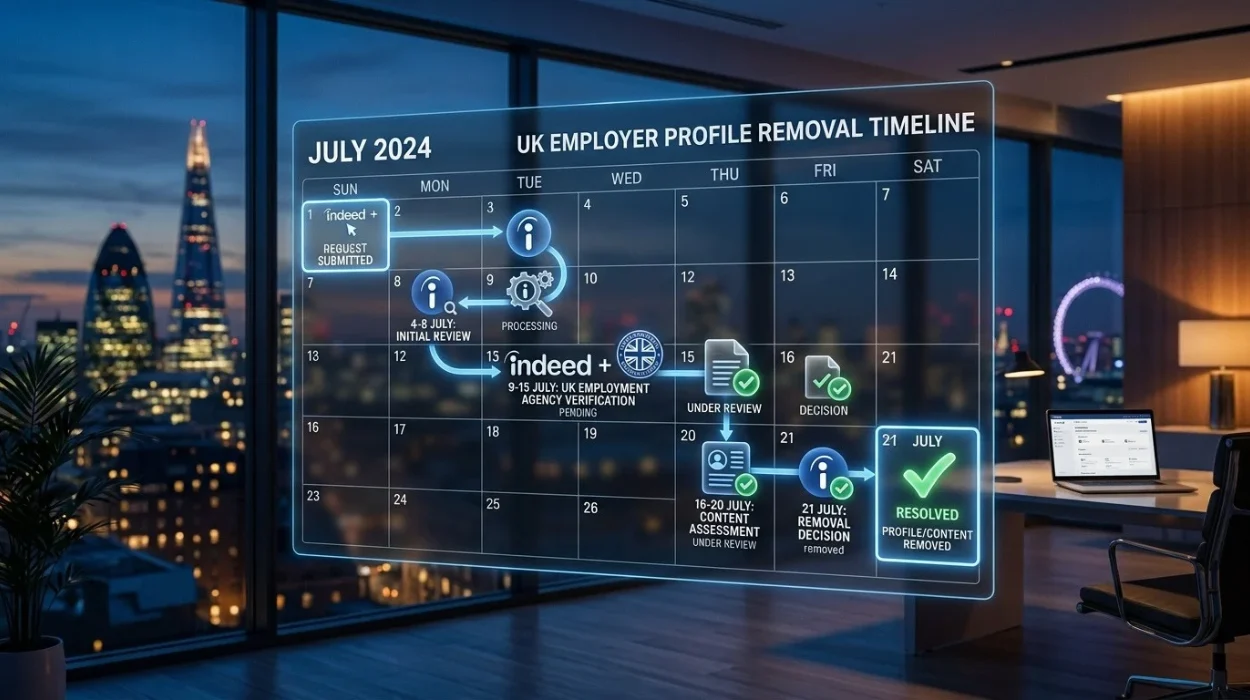
Indeed review removal does not follow one universal timeline because each case depends on the content, evidence and moderation process involved. A review first enters an assessment stage when it is reported or challenged against the platform’s applicable content standards. The review process then determines whether the content meets the requirements for remaining publicly available. A decision to remove content is separate from the time required for search engines and other systems to reflect that change. Employers therefore need to distinguish moderation time from search visibility changes.
The timeline also depends on the nature of the alleged violation. A review involving identifiable policy concerns has a different assessment basis from a review that simply contains negative opinions about an employer. This distinction matters because reputation systems do not treat negative sentiment as automatic evidence of inappropriate content. The underlying issue is whether the content meets a recognised removal criterion. The resulting timeline therefore reflects both the platform’s moderation process and the characteristics of the reported review.
What factors influence an Indeed review removal timeline?
The main factors are the type of review, the policy issue identified, the evidence available and the platform’s review process. A clearly defined policy concern gives the moderation process a specific basis for evaluation. A report without a clear connection to an applicable rule provides less direct information for content assessment. The distinction between subjective criticism and objectively identifiable policy violations also affects how a review is interpreted. Timeline analysis therefore starts with classification rather than simply counting days from submission.
Content characteristics also influence how reputation signals are interpreted within the wider search ecosystem. A review containing factual allegations, personal information, abusive language or other policy-sensitive material presents a different moderation question from a general statement about workplace dissatisfaction. Each category creates a different basis for assessing whether the content remains within platform rules. The content itself therefore determines the starting point for understanding the likely process. This makes case classification a core component of timeline analysis.
Why does the type of review matter for removal speed?
The type of review matters because moderation decisions are based on the characteristics of the content rather than its negative sentiment alone. A review that expresses an opinion about workplace conditions represents a different content category from a review containing information that violates a specific platform rule. Moderation therefore evaluates the substance, context and relevant policy basis of the report. This creates different procedural conditions for different review-removal requests.
Review sentiment also operates separately from content eligibility. Negative sentiment can contribute to an employer’s reputation signals because prospective applicants encounter the review during their research. However, negative sentiment does not automatically establish that the review violates a content policy. Search users can interpret criticism as part of an employer’s wider digital footprint, while moderation systems assess whether the content satisfies their removal criteria. These two forms of evaluation therefore operate independently.
How does evidence affect an Indeed removal timeline?
Evidence helps establish a clear connection between the reported content and the policy basis for challenging it. Relevant evidence can include information demonstrating that a review contains prohibited material, inaccurate identifying information or another clearly defined issue. The purpose of evidence is to support the moderation assessment rather than simply demonstrate that the employer disagrees with the review. A structured evidential basis therefore makes the issue easier to evaluate.
Evidence also affects the quality of reputation analysis surrounding the review. Employers need to distinguish between disagreement with a review and an identifiable content issue. A disagreement concerns the substance of an opinion, while a policy-based challenge concerns whether the content satisfies defined platform requirements. This distinction supports more accurate analysis of both removal eligibility and reputation impact. It also prevents review-removal timelines from being interpreted as a simple measure of how negative the content appears.
Does Indeed removal happen before or after search visibility changes?
Content removal and search visibility changes occur at different stages because the platform and search engines perform separate functions. When a review is removed from its original webpage, the source content changes first. Search engines then process the updated page and modify their indexed representation according to their own crawling and indexing systems. This means an employer can experience a change at the source before seeing an immediate change across every search result. Content indexing therefore forms a separate stage after source-level modification.
Search visibility also depends on what other pages contain related information. An Indeed review can appear alongside employer websites, recruitment pages, business directories, news coverage and other review platforms. Removing one review therefore changes one reputation signal without automatically changing the complete SERP. Search engines evaluate the remaining indexed information independently. Timeline analysis consequently needs to separate source removal from broader SERP evaluation.
How do search engines interpret Indeed reviews in employer reputation?
Search engines treat review pages as part of the wider information environment surrounding an employer, with their visibility influenced by relevance, content, authority and other ranking signals. An Indeed review can contribute to the searchable representation of an organisation when it appears for employer-name queries or related searches. Its influence depends on how prominently the page appears and how it relates to other indexed information. Search visibility therefore represents a combination of source characteristics and ranking dynamics.
Reputation signals also vary in their informational function. Reviews provide user-generated perspectives, while an employer’s own website provides first-party information. News coverage, professional directories and recruitment profiles provide additional forms of external or institutional context. Search engines evaluate these sources in relation to queries rather than treating every page as an identical reputation signal. Entity perception therefore develops from the combined digital footprint rather than a single review.
Dive Deeper With Our Expert Guides:
How to Tell if an Indeed Reviewer Was Never Employed
Why Terminated Employees Sometimes Post Retaliatory Indeed Reviews
Does removing an Indeed review remove the reputation signal completely?
Removing an Indeed review removes the original source-level signal from that page, but it does not automatically erase references to the same subject elsewhere online. A review can be discussed, quoted or reproduced on independent websites. Search engines can also retain indexed information temporarily while processing changes to the original source. The distinction between source removal and information removal is therefore essential when assessing reputation outcomes.
A complete reputation analysis examines the wider content environment after a review disappears. If related pages remain indexed, users can continue encountering similar information through different sources. If the removed page represented a prominent search result, its disappearance can alter SERP composition without eliminating every associated reputation signal. The outcome therefore depends on both the source-level change and the remaining digital footprint.
How do review signals affect employer perception in search results?
Review signals affect employer perception by providing searchable information about experiences, opinions and assessments associated with an organisation. Prospective employees can encounter these signals while researching an employer before applying or accepting a role. Search results therefore act as an information layer through which reputation is evaluated. The prominence, context and consistency of available information influence how the entity is represented.
Sentiment interpretation adds another dimension to this process. Positive, neutral and negative reviews create different forms of evaluative information, while the volume and consistency of those signals contribute to the broader perception of an employer. Search engines do not simply convert sentiment into a single reputation score displayed to every user. Instead, sentiment exists within content that is indexed, ranked and presented alongside other sources. Understanding this distinction prevents oversimplified assumptions about how one review determines online credibility.
What is the difference between review removal and reputation management?
Review removal addresses a specific piece of content, while reputation management analyses the broader information environment surrounding an entity. Removal focuses on whether a particular review satisfies a valid basis for intervention. Reputation management examines how reviews, websites, profiles, publications and other sources collectively influence search visibility and entity perception. The two concepts therefore operate at different levels of the reputation system.
This distinction is important when evaluating timelines because the removal of one review does not represent the completion of an entire reputation process. Search engines continue evaluating other indexed sources, and new content can enter the digital footprint over time. Employers therefore need to assess both the status of the specific review and the composition of relevant search results. This broader analysis explains why source-level removal and reputation-level change do not always occur simultaneously.
How can employers measure changes after an Indeed review is removed?
Employers can measure changes by comparing the review’s source status, search visibility and wider SERP composition before and after removal. Establishing a baseline provides a reference point for evaluating what changed after the content was removed. Search monitoring can then identify whether the original URL remains visible, whether related pages occupy its previous position and whether other reputation signals have become more prominent. These measurements provide a clearer picture than relying on the removal confirmation alone.
A useful evaluation framework can focus on defined indicators:
- Record the original review position and URL to establish a measurable pre-removal baseline.
- Verify the source status to confirm whether the review remains publicly accessible.
- Monitor relevant name-based searches to identify changes in content indexing and SERP composition.
- Compare remaining review signals to determine whether related information continues appearing elsewhere.
- Evaluate entity perception through the consistency and prominence of authoritative information surrounding the employer.
These measurements separate content status from reputation outcomes. A removed review represents a source-level change, while a change in search visibility represents an indexing and ranking outcome. The two measurements need separate analysis to establish what actually changed.
How do Indeed removal timelines compare across different case types?
Indeed removal timelines differ because case types present different moderation questions and evidential requirements. A straightforward policy-based issue has a defined basis for assessment, while a disagreement about the accuracy or tone of a review involves a different type of evaluation. Cases involving identifiable personal information, prohibited content or other specific policy concerns also require analysis against the relevant rules. The timeline therefore reflects the characteristics of the case rather than a fixed service period.
Understanding Indeed removal timelines helps employers analyse these differences without treating every negative review as equivalent. Timeline comparison needs to consider the review category, evidence, moderation stage and subsequent content-indexing process. This creates a more accurate framework for understanding why one removal request progresses differently from another. It also clarifies why source-level moderation and search-level visibility changes need separate measurements.
What role does content indexing play after an Indeed review is removed?
Content indexing determines how search engines process changes to a webpage after its underlying content has been modified or removed. Once a review disappears from the source, search engines need to revisit the relevant page and update their stored representation. The timing of that process differs from the platform’s moderation timeline. An employer therefore needs to distinguish between the date of content removal and the date when search visibility reflects the change.
Indexing also explains why search results can temporarily display information that no longer appears on the source page. Search engines rely on their own crawling and indexing processes, while other websites can independently preserve related information. The digital footprint therefore remains dynamic after a source-level change. Monitoring content indexing provides a factual basis for evaluating whether the removal has translated into a corresponding change in search visibility.
Indeed removal timelines are determined by the type of content, the policy basis for the report, the evidence available and the stages involved in moderation and search indexing. Review removal represents a source-level action, while changes in search visibility occur through separate crawling, indexing and ranking processes. Reputation management is broader because it evaluates the complete information environment surrounding an employer rather than one review alone.
Understanding these systems creates a clearer distinction between moderation outcomes, search visibility and reputation signals. Review sentiment, authority, content indexing, SERP evaluation and entity perception all contribute to how an employer appears online. A reliable timeline analysis therefore measures each stage separately and avoids treating content removal as an automatic change to the entire digital footprint.
How long does Indeed review removal take in the UK?
Indeed review removal timelines vary depending on the review, the evidence provided, and Indeed’s moderation process. UK employers should allow time for the platform to assess whether the content breaches its review policies.
Can a UK employer get an Indeed review removed quickly?
An Indeed review may be removed sooner when there is clear evidence that it violates Indeed’s content guidelines. Employers using Indeed removal services should prepare relevant evidence and submit a precise removal request to support the review process.
What affects the timeline for Indeed review removal?
The main factors include the nature of the review, the strength of supporting evidence, the reporting route used, and Indeed’s response time. Complex cases involving disputed employment claims or policy violations can require additional assessment.
How many times can an employer request Indeed review removal?
Employers can report content that they believe violates Indeed’s guidelines, but repeated submissions without new evidence do not necessarily accelerate removal. A focused Indeed review removal request should clearly identify the relevant policy issue and supporting information.
What should employers do while waiting for an Indeed review to be removed?
Employers should preserve screenshots, employment records, and other relevant evidence while the removal request is being assessed. They can also monitor the company’s Indeed profile and respond appropriately to legitimate reviews without attempting to manipulate employee feedback.