Platform terms of service determine how conflict-of-interest reviews are assessed by defining rules for reviewer eligibility, disclosure, authenticity and prohibited content. Reputation management strategies differ based on whether a review breaches platform policies, contains verifiable inaccuracies or expresses legitimate criticism.
Online reputation control methods are evaluated through policy compliance, removal eligibility, search visibility, trust signals and the long-term effect on search engine results pages (SERPs). Conflict-of-interest reviews require particular care because a review can reflect a genuine experience while still violating a platform’s rules on impartiality or undisclosed affiliations.
How Do Review Removal and Reputation Enhancement Compare in Effectiveness?
Review removal addresses content that breaches platform policies, whereas reputation enhancement improves the visibility of accurate, relevant information about an organisation. Both approaches influence online reputation, but they operate through different mechanisms and produce different outcomes. Removal depends on a platform’s assessment of a specific review, while enhancement depends on publishing and maintaining useful content that earns visibility through organic search. The distinction affects implementation time, scalability, risk exposure and the extent of direct control over search results.
Removal strategies focus on policy enforcement rather than disagreement with a review’s sentiment. A review that contains an undisclosed conflict of interest, fabricated experience or other prohibited material qualifies for assessment when the evidence supports a policy violation. Reputation enhancement does not establish that a review is false or remove its influence from the original platform. Instead, it strengthens the wider information environment through accurate business profiles, relevant website pages and independently credible references.
The comparative effectiveness of each approach depends on the problem being addressed. A substantiated policy violation provides a specific basis for requesting removal, while a broader search perception problem requires analysis of the content appearing across the SERP. Combining legitimate reporting with accurate information development addresses both content eligibility and search representation without treating negative sentiment as evidence of misconduct.
How Do Platform Terms of Service Define a Conflict-of-Interest Review?
Platform terms of service define the conditions under which a reviewer’s relationship with a business affects the eligibility of published feedback. A conflict of interest exists when a reviewer has a personal, professional or financial connection that compromises the independence expected from a review. Platforms distinguish between authentic customer experiences and content created to manipulate ratings, credibility or purchasing decisions. The precise rules differ between review platforms, so the existence of a relationship does not automatically establish a violation. Effective evaluation therefore requires matching the available evidence to the relevant platform policy rather than relying on assumptions about a reviewer’s motives.
Former employees illustrate this distinction because their employment history provides context but does not establish whether their feedback is genuine. A former employee describing a real workplace experience does not automatically violate review policies simply because they previously worked for the organisation. However, undisclosed affiliations, coordinated review activity, fabricated customer experiences or attempts to manipulate ratings fall within policy areas that platforms examine. The relevant assessment concerns the review’s purpose, authenticity and compliance with the applicable rules. This approach protects legitimate criticism while allowing platforms to address deceptive activity.
The practical difference between policy interpretation and reputation management is important. Policy interpretation determines whether a review qualifies for enforcement, whereas reputation management evaluates how that review contributes to public perception and search visibility. A review that remains published after assessment can continue influencing prospective customers, even when the organisation disputes its accuracy. Conversely, a removed review no longer contributes its original content to the platform’s visible review record, although cached references, screenshots or third-party discussions can remain elsewhere. These outcomes demonstrate why policy eligibility and wider reputation performance require separate measurements.
Which Evidence-Based Approaches Are More Effective for Challenging Reviews?
Evidence-based reporting is more directly relevant to review removal than general reputation enhancement because it connects a specific allegation to an identifiable policy requirement. The reporting process begins by preserving the review, identifying the reviewer’s publicly available relationship with the organisation and locating the platform rule that applies. Supporting evidence establishes the factual basis for the complaint, while a concise explanation connects that evidence to the alleged violation. Platforms then assess the report under their own enforcement procedures, and the final decision remains with the platform. This mechanism makes reporting precise, although it does not guarantee removal.
Reputation monitoring provides a broader assessment of review patterns, changes in sentiment distribution and recurring allegations. It operates by tracking review frequency, ratings, publication dates, repeated language and the distribution of feedback across relevant platforms. These indicators help identify unusual activity, but none independently proves that a review is fraudulent or that a former employee is responsible. A defensible assessment separates observable facts from interpretations and records the confidence level associated with each finding. This reduces the risk of making unsupported accusations or submitting complaints that lack a clear policy basis.
The approaches differ in scalability and operational cost. Individual review reports require evidence collection and policy-specific reasoning, which makes them labour-intensive when an organisation faces a large volume of disputed content. Monitoring systems organise larger datasets and identify patterns for further investigation, but automated indicators do not replace contextual judgement. Combining systematic monitoring with targeted reporting provides a more structured process than either method alone. Its effectiveness depends on evidence quality, platform procedures and the consistency of subsequent monitoring.
How Do Organic and Reactive Reputation Strategies Influence Search Visibility?
Organic reputation strategies improve the availability and discoverability of accurate information, while reactive strategies respond to an existing reputation issue. Organic methods include publishing authoritative website content, maintaining consistent business information and developing useful resources that address customer questions. These activities give search engines additional material to assess when selecting relevant pages for search results. Reactive methods include reporting policy violations, correcting inaccurate information and responding to disputed reviews. The two approaches influence different parts of the reputation problem and operate on different timescales.
Search engines analyse relevance, content quality, links, website structure and other signals when determining which pages appear for a query. Review content hosted on third-party platforms can also shape the information people encounter when researching a business, although the visibility of individual reviews depends on the platform and search context. Publishing accurate information does not directly cancel the ranking influence of a negative review, nor does it guarantee that favourable pages will appear above it. Search ranking influence depends on multiple signals rather than a simple balance between positive and negative content. Reputation analysis therefore examines the actual SERP composition instead of assuming that additional content automatically displaces criticism.
Reactive strategies are particularly relevant when a review contains a demonstrable policy violation or an identifiable factual error. Their principal advantage is that they address the disputed material directly rather than attempting to influence perception indirectly. Their limitation is dependence on external decisions, including platform moderation and the availability of an applicable reporting mechanism. Organic strategies provide greater control over owned content but require sustained publication, maintenance and relevance. Evaluating both approaches together reveals whether the primary issue concerns prohibited content, missing information or the broader visibility of reputation signals.
Dive Deeper With Our Expert Guides:
How to Identify and Document Coordinated Fake Review Attacks
What Trustpilot Requires Before Removing a Fake Review Submitted in the UK
How Does Content Suppression Compare with Content Enhancement?
Content suppression seeks to reduce the visibility or availability of particular material, whereas content enhancement improves the usefulness, accuracy and discoverability of legitimate information. Suppression through platform removal is appropriate when content breaches the applicable rules, while search engine removal requests depend on the relevant legal or policy grounds. Attempts to suppress lawful criticism solely because it is unfavourable create compliance and credibility risks. Enhancement provides an alternative by strengthening relevant information without requiring the removal of legitimate opposing viewpoints. These methods therefore differ in eligibility, control and long-term sustainability.
Content enhancement operates through the development of authoritative resources, accurate business information, relevant service explanations and substantive answers to common search queries. Such content supports entity credibility by helping users understand an organisation’s activities, expertise and public record. Its value depends on accuracy, originality, relevance and the extent to which it answers genuine information needs. Publishing repetitive pages solely to occupy search results introduces quality risks and does not establish reliable authority. A sustainable strategy prioritises information quality over the volume of pages produced.
The two approaches also produce different risk profiles. Legitimate removal requests can reduce exposure to content that violates platform rules, but unsupported complaints can consume resources and undermine the organisation’s credibility with reviewers or platform moderators. Enhancement carries less direct dependence on moderation decisions, although organic visibility remains subject to algorithmic changes and competition. Neither approach guarantees a particular SERP position or a uniform public response. A balanced evaluation measures whether the resulting search environment becomes more accurate, informative and representative of the available evidence.
Which Reputation Management Approach Delivers More Sustainable Results?
Long-term sustainability depends on whether the method addresses the underlying cause of the reputation issue rather than only its immediate visibility. Removal can resolve a specific policy violation, but it does not prevent unrelated reviews or third-party commentary from appearing later. Organic content development establishes a continuing source of accurate information, although its effect on search visibility develops through ongoing relevance and performance. Monitoring supports both methods by identifying changes in review activity and search representation. The strongest evaluation distinguishes the resolution of an individual incident from the maintenance of a credible digital footprint.
A useful assessment framework measures four dimensions: effectiveness, scalability, risk exposure and sustainability. Effectiveness records whether a policy-compliant removal request succeeds or whether relevant information gains measurable visibility. Scalability examines the resources required to assess additional reviews, monitor platforms and maintain published content. Risk exposure considers the possibility of unsupported accusations, privacy breaches, policy violations or misleading responses. Sustainability measures whether improvements persist over time without depending entirely on repeated intervention.
These dimensions also clarify the difference between short-term and long-term outcomes. A successful removal can produce an immediate change in the review record, but its wider effect depends on whether the material appears elsewhere. Content enhancement requires ongoing maintenance, yet it supports a broader information base that remains useful beyond a single dispute. Monitoring connects both time horizons by recording changes in review sentiment, search visibility and the presence of relevant content. Consistent measurement makes it possible to distinguish a temporary change in perception from a lasting improvement in information quality.
Where evidence establishes that a review concerns a former employee and violates an applicable policy, the analysis becomes more specific. An organisation can evaluate the evidence, identify the relevant terms of service and assess the appropriate reporting route before considering further options. The phrase remove fake reviews from former employees describes this particular issue without assuming that every review written by a former employee is fake. The distinction matters because review authenticity, employment history and policy compliance are separate questions that require separate evidence.
How Can Businesses Evaluate the Appropriate Strategy for a Review Dispute?
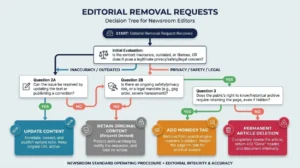
Businesses can evaluate the appropriate strategy by classifying the disputed content before selecting an intervention. The first distinction is between a negative opinion, a potentially inaccurate factual allegation and content that appears to breach a platform policy. Each category requires a different assessment because criticism is not inherently deceptive, factual disputes require evidence, and policy violations depend on the platform’s rules. Classification reduces the risk of using removal requests where the underlying issue concerns disagreement rather than prohibited content. It also helps organisations allocate resources according to the nature and significance of the problem.
A structured evaluation follows these steps:
- Preserve the review’s text, publication date, rating and relevant context to establish a reliable record of the disputed material.
- Identify the applicable platform terms and determine whether the evidence supports a specific policy concern, such as fake engagement or a prohibited conflict of interest.
- Assess the available evidence independently, distinguishing confirmed facts from assumptions about the reviewer’s identity, employment history or intentions.
- Compare removal, factual clarification and organic content enhancement according to their eligibility, likely impact, operational cost and risk exposure.
- Monitor subsequent review activity, search visibility and sentiment distribution to determine whether the chosen approach addresses the original issue.
The resulting decision depends on the evidence and the objective of the intervention. Policy-based removal addresses content that qualifies for enforcement, while factual clarification improves the accuracy of the information available to readers. Organic enhancement supports a wider search presence, and monitoring evaluates whether changes persist. Treating these methods as distinct but complementary options provides a more reliable basis for reputation management than relying on ratings alone.
How Should Conflict-of-Interest Reviews Be Evaluated?
Platform terms of service establish the boundaries for assessing conflict-of-interest reviews, but the existence of a personal or professional relationship does not automatically invalidate feedback. Removal strategies depend on evidence of a policy violation, whereas reputation enhancement improves the availability of relevant and accurate information. Reactive methods address specific incidents, while organic methods support a broader and more sustainable digital footprint. Content suppression and content enhancement also differ in their eligibility requirements, risks and influence on SERP composition. An evidence-led approach evaluates these mechanisms separately and measures their combined effect on search visibility, trust signals and entity credibility. Businesses investigating Remove Fake Reviews from Former Employees strategies must also distinguish genuine criticism from reviews that breach platform policies, ensuring that removal requests are supported by relevant evidence.
What is a conflict-of-interest review?
A conflict-of-interest review is feedback published by someone whose personal, professional or financial relationship with a business affects their independence. Whether it violates platform rules depends on the platform’s terms of service and the circumstances surrounding the review.
Can a business report reviews written by former employees?
Yes, a business can report a former employee’s review if it has evidence that the content violates the platform’s policies. A review is not automatically removable simply because the reviewer previously worked for the organisation.
How do platform terms of service apply to fake reviews?
Platform terms of service establish rules against prohibited review activity, including fake engagement, fabricated experiences and certain undisclosed conflicts of interest. Platforms assess reported reviews against their specific policies before deciding whether to remove them.
What evidence is needed to report a conflict-of-interest review?
Relevant evidence includes the review’s content, its publication details, publicly available information about the potential conflict and the specific platform policy involved. Clear, verifiable evidence helps moderators assess whether the review breaches the applicable rules.
What is the difference between review removal and reputation management?
Review removal targets specific content that violates platform policies, while reputation management also involves monitoring online mentions, improving accurate information and evaluating search visibility. The appropriate approach depends on the evidence, the nature of the dispute and the organisation’s wider reputation objectives.