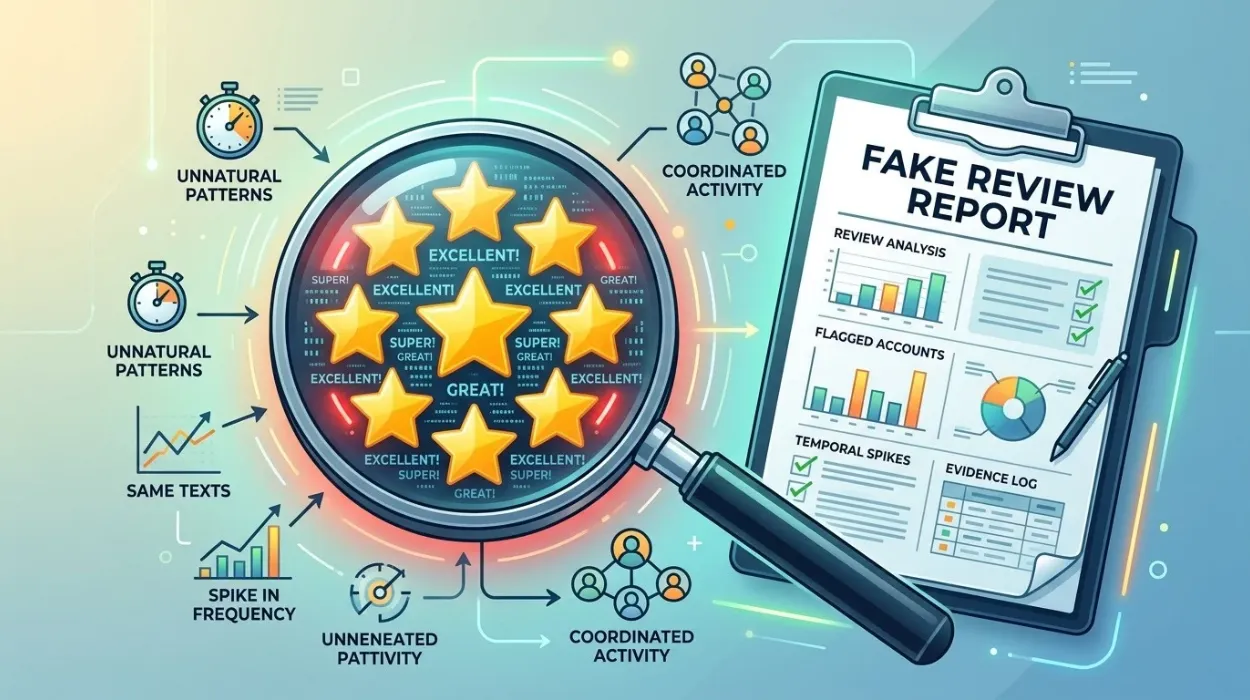
Coordinated fake review attacks are identified by analysing unusual patterns across reviewer behaviour, timing, language, ratings, and account activity rather than relying on a single suspicious review. Effective documentation connects these observable signals into a structured evidence record that distinguishes coordinated activity from ordinary negative customer feedback.
Reputation management strategies differ based on whether the objective is to identify harmful information, reduce its visibility, or establish evidence that supports a platform review. Online reputation control methods are evaluated through their effect on reputation signals, entity credibility, search visibility, and the composition of search engine results pages.
How can coordinated fake review attacks be identified?
Coordinated fake review attacks are identified through patterns that indicate multiple reviews lack independent origins. A coordinated attack is an organised pattern of review activity involving multiple accounts, repeated themes, similar language, unusual timing, or other connected behaviours. Individual reviews provide limited evidence because legitimate customers can express similar opinions about the same business. A pattern becomes more informative when several independent characteristics appear together. The analysis therefore focuses on relationships between reviews rather than treating every suspicious review as an isolated event. This approach creates a stronger distinction between ordinary negative feedback and potentially coordinated activity.
Review analysis begins with observable characteristics that can be recorded consistently across the affected review profile. Relevant signals include publication dates, star ratings, wording, reviewer history, profile activity, frequency, and recurring claims. The purpose of this analysis is not to assign a definitive authenticity judgement from one characteristic. Instead, each observation contributes to an evidence pattern that can be evaluated alongside other signals. Consistent documentation also makes later comparisons easier when additional reviews appear. This creates a structured basis for evaluating whether review activity represents independent customer experiences.
Which signals indicate that reviews are coordinated?
The strongest indicators of coordination are patterns that connect multiple reviews through timing, language, account behaviour, or repeated content characteristics. A review cluster is a group of reviews displaying a notable concentration around a defined period or theme. A sudden cluster does not automatically demonstrate manipulation because legitimate events can generate increased customer feedback. The analytical value comes from combining timing with additional similarities such as repeated phrases, identical claims, unusual rating distributions, or related reviewer behaviour. These combined signals provide greater contextual information than review volume alone. Evaluation therefore depends on the relationship between signals rather than the presence of one anomaly.
Language similarity is particularly useful when examining large review sets because repeated structures can reveal connections between otherwise separate accounts. Identical phrases, unusual grammatical constructions, repeated descriptions, or distinctive wording can create linguistic similarities across reviews. Textual similarity alone does not establish common authorship because customers discussing the same issue can naturally use overlapping terminology. The evidence becomes more significant when linguistic repetition appears alongside concentrated publication dates or unusual account activity. This creates a layered evaluation model that separates ordinary similarity from potentially coordinated behaviour.
How does reviewer behaviour help distinguish fake reviews?
Reviewer behaviour helps distinguish suspicious activity by providing information about an account beyond the content of one review. A reviewer profile can reveal patterns in review frequency, subject matter, locations, ratings, account age, and interactions with unrelated businesses where the platform exposes such information. An account that repeatedly publishes highly similar reviews across unrelated entities presents a different behavioural pattern from a customer with a consistent history of genuine local experiences. Behavioural analysis therefore expands the investigation from individual content to account-level activity. Platform-specific privacy controls limit the information available for analysis, so documentation must rely only on observable data. The resulting evidence remains descriptive rather than speculative.
Account behaviour also helps evaluate whether multiple reviewers operate independently. Closely timed activity across accounts, repeated rating behaviour, or unusually similar review structures can create an identifiable pattern. These observations become more relevant when they occur across unrelated businesses or within a narrow timeframe. However, correlation does not establish coordination by itself. A rigorous assessment records the observable relationship and separates it from any conclusion about the reviewers’ intentions. This distinction improves evidence quality and reduces the risk of incorrectly classifying legitimate customer feedback.
How should fake review evidence be documented?
Fake review evidence is documented most effectively through a structured record that preserves the original information and the reasoning behind each observation. Documentation is an evidence-management process rather than a collection of screenshots without context. Each review record can include the publication date, rating, exact wording, reviewer profile information that is publicly visible, review URL, and relevant behavioural observations. Recording information consistently allows patterns to be compared across reviews. It also establishes a chronological record that shows when specific signals appeared. Clear documentation separates factual observations from analytical interpretations.
A practical documentation framework can evaluate each review through a consistent sequence:
- Record the review URL, publication date, rating, visible reviewer information, and exact wording to preserve the original evidence.
- Compare language patterns across reviews to identify repeated phrases, unusual structures, or distinctive claims.
- Analyse publication timing to establish whether suspicious reviews form an unusual temporal cluster.
- Examine observable reviewer activity to identify repeated behaviour across businesses, categories, or locations.
- Separate direct observations from interpretations so the evidence record does not present assumptions as established facts.
This structure creates an auditable evidence trail without requiring unsupported conclusions about who created the reviews. It also allows additional evidence to be added without changing the original observations.
Is content removal more effective than content suppression for fake reviews?
Content removal and content suppression address different reputation management mechanisms, so their effectiveness depends on the underlying problem. Content removal focuses on taking specific material out of its original publishing environment when a valid platform policy or other applicable basis exists. Content suppression focuses on changing the composition of search results by increasing the visibility of relevant, credible content while reducing the relative prominence of unwanted material. Removal therefore changes the source environment, while suppression changes the search visibility environment.
The distinction is important because removal does not guarantee that related content disappears from search results immediately. Search engines can retain indexed references, cached information, duplicate pages, or related discussions after the original content changes. Suppression also does not establish that the underlying material is false or invalid. It operates through content relevance, authority, freshness, and other ranking mechanisms. Content removal and content suppression therefore represent different mechanisms rather than interchangeable tactics. Evaluating them requires examining the source, visibility, indexing status, and search landscape associated with the reputation issue.
Dive Deeper With Our Expert Guides:
What Trustpilot Requires Before Removing a Fake Review Submitted in the UK
How to Remove Your Data From People Search Sites in the UK Using GDPR Rights
How does reactive review management compare with organic reputation building?
Reactive review management responds to existing reputation risks, while organic reputation building develops credible information and positive reputation signals over time. Reactive methods begin with a specific trigger, such as a suspicious review cluster, and focus on identifying, documenting, and addressing the affected content. Organic approaches build a broader information environment through authentic customer feedback, accurate business information, authoritative content, and consistent digital signals. Reactive management is therefore event-driven, whereas organic reputation development is cumulative. Each approach addresses a different stage of the reputation lifecycle.
The two approaches also differ in risk exposure and sustainability. Reactive action can address an immediate information problem but remains dependent on the existence of a specific issue and the rules of the platform involved. Organic reputation development creates a broader evidence base that supports entity credibility across multiple information sources. It does not eliminate the need to assess suspicious content when an attack occurs. A coordinated review attack can therefore require reactive analysis within a wider long-term reputation framework. Comparing the approaches requires measuring both immediate response capability and the durability of the resulting information environment.
What is the difference between short-term and long-term fake review management?
Short-term review management focuses on identifying and documenting an active reputation event, while long-term management evaluates whether the entity’s information environment remains credible and consistent. Short-term analysis prioritises review patterns, evidence preservation, platform rules, and immediate changes in search perception. Long-term analysis examines recurring review behaviour, reputation signals, content consistency, entity credibility, and SERP composition. The two timeframes therefore measure different outcomes. One evaluates the immediate information disturbance, while the other evaluates the stability of the broader reputation ecosystem.
Short-term action also has different scalability characteristics from long-term monitoring. A small review cluster can be analysed manually using structured evidence records, but larger datasets require consistent classification and comparison methods. Long-term monitoring requires repeatable processes that detect changes without treating every negative review as suspicious. This distinction reduces unnecessary escalation and keeps analysis focused on measurable signals. Sustainable reputation analysis therefore depends on establishing criteria that remain consistent as new review activity appears.
How do fake review attacks affect search visibility?
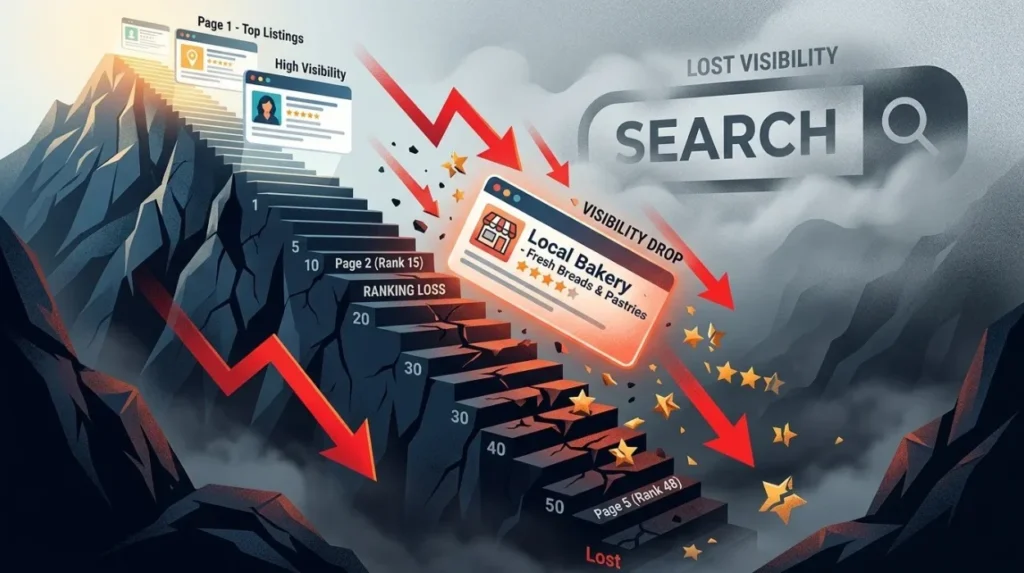
Fake review attacks affect search visibility primarily by changing the information associated with an entity rather than by functioning as a single direct ranking instruction. Search engines evaluate content, relevance, authority, entity relationships, and other signals when determining which information appears for a query. Review content contributes to the information environment surrounding businesses, particularly for branded and local searches. A coordinated negative review pattern can therefore influence the information users encounter even when it does not directly determine ranking position. Search visibility and reputation perception remain related but distinct concepts.
The composition of the search engine results page also matters. SERP composition is the collection and ordering of different content types that appear for a query, including business profiles, review platforms, websites, directories, news pages, and other sources. A reputation issue becomes more visible when negative material occupies prominent positions across multiple results. Content suppression versus content enhancement therefore involves evaluating how the entire SERP is structured rather than examining one URL in isolation. This approach provides a more accurate measurement of search perception.
How can the effectiveness of a fake review response be evaluated?
Effectiveness is evaluated through measurable changes in evidence quality, review visibility, search perception, and reputation signals rather than through assumptions about outcome. The first measure is evidence completeness: whether the available documentation establishes a clear and reproducible pattern. The second is platform response, including whether reported content is reviewed or changed according to the relevant platform’s procedures. The third is search visibility, measured by monitoring how review-related pages and business profiles appear for relevant queries. The fourth is sentiment distribution, which measures how positive, neutral, and negative review content is represented across the available review environment.
A useful evaluation framework also considers scalability and risk exposure. A method that works for five suspicious reviews does not automatically remain practical when hundreds of reviews require analysis. Similarly, an aggressive classification process creates greater risk of incorrectly identifying legitimate criticism as fraudulent. Sustainable analysis therefore balances detection accuracy, evidence quality, operational scale, and platform compliance. Measuring these dimensions provides a clearer basis for comparing reputation management approaches than relying on a single visibility metric.
Which reputation management approach provides the most sustainable outcome?
Sustainability depends on whether the approach improves the underlying information environment while maintaining accurate evidence and consistent monitoring. Removal-focused methods address specific content when a legitimate basis exists, while suppression-focused methods address the visibility of information within search results. Organic reputation development strengthens the broader information environment through authentic and authoritative signals. Reactive monitoring detects emerging problems and provides evidence for targeted evaluation. These approaches operate at different layers and therefore produce different forms of impact, making Remove Fake Reviews and Protect Your Business a consideration within source-level reputation management.
A sustainable framework treats reputation as an information system rather than a single review score. It evaluates source credibility, content authenticity, review patterns, search visibility, entity relationships, and sentiment distribution over time. This perspective prevents short-term changes from being mistaken for permanent reputation improvement. It also recognises that search ecosystems continuously change as new content is published, indexed, ranked, and removed. Long-term evaluation therefore requires repeated measurement rather than one-time assessment.
Identifying coordinated fake review attacks requires pattern analysis across review content, timing, reviewer behaviour, language, ratings, and account activity. Documentation converts these observations into structured evidence that distinguishes measurable characteristics from unsupported conclusions. This approach provides a stronger basis for evaluating suspicious activity within platform and search ecosystems.
Reputation management methods also differ according to their mechanism. Content removal addresses the original source, content suppression addresses search visibility, organic reputation development strengthens broader credibility signals, and reactive monitoring responds to specific reputation events. Comparing these approaches requires consideration of effectiveness, scalability, risk exposure, sustainability, search ranking influence, and SERP composition.
The central distinction is between changing information at its source and changing how information is discovered and interpreted. Understanding that distinction allows fake review management to be evaluated as a reputation system involving content, platforms, search engines, and user perception rather than as a single ranking or review problem.
How can you identify a coordinated fake review attack?
Look for unusual patterns in review timing, repeated wording, rating behaviour, reviewer activity, and similar claims across multiple accounts. A combination of connected signals provides stronger evidence than one suspicious review.
What evidence is needed to report fake reviews?
Useful evidence includes review URLs, publication dates, ratings, exact wording, visible reviewer information, and documented similarities between reviews. A structured record helps distinguish observable facts from assumptions when reporting suspicious review activity.
Can fake review attacks affect local SEO?
Fake review attacks can affect local SEO indirectly by changing reputation signals, customer trust, sentiment distribution, and the information associated with a business. Their impact on search visibility depends on the wider search and review ecosystem rather than one review alone.
Is removing fake reviews better than suppressing them in search results?
Review removal addresses content at its original source when it violates platform rules, while content suppression focuses on reducing the visibility of unwanted information in search results. The appropriate approach depends on the source, evidence, platform policies, and SERP composition.
How long does it take to document a fake review attack?
The time required depends on the number of reviews, available reviewer information, and complexity of the suspected pattern. A structured investigation records timing, language, ratings, account activity, and related signals consistently across the review set.